It’s been a funny old year. But haven’t they all been, lately? A journalist asked for some stats at work the other day and I had to write an email justifying why no two years are really comparable and then I stopped and thought: why am I doing this? Of course you can’t compare 2020 to 2021 to 2022. We’re living through a series of crises.
It has not been a vintage running year for me. I picked up a calf injury by pushing too hard in a 30k race in February, deferred my Brighton marathon place, trained fitfully over a hot summer, ran the Rutland marathon and did not enjoy it, then finally got Covid and missed the beginning of the cross-country season. My annual mileage is set to be my lowest for many years.
But, surprise! I still love running. When I have managed to get out for a run – even (especially?) the ones where I walked – I’ve loved it more than ever. The injury and Covid were rotten, but they made me appreciate running more. I missed being outside, covering ten miles with ease, and getting out of my head as well as the house.
I went part-time (if 4 days a week with some work on fridays really counts as part-time, which I would argue it does not) in March, with the intention of doing some creative writing on my day off. I’ve found it hard. Not working quite so much has been great, but it turns out that creativity is not a tap I can just turn on when I have a spare few hours. Also, there are a whole heap of other things I want to do with six hours to myself, and running is high on the list.
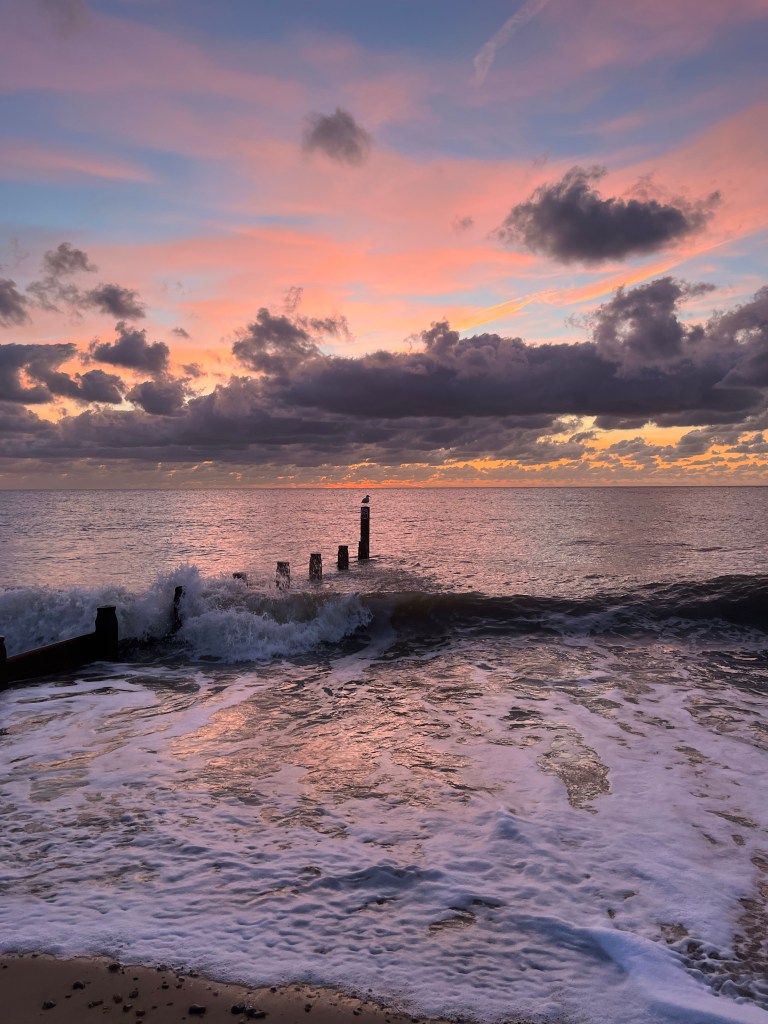
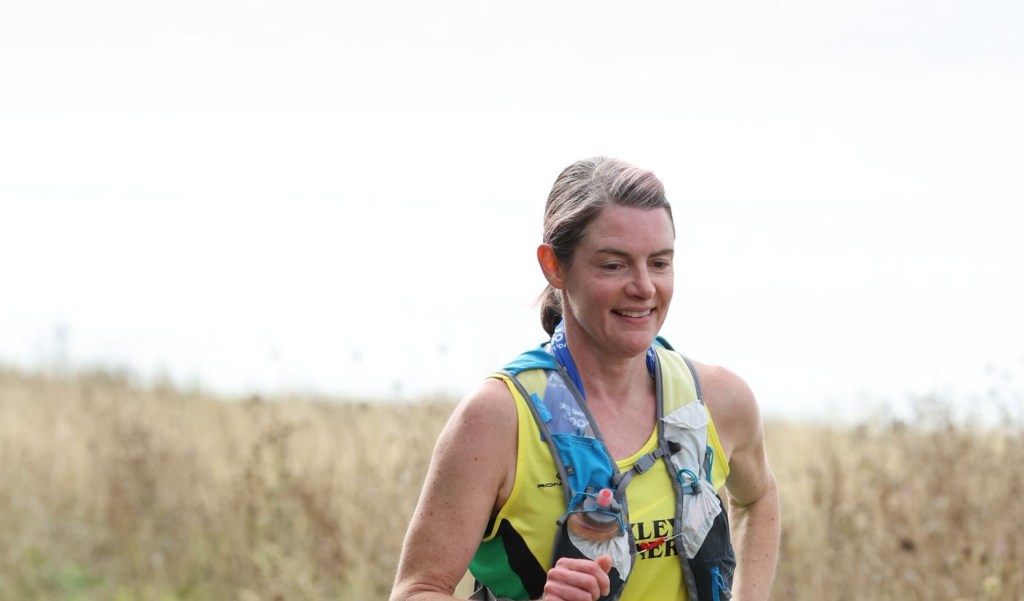
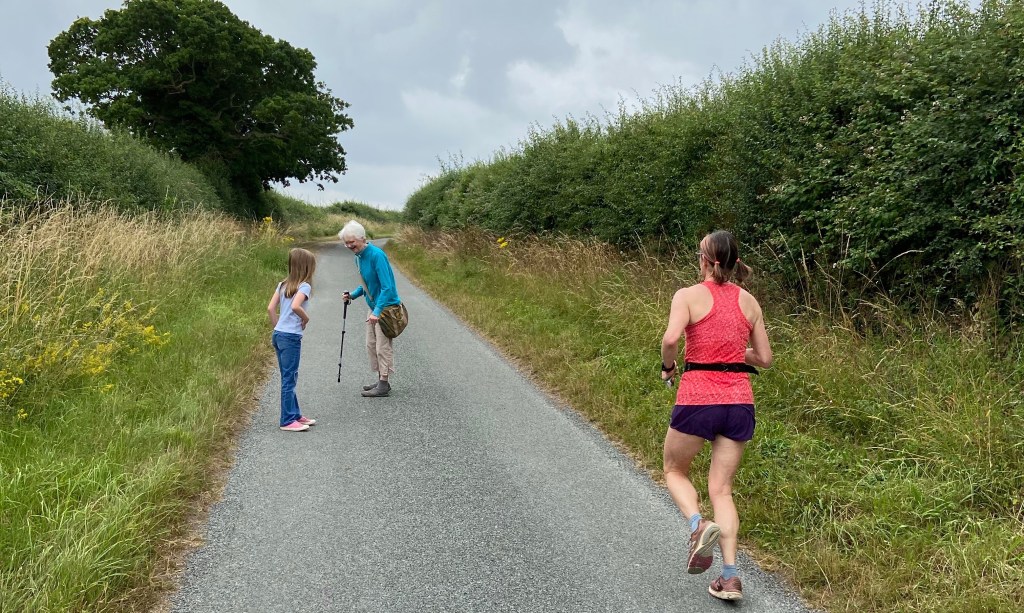
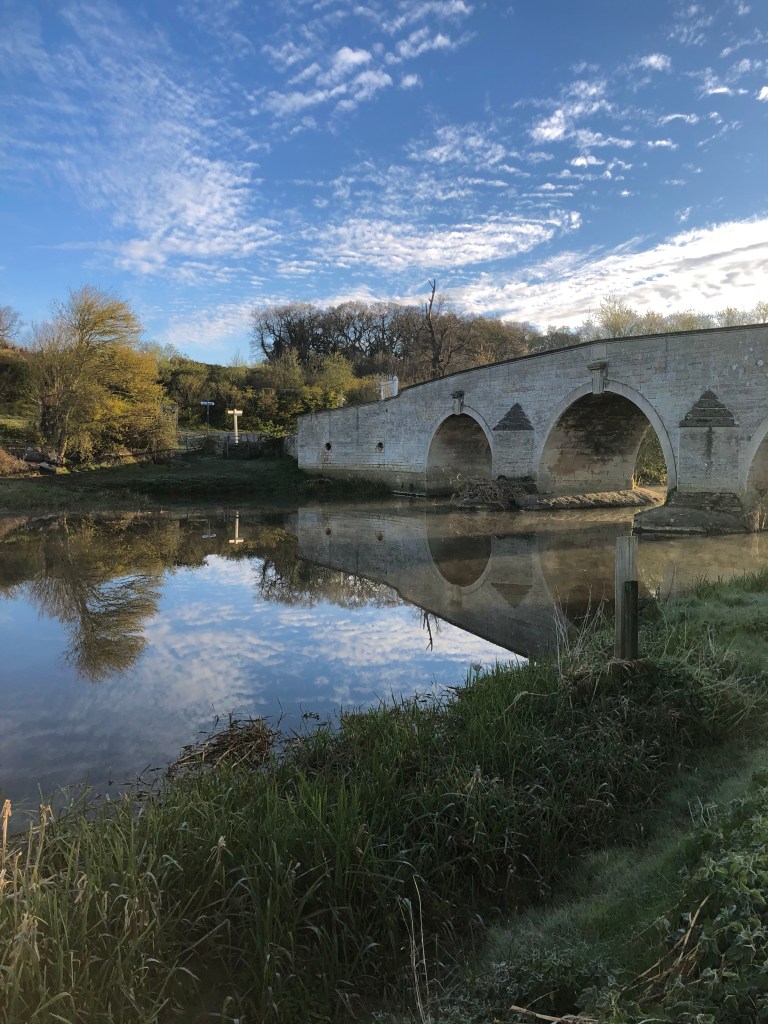
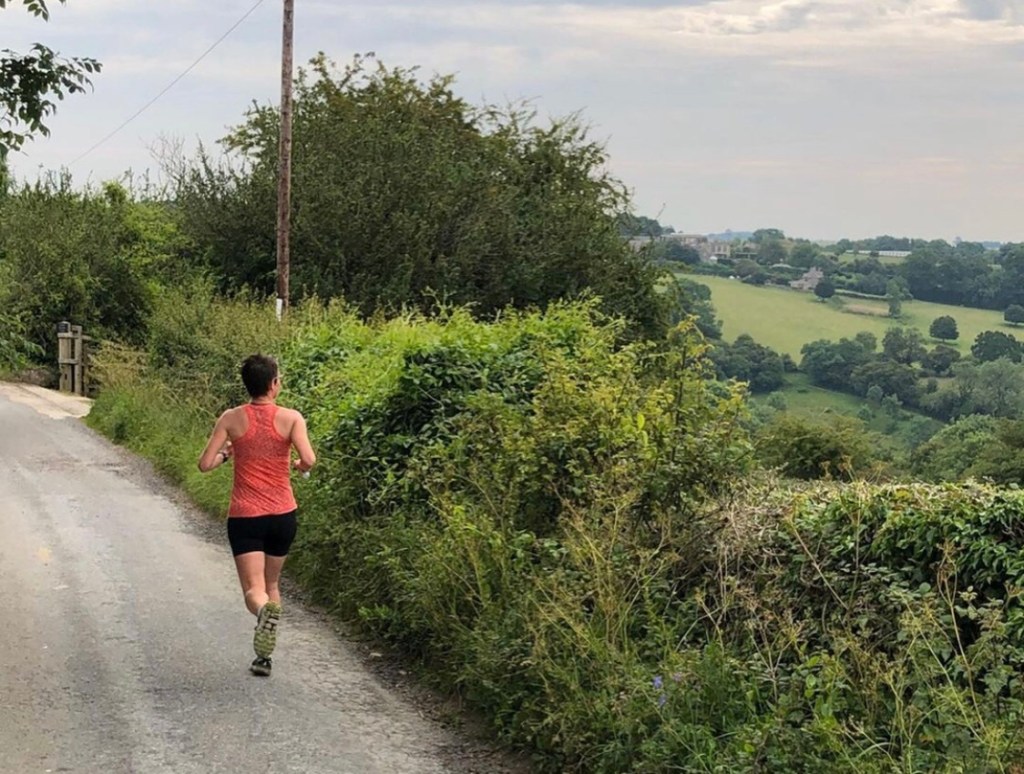
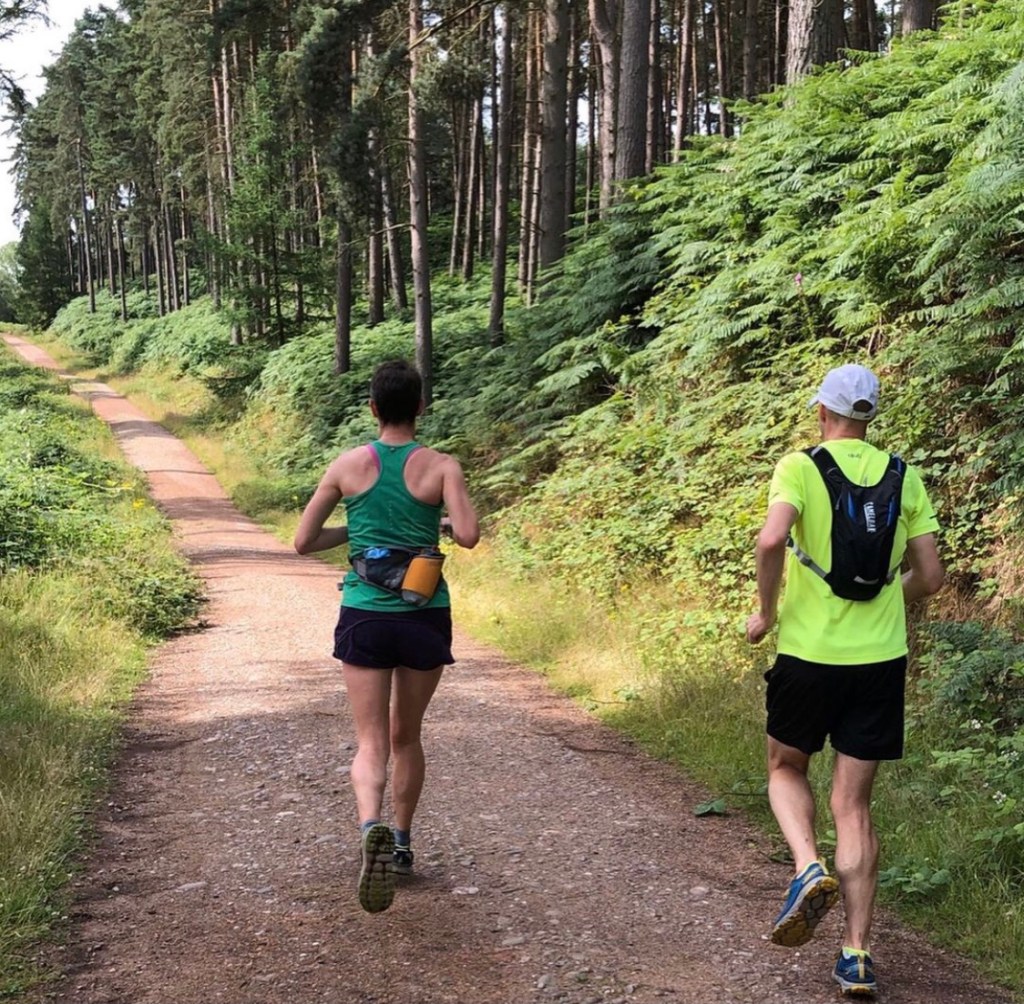
My best runs this year have been Friday morning runs. Some of them with Lazy Girl Laura, but most of them alone. Does running count as being creative? Maybe not, but it definitely does count as beautiful. I’ve shared some of my favourite running photos from the year in this blog. You can’t see me in any of the pictures, but I was there.
‘Such perfect marathon weather’. The smooth path stretches along the edge of the dam. A family claps and cheers from a bench. Ten more runners overtake me.
‘I’m glad I’m not going out too fast’. The smooth path ends, turns gravelly and weaves through a carpark and up onto a grassy slope.
‘I just need to keep the lid on for ten miles’. A marshal shouts, “well done young lady”. I’m 46, but I’ll take it. The stony track curves up and down around the inlet of the reservoir.
‘Look at the water, maybe I’ll see the osprey’. The lead runner of the half marathon whizzes past.
‘Keep it steady’. Another sharp uphill, a right turn, a left, a downhill.
‘The turning point must be soon’. The lead male runner passes, big beard, leopard print vest.
‘Do not speed up’. The first woman runs past, pink t-shirt, big smile.
‘I do not need to speed up’. Five more women pass and the turning point is there. The route doubles back around a line of orange cones in the woods.
‘Keep a lid on it’. Runners pass, still on their way to the turning point. The five mile marker goes by.
‘Only five? No, don’t think that. Half way to ten ’. The runners coming the other way are slower and more friendly.
‘This is better, I’m enjoying it’. Say “well done!” to every female runner. A dog lifts its leg to pee on the seven mile marker post.
‘Nearly at the dam, now’. A man sitting on a bench makes full eye contact with me and says nothing. Across the dam. A child jumps up and down, blowing a whistle.
‘I should be feeling better than this’.
The path stumbles between mole hills and rabbit holes. ‘This grass is really green from the rain’.
The route goes back past the start funnel. ‘Try to look good’.
The loudspeaker calls out the names of passing runners. A few cheers. ‘Try to feel good’.
Out of the carpark, the seventeen mile loop back to the finish begins. ‘I won’t count the hills’.
There were six hills between that point and Hambleton Peninsula. ‘This might be a bad patch’.
The half marathon turning point is behind me at eleven miles. ‘I might feel better soon’.
The path stretches out along the north shore, looking flat but somehow going uphill. ‘It’s good to be outside’.
Mile fourteen. Mile fifteen. Up the hill to mile sixteen, my chest pulls with every breath of air.
“Stop it!” I shout out loud.
But I can’t push away the negative thoughts. Over the final ten miles, I try everything.
‘It’s good that my achilles isn’t hurting’.
‘Every uphill has a downhill’.
‘This gel will make me feel better.’
‘I always love running here’.
‘It’s still a beautiful day’.
‘No-one is going past you’.
‘Everyone feels the same.’
‘Don’t walk unless you have to’.
‘Just walk if you need to’.
‘Just get to the finish’.
‘You’re going to make it’.
When I cross the finish line I feel two things: relief, and certainty that there was nothing I could have done differently. This day wasn’t my day.
It is true that much of a marathon is what’s inside your head, the stories you tell yourself about how you’re feeling, the stories you tell yourself before you start, and how you spin it afterwards. But now that I’m older, I can see that it’s really the body. Yes, you can make yourself keep running or let yourself give up, you can decide to push or decide to walk. But it all comes from the body. The training, or the feelings on the day, dictate it too.
Looking at my insane heart rate recordings, I know I couldn’t have done anything else on this day. I know that the rushing of blood in my ears, the nearly fainting, that was the very edge of what was possible. I went right up against it. There was nothing more I could have done on that day.
When you’re young, or you have tons of training in your legs, you can carry a bad day and your brain is your only barrier. As you get older, on a bad day you can’t push through it. But on a good day, you can run just as fast as ever.
I get excited when the overnight temperature on the weather app drops to single figures, but the days are still warm. On a clear night, mist will rise from the river and spread its cold fingers over the water meadows, leaving wisps of cloud floating over the lake. As the first rays of sun peep over the horizon, the mist disappears like a magic trick.
Sunrise was at 6:36am, and I didn’t want to run in the dark, but I did want to be by the river at first light. I set my alarm for 5:35am. I know it’s mad, but this doesn’t feel early any more. In lockdown, I became obsessed with running before anyone else was up, and as the days got longer, my alarms got earlier.
I had a coffee but didn’t eat breakfast. I did my usual activation exercises. Ten years ago I would have thought this too was mad: who would sacrifice 30 minutes of sleep for a coffee and some squats? But ten years ago I could have sprinted in heels. Now I have to warm up just to walk downstairs.
I jogged through the estate in the twilight, crossing the railway tracks and the weir before I saw another person. Three women in hijabs, who I sometimes see at this hour, said good morning as they ran past me on the bridge.
Taking the river path, I could feel the mist cold in my nostrils, and damp on my arms and legs. Over the footbridge and into Ferry Meadows, the sun was up and the pale light turned briefly orange. Over the lake, the sky was settling into blue, and terns wheeled and skimmed the surface. A heron sat hunched on a buoy in the middle of the lake and invisible fish rippled the water from below.
I felt completely free to enjoy this run. It’s the second Friday after school started, my parents are away, I don’t have to work, and it’s the first Friday in a few months where I can put myself first. I didn’t have to do the school drop off. I didn’t have to run fast, or far. Still, I had a goal. Every run has a purpose. Sometimes you set it, sometimes it’s set for you, and sometimes you learn it afterwards.
Today, I ran to drink in the beauty. I don’t care if this sounds naff because it isn’t. I learned that in lockdown too.
I’m half way through my training plan for Brighton Marathon and I’ve realised that even if I make it to race day intact, my trainers will not. I run in New Balance 880s – basic neutral road shoes. They’re good; comfortable, no injuries and they last well. But lately, my eye has been wandering and I’ve been wondering: what if I’m the only person on race day without carbon plate shoes?
Everybody’s doing it now
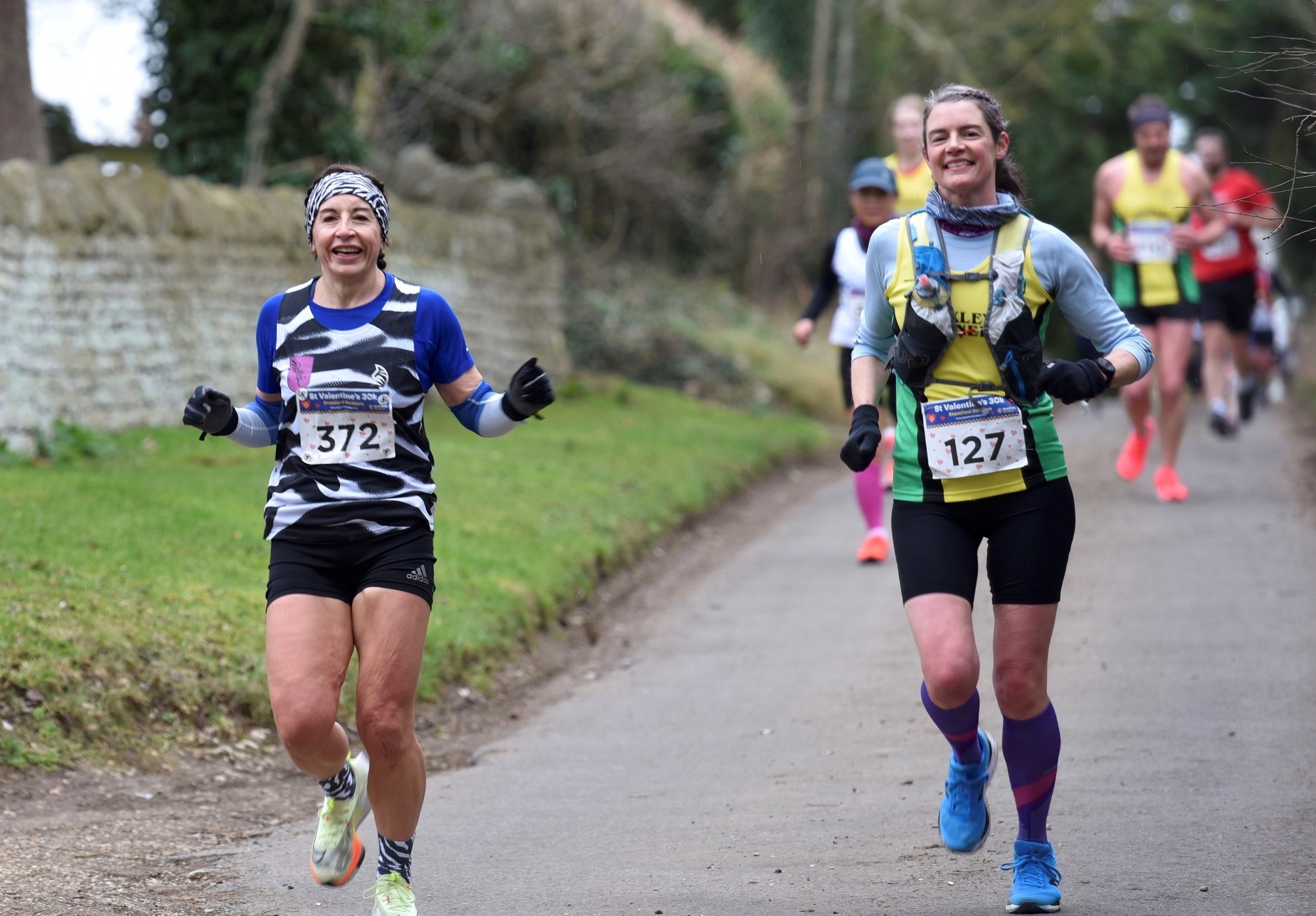
This photo was taken at the race I did yesterday: the Valentine’s 30k – run by a local club Stamford Striders. It was a great event with a real community feel, run around country roads. It’s not an elite race, but a fair proportion of runners of all speeds were wearing Nike Vaporfly Next % shoes – or similar ones with a carbon plate.
The last time I raced over a similar distance was in early 2020, when Next % shoes were still a talking point – considered to be expensive and still pretty rare. At the start line, a couple next to me were wearing matching ones, and other runners were nudging each other. Now, most marathon runners I know either own them already, or are saving up to get some. They’re common at parkrun and I even saw someone lining up at a cross country race in them last weekend.
Would I wear them for a cross country race? Of course not. Spikes, or shoes with lugs, make me faster at cross country, and I have always worn them. Would they make me faster at Brighton marathon? Probably. If I were an elite runner competing against others, or up against the clock trying to get a Boston qualifying time, I would be off to the Nike store right now. But I set my marathon pb wearing road shoes, and if I beat that pb now (as if) wearing carbon plate shoes, I would always think, “it was the shoes that did it”.
And so…
Am I going to buy a pair? I don’t think so. If someone gave me some as a present, I would be interested to see what happened, but no, I’m grateful for a reason not to spend the money.
I do occasionally panic that I will be the only one lining up in Brighton in normal shoes, but don’t you worry. If I can run sub-3:30 for a marathon in regular road shoes at 46 years old, I will make sure everyone hears about it.
I’m running, but I’m not fit. I mean, I’m fitter than someone who doesn’t run. But I’m not race fit. I mean, I could run a race, faster than some people, but not as fast as I want to run it. Okay, I am a bit fit. And the bit fit that I am, to be specific, is Mile Two Fit.
In Mile One, I am slow. Every run at the moment starts slow – this is the thing about being over 40, I have to start slowly no matter how many warm up exercises I’ve done in the hallway. My knees are creaking, my back is stiff, I’m shuffling my feet.
By Mile Two, I am ready to rock, ready to run, ready ready ready steady go baby! I feel great. I don’t even feel like I’m trying. My legs are turning over, my feet are bouncing, my breath is coming easy. I’m holding myself back and I’m still super fast. Can you even believe that mile split?!
By Mile Three the party’s winding down. I keep pushing the pace but it’s not easy now, it’s an effort. I have to concentrate on breathing, think about my stride, work hard to drive my knees forward and pick up my feet.
At Mile Four, it’s over, but I’m still moving, just about. I’ve already done 5k! Everything else is a bonus at this point. Mile Five is extra – if I slowed down enough in Mile Four I might get a second wind for half a mile. Mile Six is usually the last, so it’s fine to walk a bit of that.
Mile Two, I miss you. I want to live in that Mile Two feeling for the whole run. Mile two, I love you.
Perspective is an odd thing. When parkrun were pushing for a return in England in September 2020 it felt too soon, and that turned out to be correct. I didn’t want to be Run Director responsible for a junior parkrun event when cases in Peterborough were rising and a friend or family member of a volunteer could potentially catch COVID and die as a result. Back then there were 10 new cases in P-town every day (about 36 per 100,000 people). This week, the rate is ten times higher – 360 per 100,000 people, and yet I’ve been happily running and volunteering at parkrun and junior parkrun for a few weeks now.
It’s obvious what’s changed. I am vaccinated, along with most “at risk” older and vulnerable people in the UK (though maybe not in Peteborough?). And vaccination is preventing severe illness and death. But coming back to racing and parkrun is still something I’m getting used to, and I wanted to write down how I’m feeling so that, in a year’s time, I can look back at this as Captain Hindsight and point out all the things I got wrong. Or hopefully not! Anyway:
Running outside with other people now feels safer
Remember in the early days of COVID when we weren’t sure whether we should even be outside at all? People in my local facebook group warned of particles of virus floating about like giant snowflakes in the air, and complained about joggers – our dangerous breath and sweat and snot and spit. I wore a buff for my runs and raised it over my nose and mouth when I passed people, but that didn’t stop them looking scared and moving away.
To be honest, I still hold my breath when I pass someone on a narrow path. Maybe I’ll always do it? But I know that outside transmission is much less likely, and as long as I’m not stuck running one metre behind the same person for 15 minutes, I feel comfortable.
I think COVID has made us more considerate runners. I will happily miss out on high fives if it means never being accidentally spat on or elbowed out of the way in a race, thank you very much. And as for the man I once saw sitting on a cafe chair in his sweaty pants merrily changing his trousers after parkrun, some things are best left behind.
I am ready to run a bit faster
When races started coming back in England, I was unfit, unhappy, and unready to race. Running saved my life hundreds of times over the past 18 months, but walking was also a big part of that and, for me, walking and racing don’t mix. Over the summer, many of my friends and family have been marathon training (and running! Shout out to Chris conquering the terrifyingly hilly Bath marathon) and inevitably I got fomo and signed up for a race.
I wanted to start with a race I would love, so I chose my favourite distance – a half marathon – and my favourite format – rolling country lanes. The Wissey Half Marathon takes place in “the idyllic Norfolk countryside, starting and finishing in the historic village of Oxborough”. It is advertised as fast and flat, but I wasn’t looking for a pb. I just wanted to enjoy it and push myself a tiny bit in the run-up and on the day.
I didn’t do much specific training. I was already running 30-35 miles a week, including a long run at the weekend. I did introduce a tiny bit of speed and hill work and what little I did, I enjoyed. I used David Roche’s 6 week re-introduction to speed and enjoyed the power hill strides, though finding an actual hill for them in Peterborough was the hardest bit!
I remember why I love races
After a month of grey skies and 18 degree damp, 5th September was of course warm and sunny. It was a perfect day for a picnic in the park, less perfect for racing 13.1 miles. On the car journey to Norfolk, I was surprised to find that I didn’t care. I was happy to slow down if I needed to, delighted to look at the views, and excited to get out in the countryside. I ran 11 of the 13 miles with a huge grin on my face, and yes the grin turned to a slight grimace in the last two, but we can gloss over that. My target was 8 minute miles, and I made it: 1 hour and 43 minutes on the clock, 12 minutes slower than my best, but I felt like I’d won.
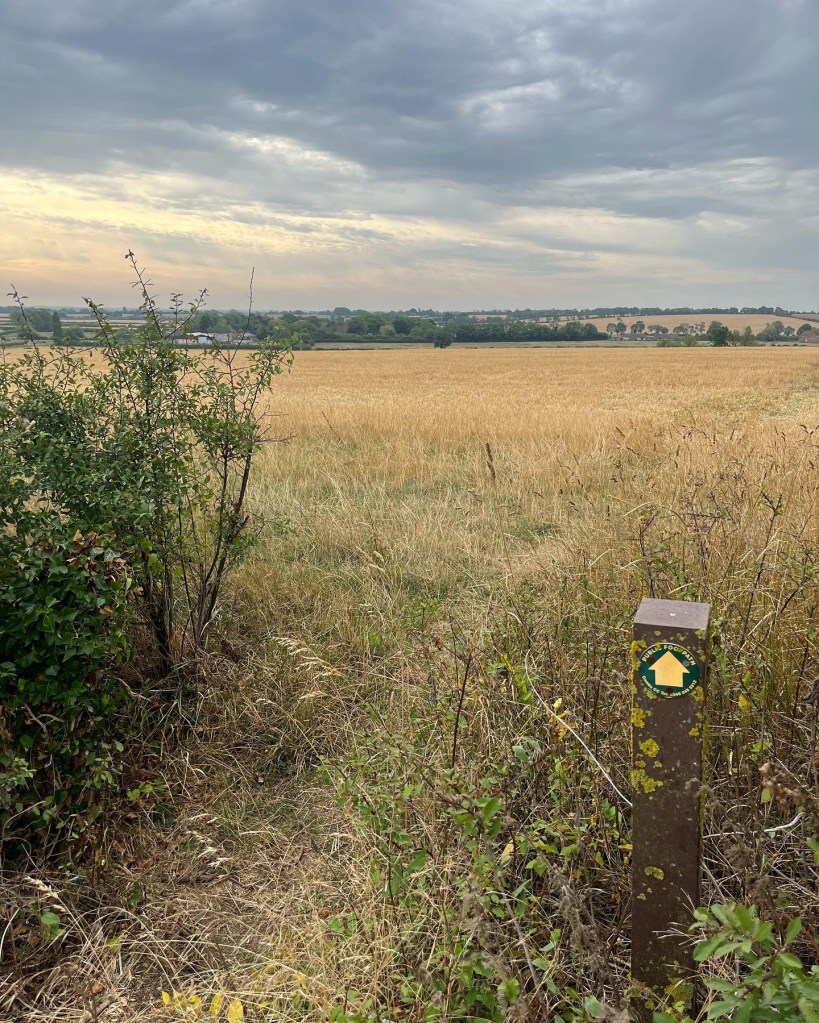
I loved everything about the race: the parking on the village green; every single runner saying hello as we walked to the start; the terrible instant coffee in the village hall; fields of sunflowers either side of the road; rolling fields and combine harvesters; tractors waiting for the runners to pass; friendly marshals and their kids helping out; chats with fellow runners. My favourite moment was about 5 miles in: I was running with an older man who was run/walking (fast!) and we passed a “public footpath” sign pointing the way to a smooth grassy path along the side of a field, heading over a hill into the distance. “I wonder where that goes?” we both asked, in unison.
All my joy in running comes from the world outside my body. The sun on my back; the dirt under my feet; leaves brushing by my legs. Traffic lights changing to green in the twilight. A glimpse of swifts overhead. The muffled thump of footsteps in the snow.
Joy comes from how my body reacts. The thrill of clearing a big puddle at the last minute. The gradual unclenching of my shoulders as I’m warming up. The moment when I can’t tell raindrops from sweat any more and give in to being soaked. As gravity takes over on a long downhill and my legs freewheel like they belong to someone else. The triumph of getting control of my breathing and knowing that I’m strong enough to start running again.
I run with my body, but experience it with my mind. When I’m running I can see so much, experience so much, and it is a liberation. My body and my senses are taken up with the act of running. I am freed from myself.
It’s strange that this feeling of freedom is rarely reflected in the images we share of running, and that the opposite is true. We seem confined to our bodies. We share photos of ourselves, staged or taken many times, with filters and flattering lighting. We cut out the backgrounds, we wipe away the sweat and salt from our skin. Sometimes, photos of people running do convey the joy or pain that we’re feeling, or record what we’ve achieved, but mostly they’re just poses, faces and clothes.
I don’t care how runners look. I want to know where they’ve been, what they’ve seen, and what they’ve done. When I see a sweaty, salty selfie it makes me smile, and I love a good race pic as much as the next runner, but I worry that with every image I share of myself I might be erasing a tiny bit of what running really means to me. What if all our running selfies are creating a Perfect Beauty Standards Running Monster that makes other women and girls think running is not for them?
It’s not how we look while running that matters, it’s how we feel. Our appearance to others is fleeting, passing in the blink of an eye. For me, it’s not what running is about. I want to see and understand what running means to other people, not what it makes them look like. More reflections. Fewer mirror selfies.
Ten years ago, when I was called a jogger instead of a runner, I got very pissed off. So pissed off I started this blog. My twitter handle is @notajogger. My instagram account is @notajogger. I was pretty serious about not being a jogger.
I still wouldn’t call myself a jogger, but I wouldn’t cry if you did. Because these days, I’m not always a runner. Sometimes – ok, most of the time – I’m a run/walker. What does that mean? Well, it’s a technical term that means I run for a bit and then I walk for a bit to get my breath back and then I start running again.
Seriously, run/walking is an official thing
Run/walking is not just for speed training, but for every run – and even for races. Jeff Galloway calls it “Run Walk Run”, and the principle is that every run becomes a form of interval training: warding off injury, speeding up recovery, and “bestow[ing] joy on non-stop runners who had given up”.
When I, aged 10, was learning to run with my dad, his only piece of running advice was “you can slow down, but you must NEVER walk”. This was firmly lodged in my brain for years. The minute I walked, by definition, the run was over. I could jog a bit to get home, but the main work was done; I had failed as soon as I started walking. Aged 35, I thought it was normal to ask if it was “ever ok to walk?“.
On one level, this still makes sense. If I am training for a race and want to push myself, I need to know that I have the physical and mental toughness to keep going when I want to stop. However, after 25 years of running I don’t need to build this toughness again, because I already have it. Whenever I need it, I can call upon a memory bank of runs where I conquered the urge to walk.
This won’t always work. At the 2018 London Marathon I walked and it felt like a failure because I had no other choice; I walked because I couldn’t run another step. And it didn’t even make me feel better! But one race like this will never destroy the toughness I’ve proved in hundreds of others.
Walking doesn’t have to be a failure, it can be a choice.
During a long run these days, I am more likely to take walk breaks in the first half of the run when my body is still warming up. Once I’ve got going, the pace usually feels easier and I forget to walk. The ultra running trick of walking up all the hills doesn’t really work in the fens, but I can use it for the parts of the route I don’t like instead: the muddy edges of a field, railway crossings, and busy paths where I get stuck behind a queue of people.
Making a tactical decision to walk, when I want to but before I need to, has helped me enjoy my running more this year, and I think it’s helped me stay injury-free.
Running in a global pandemic, is it ever possible not to walk?
Over the last year, I can count the runs where I haven’t walked on two hands. No races, no pressure, no reason not to walk. Sometimes I stop my watch, but more and more these days, I don’t. Who would I be stopping it for?
The “elapsed time” feature on Strava is controversial, but I think it has liberated a lot of runners. We can no longer pretend we can get through a run without stopping at the lights, changing our music, taking photos, tying our laces, having a chat: all excuses we use to have a rest and then carry on running, enjoying it that little bit more because we gave ourselves a break.
I talked to my dad, now 75, about my new habit of taking walk breaks. “You wait,” he said, “when get to my age, you’ll be taking run breaks”.
10k is my nemesis distance. Too long to be short, too short to be long; it’s running kryptonite.
This is one reason why I haven’t attempted a 10k race since September 2011, the others being 2) pregnancy, c) wine.
On Sunday our friend Brian was staying for the weekend and we decided to run one of the Regent’s Park Summer 10k series – you can just turn up 15 minutes before the start, pay your £16, tie on your timing chip and off you go. Spontaneity is not usually my middle name, but in this case I think not booking in advance gave me some psychological advantages: I didn’t obsess about it beforehand, I didn’t really* train for it, and I didn’t have a pace in mind. There were no hopes to be dashed – I was just going to turn up, give it a go and see what happened.
What happened? Some flippin’ excellent things! I paced it sensibly, ran a negative split, and got a new pb of 43:04. Best of all, I didn’t even feel like death at the end so there is room for improvement.
Now that the race is over and I no longer need them, I have come up with some useful tips on how to run a 10k.
1. START SLOWLY
The Regent’s Park 10k is a 3 lap course, which I have previously found to be soul destroying, but this time I used it to my advantage. Rather than starting at maximum pace and trying in vain to get faster each lap, I started at a pace that felt way too slow and really did get faster each lap. Aiming for a 45 minute finish, I actually came in a lot quicker as I felt so good in the second and third laps.
2. STRUGGLING? SLOW DOWN
I wasn’t aiming for a pb so I tried a crazy thing: actually enjoying the race. Every time I started to feel uncomfortable in the lungs, legs or stomach, I slowed down a bit because I didn’t want to feel like that. Then, once I felt better, I found I sped back up to pace without really trying.
3. GET TACTICAL
The Regent’s Park course is billed as “flat”, but really it has a couple of slight inclines and declines which shouldn’t be ignored. If you try to run them all at the same pace, your perception of how hard you’re working gets skewed and you end up ruining yourself. Slow down a bit on every incline, and you will reap the rewards on the downhills.
4. SAVE IT FOR THE END
This is a version of 1. Pick a point at which you are willing to give it everything and save your heroics for then. I picked 8k, but it ended up being 9k, then really just the final straight. Things do even out in the end, though. I used to peg it for one lap, die in the second and end up jogging it in. How much better to end on a sprint finish in front of your husband and child?
Like any tips, these seem really obvious. But, given that I’ve managed 20 years of running without following them, I hope they’re worth sharing.
* Ok, I have done some training, but nothing specifically 10k focused other than two interval sessions during which I nearly threw up. (6 x 800m with 1.5 minute recoveries, pain fans)
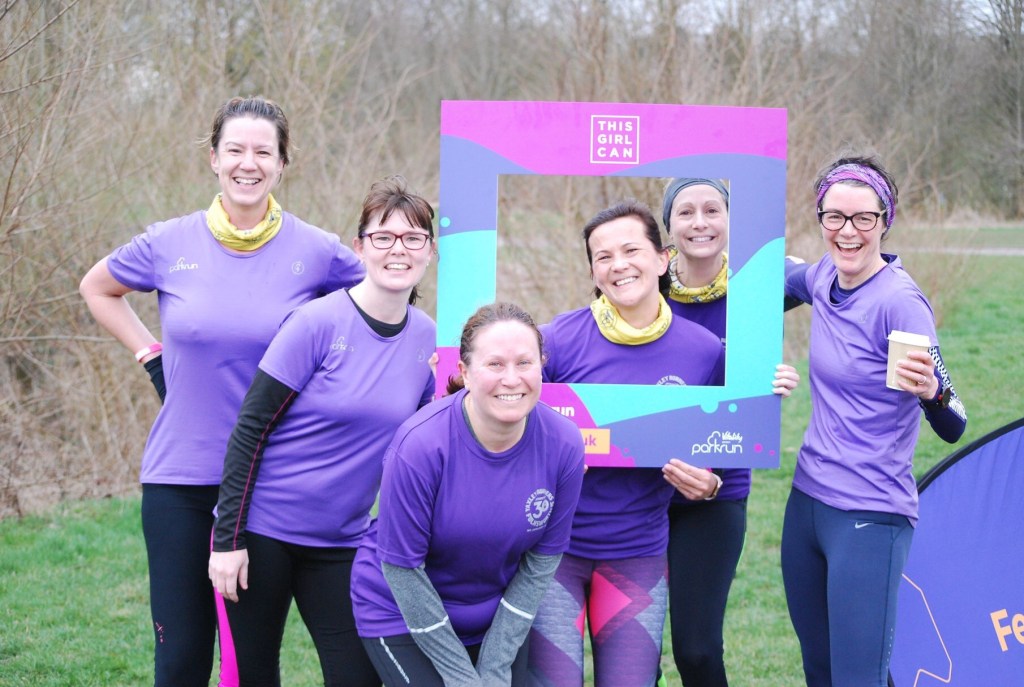
Me, daughter and 38 minute 10k-er Brian post-race. Plus plastic cup.
Behold! Warrior woman, striding it home in 3hours 41 minutes at yesterday’s Milton Keynes Marathon, with a grazed knee but a big smile. How strong I look! How fresh!
I love this picture, taken by my sister who so brilliantly came to see me at the end of the race. I love it even though it is a massive lie.
The thing about a stadium finish, I discovered, is that it forces you to (MK) don your gameface and power home like Paula. This is a good thing, but the scene in the Arena, behind the stadium, was the true face of marathon running. Everywhere runners were prostrate in exhaustion and pain. The St John’s Ambulance medics were running out of chairs. There was a distinct whiff of vomit.
My sister and her boyfriend found me on one of the chairs having a piece of metal prised out of my knee. The St John’s medic was keen to know if it hurt. “Hurt?” I said, “compared to the race, no, it does not hurt. At all.”
I fell over at some point in the last six miles of the race. Where, I could not say. It was a bit embarrassing, spinning onto my back whilst cornering one of Milton Keynes’ 96,000 roundabouts, but my main feeling was one of relief not to be running for 10 seconds. That and appreciation for the blood now dripping down my leg. A war wound!
This race is an odd one. A city marathon that starts on empty dual carriageways, as if the zombie apocalypse had left only an army of runners on the streets, it then has a long succession of cycle paths with one child and his gran waving you on, before heading towards IKEA and ending up in a proper stadium. It has many out and backs – oh, so many out and backs – where you are cruelly faced with other runners who look better and faster and, most importantly, nearer the finish than you. In a mean piece of planning, most of the out and back sections are down and up the same hill.
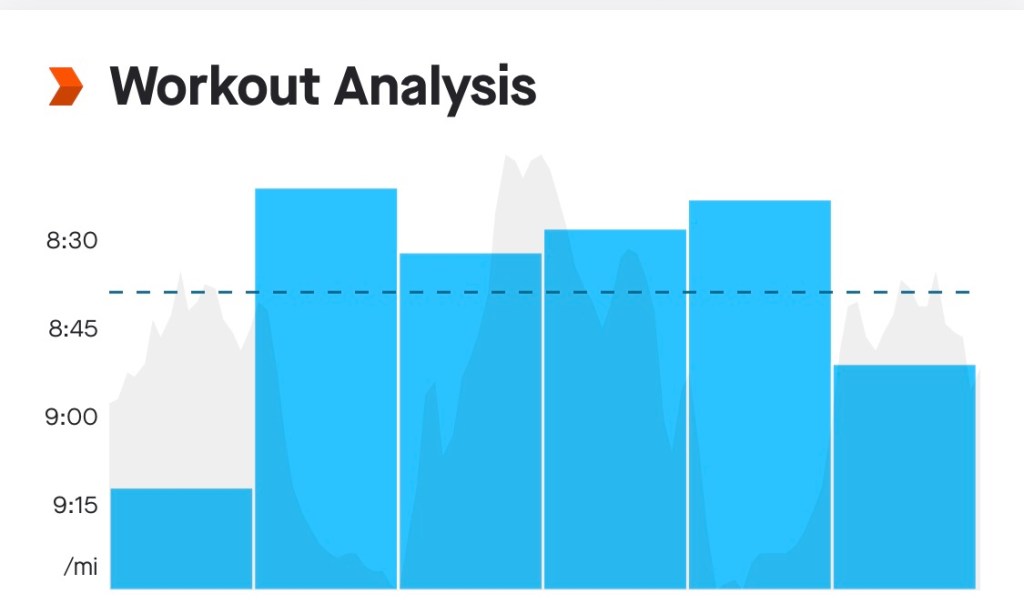
This section destroyed my pacing. I wasn’t wearing headphones, so couldn’t hear the Strava lady giving splits and had to rely on my poor maths to work out mile times. I thought I was doing ok on 3:35 pace (and in fact I was) until I got overtaken by the 3:45 pacer group at 7 miles. This really threw me. I put in a couple of sub-8 minute miles over an uphill section. I shook off the 3:45 pacer but sweat was now stinging my eyes – it was too warm for heroics, and I would pay for them.
I enjoyed the race after the half-marathoners disappeared at 11 miles, but I knew pain was on the way. At 19 miles everything started to hurt: stomach, knees, quads, neck (neck?!). I promised myself to slow down but never never walk. Even on sharp underpass inclines (of which there were about 937) I ran the slowest I possibly could without walking. At one point I felt like the only person who wasn’t, it was really surprising, and I think the weather and course must have been to blame. I didn’t do it to prove anything to anyone, but because once I started walking I wouldn’t be able to start running again.
So, I went from 8:15 miles to 9:30 miles, but I made it home before that bloody 3:45 pacer.














 Not a Jogger