Maybe don’t show me the strava stats

I’ve always been a late adopter when it comes to tech. The last person in my friendship group to get a mobile phone, I held out until the day I had to spend an hour and twenty minutes waiting in the car park of Balham Sainsburys because everyone was running late, but had no way of telling me.

When I started running in 1993 I wore a casio stopwatch that went up to one hour, before starting again at 00:00:00. I still have it, it still works, and I’ve never changed the battery. I just looked up when GPS watches were invented, and the first garmin went on sale 20 years ago. I bought one in 2014.

Why did I need a watch to tell me how fast I was running? I worried it would stop me from “running on feel” and listening to my body. Now I can’t imagine running without it. If I want to test whether I’m still running on feel, I just don’t look at my watch during the run, and check the data later. That way I can still run on feel, but also find out if my feelings are accurate.

I’m on my third garmin now, but still a fairly basic version (Forerunner 55) with all the alerts and suggestions switched off. I don’t want my watch to tell me what to do, or nag me to do more. The best thing about using a GPS watch is not having to do sums. Racing used to be a maths test: dividing your goal time by 26.2, writing down key splits on your hand, and re-calculating your pace at every mile marker.

Uploading my runs to strava, I love seeing my routes, and other people’s, to get ideas of where to run. Back in the pre map-my-run days, when I wanted to plan out a long run I genuinely had to get a piece of string and measure out a run on the A-Z or an ordnance survey map. Now I do an online version of this with the amazing OS app. But instead of writing the directions on my hand (hands were very important in the past), I can just look at the route on my phone in the middle of the run, and it tells me where I am.

Technology really is magic, and we’re lucky to have it. It has changed so much about running, it’s hard to remember what it used to be like. But last month, my free strava account was automatically upgraded to a subscription for a month, and I remembered that tech isn’t always good for you. At first, I was excited. What’s not to love about viewing our fitness trends over time, and training progress week by week?
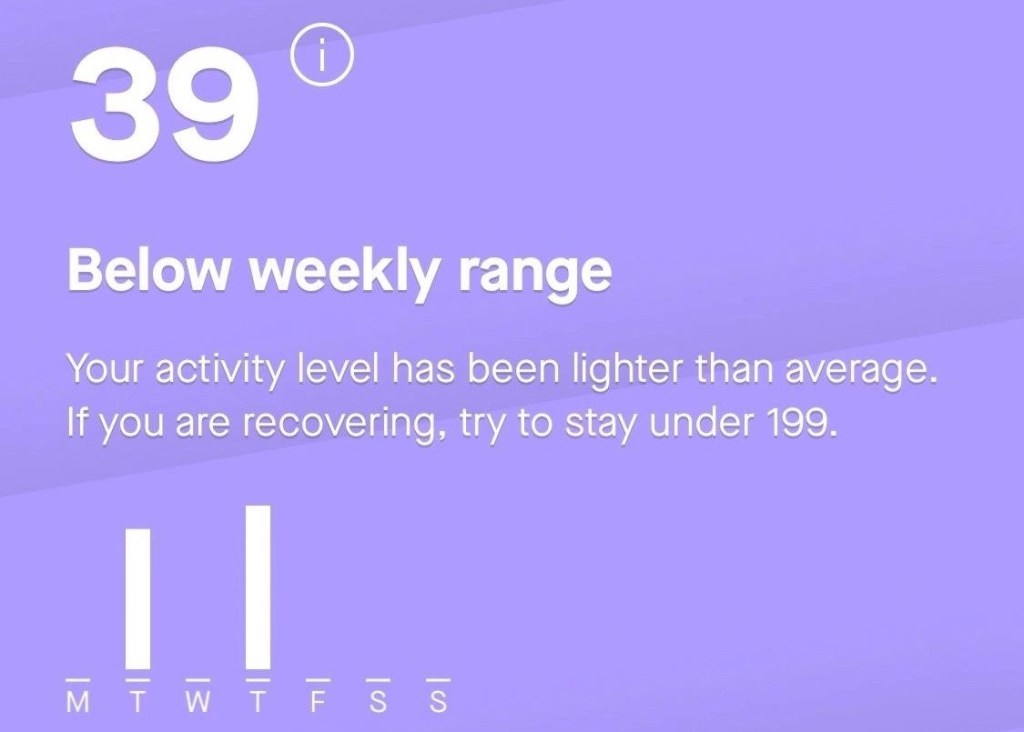
What’s not to love? For me, this kind of analysis was de-motivating, and anxiety-inducing. When all my numbers are going up, I feel pressure to keep them there. When they’re going down, I feel depressed and frustrated I’m not making them go up again. This is what losing “running on feel” looks like to me. An overload of analysis which controls my feelings about running. I didn’t feel bad about my training before, but now that I can see the stats, I do.

Strava has tried not to make its language all about monster weeks, and to frame rest weeks as positive. But the colours, the numbers, the charts, they paint more of a picture than the words. If you’re a runner like me who is self-critical, and over-competitive, this is risky.

The month’s subscription just came to an end, and my account is back to normal, just in time for me to pick up a knee injury. So whatever happens now, at least not having to look at my declining fitness trend is a light in the darkness.
Is it a training race, or a race race?

It’s that time of year. You’ve just finished a long marathon training run. Your face is salty, your thighs are throbbing, but you’re buzzing. You did it! It’s in the bank. You upload your run to strava, and while you’re waiting, you scroll through other people’s runs. You look at the distances, the times, the comments. You tap “view analysis” and look at your elapsed time. It doesn’t look as good. The buzz starts wearing off.

“I could have gone faster”, you think.

Yes. You could have gone faster. But *should* you have? The answer is no, and you know it. Long slow runs are called LSRs for a reason. They’re not long tempo runs, or long steady runs, or long fast runs. Being slow is the point.

While we’re out running further, our bodies are getting stronger. The stress of the increased mileage is overloading our muscles, and triggering adaptation. By running slowly, we’re reducing the impact of this overload on our bodies, recovering more quickly, and protecting ourselves from injury. There are no strava crowns for being slow and sensible, so we just have to remember that the benefits are invisible, but real.

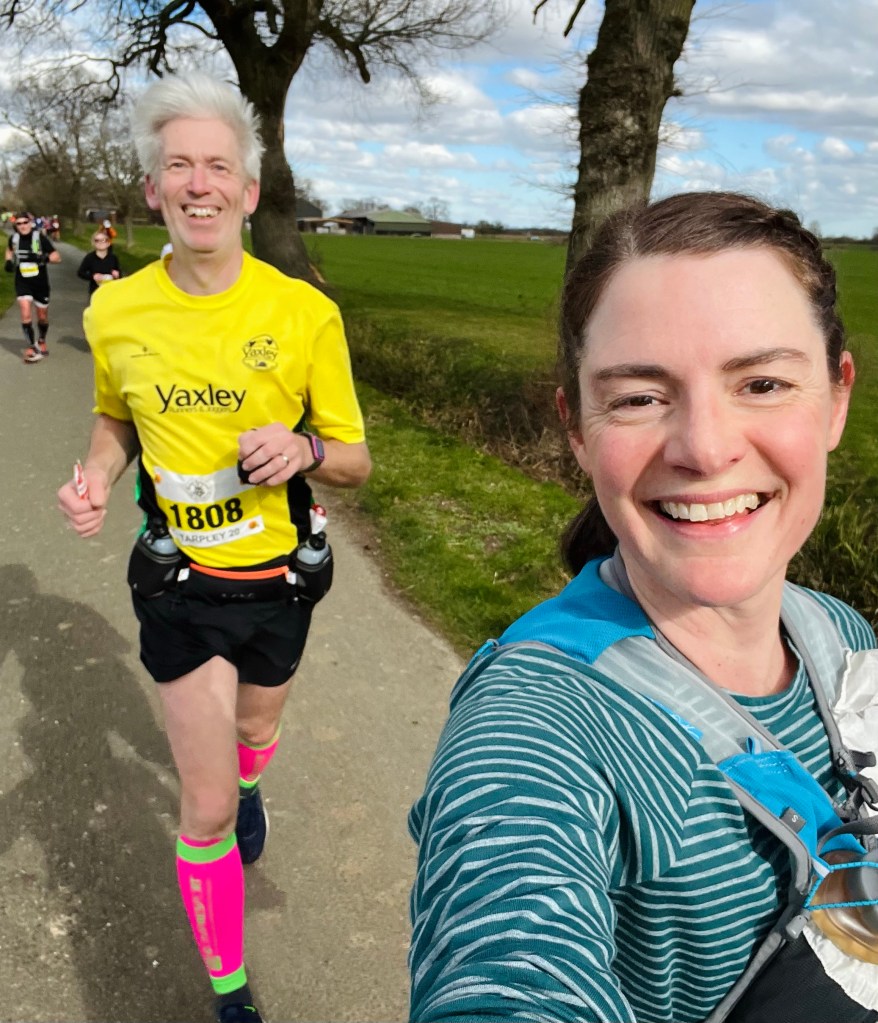
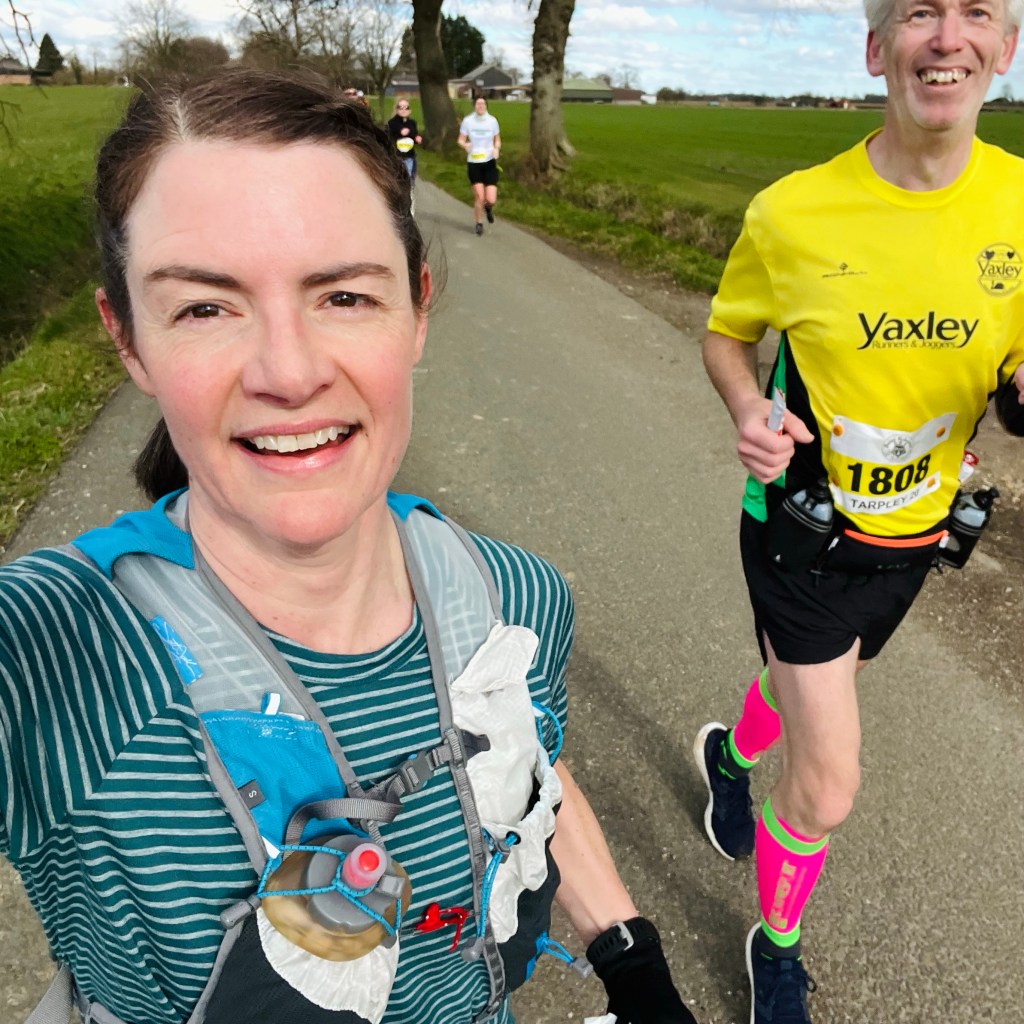
This is easy to say, but harder to stick to. Last weekend I ran a 20 mile race- the Tarpley 20 – as part of my marathon training. Before I joined a running club, I had never heard of anyone doing a race as a training run. Don’t these people realise that running is free? I would have said. But long races make for brilliant marathon training. They are locally run, reasonably priced and well supported. If you’re struggling to motivate yourself to cover 30k or 20 miles by yourself, pinning on a race number alongside 300 people who probably feel the same really helps.

The challenge with a training race, though, for anyone with a shred of competitiveness in their veins, is that it’s still a race. It’s really hard not to race a race. I should know, I’ve done it. At the Stamford 30k in 2022 I went too hard in driving rain and picked up a calf strain that ended my chances of running Brighton marathon. At the Oundle 20 in 2019, I got carried away with it being a club championship race and, looking back, put in a much better performance than I managed at Boston marathon four weeks later.

At the start line last Sunday, I could still feel the temptation. Before the race, to guard against this, I had told anyone who’d listen that I was going to take it slow. Even so, I found myself finishing my first mile in 8 minutes 17 seconds (AKA, this year’s goal marathon pace). Luckily, my brother in law caught up with me in mile two and asked me (in the nicest way) what the hell I was doing. Slowing down, I replied.

I did, and as a result, I really enjoyed the run, especially the last few miles. When I got to the finish, I not only felt I could run another 6.2 miles, I actually wanted to. I can honestly say I have never felt like that at the end of any race, ever.

I am not a coach, and I can only talk from my own experience, but I wouldn’t race – as in, properly race – anything longer than 10km in the run up to a marathon. If we’re tempted to push it harder for longer, we need to ask ourselves: what is the main goal? Is it to perform really well in the marathon, and get to it on top form and uninjured? Is it to perform really well in the club champs? Is it to boss the cross country season? Because we cannot do them all.

When it comes to your marathon, so many things about race day are uncertain. Focus on what you can control. Focus on the goal.

Don’t risk leaving your best race in training.

Whisper it… I might be getting my fitness back

After three months of covid and a post-covid cold from hell, I’m finally getting back to my pre-covid fitness. It makes me nervous to write this, in case I chase it away, but I also want to record it. If I say it out loud, I can start to believe it.

Early morning intervals are back

Three months sounds like nothing, but feels like forever. At first I was just happy to be able to get outside. But when my garmin beeped a “your stress levels are unusually high” warning at the start of a run, and then repeatedly told me my easy jogs were done at a “threshold” level heart rate, I was worried. How could I listen to my body, when I felt fine but so obviously wasn’t?

Mine was a mild Covid case, with most of the OG symptoms but no cough. I only took one day off work and, after two weeks of no running, I was keen to start again. People who’d had covid (which at this point was pretty much everyone) kept warning me to “take it easy”, and “don’t rush back to exercise”. It sounded like they wanted to add “… or you’ll get long covid”. I tried to find some proper medical advice for post-covid running, but failed. Is there any?

This Runner’s World article is the best summary I could find of what information there is for us to go on. It shares data on elite athletes, which I did not find helpful, but also looks at a big study of fitbit data which finds that the average covid sufferer doesn’t return to regular resting heartrate for 79 days following infection. 79 days is… three months.

Three months after Covid infection, my heart rate is now connected to the effort I’m putting in. I can stay in the “easy” heart rate zone without stopping to walk, and in the past two weeks I’ve run:

  • my first interval session since October 2022;
  • a 5 mile cross-country race, within 15 seconds a mile of my old pace; and
  • an 18 mile long run.

My heartrate looked normal during each of these, and they were all a massive effort and a hideous struggle. I loved them!

It’ s official. I’m back. (fingers crossed)

January: the month for taking motivation wherever we can find it

Speculoos & cream cheese: motivation in a biscuit

It’s getting near the end of January (hurrah!), and resolutions are fraying along with tempers. We are all hanging out for payday, for lighter days, and warmer weather. But running can’t wait, at least not for me. If I am going to run London marathon this year – and I think I am – I need to get out there now.

Usually I have a training plan, and use that to hold myself to account. But not this year. At least, not yet. I had so much time off running in late 2022 that I never got to build a good marathon running base. My past three months’ running still look like a rollercoaster with big dips for Covid and The Cold, and I haven’t strung together three weeks’ good mileage yet. Once I can do that, I will call it marathon training.

Running without a plan is tempting in the spring or summer, when just being outside is a delight. Right now, ploughing through the mud in -4, not having a plan is a big risk. With energy bills so high, my house is cold, and just getting changed into my running kit is the hardest part of going for a run.

January is the toughest month for running. It’s mad that this is time most people start training for their first marathon. And honestly, if nearly thirty years of running has taught me anything it’s this: find motivation wherever you can. Looking forward to a bath when you get home? Want to wear that new headband? Have to go to the post office? Want to see the seals in the River Nene? All reasons I have used to go for a run in the past two weeks.

The king of motivators – always – is the one I use least: running with other people. I run alone because it’s convenient, but also because there’s nobody else to worry about. Even when I’m running with friends and family I get anxious: am I talking too much? Too little? Am being boring? Am I going too fast? Too slow? I wish I could turn off these fears, because running with other people is brilliant. Time goes more quickly, I get to hear all the gossip, and – most importantly – I always turn up.

(p.s. I did not see the seals)

2023 in running: a miserable and magical year

It’s been a funny old year. But haven’t they all been, lately? A journalist asked for some stats at work the other day and I had to write an email justifying why no two years are really comparable and then I stopped and thought: why am I doing this? Of course you can’t compare 2020 to 2021 to 2022. We’re living through a series of crises.

It has not been a vintage running year for me. I picked up a calf injury by pushing too hard in a 30k race in February, deferred my Brighton marathon place, trained fitfully over a hot summer, ran the Rutland marathon and did not enjoy it, then finally got Covid and missed the beginning of the cross-country season. My annual mileage is set to be my lowest for many years.

But, surprise! I still love running. When I have managed to get out for a run – even (especially?) the ones where I walked – I’ve loved it more than ever. The injury and Covid were rotten, but they made me appreciate running more. I missed being outside, covering ten miles with ease, and getting out of my head as well as the house.

I went part-time (if 4 days a week with some work on fridays really counts as part-time, which I would argue it does not) in March, with the intention of doing some creative writing on my day off. I’ve found it hard. Not working quite so much has been great, but it turns out that creativity is not a tap I can just turn on when I have a spare few hours. Also, there are a whole heap of other things I want to do with six hours to myself, and running is high on the list.

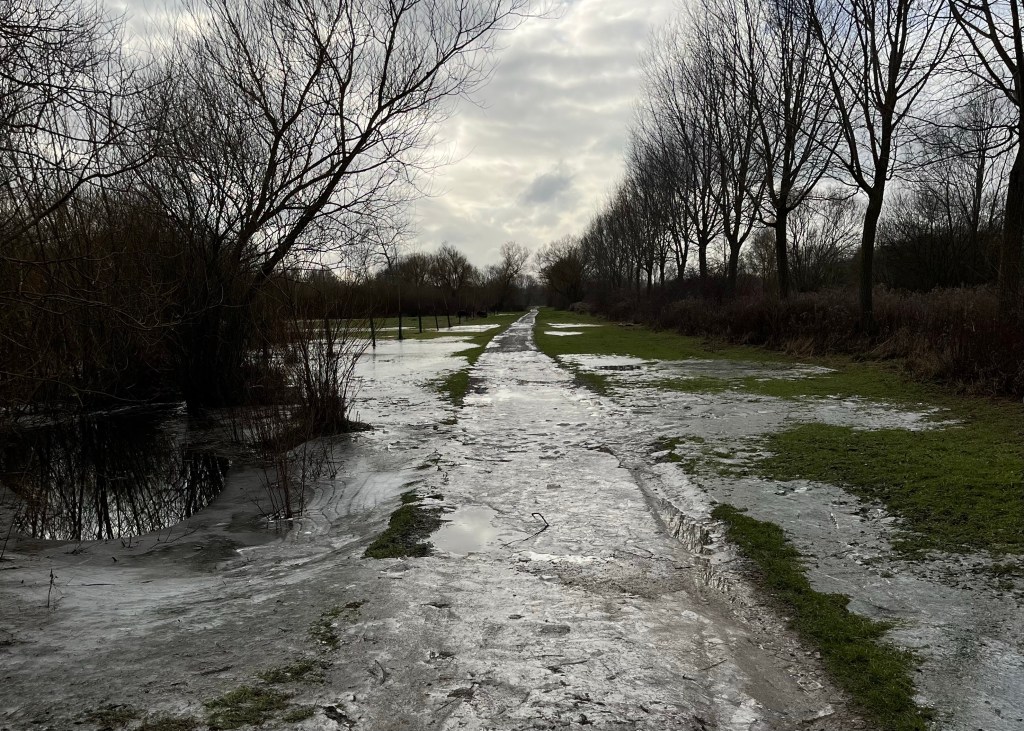
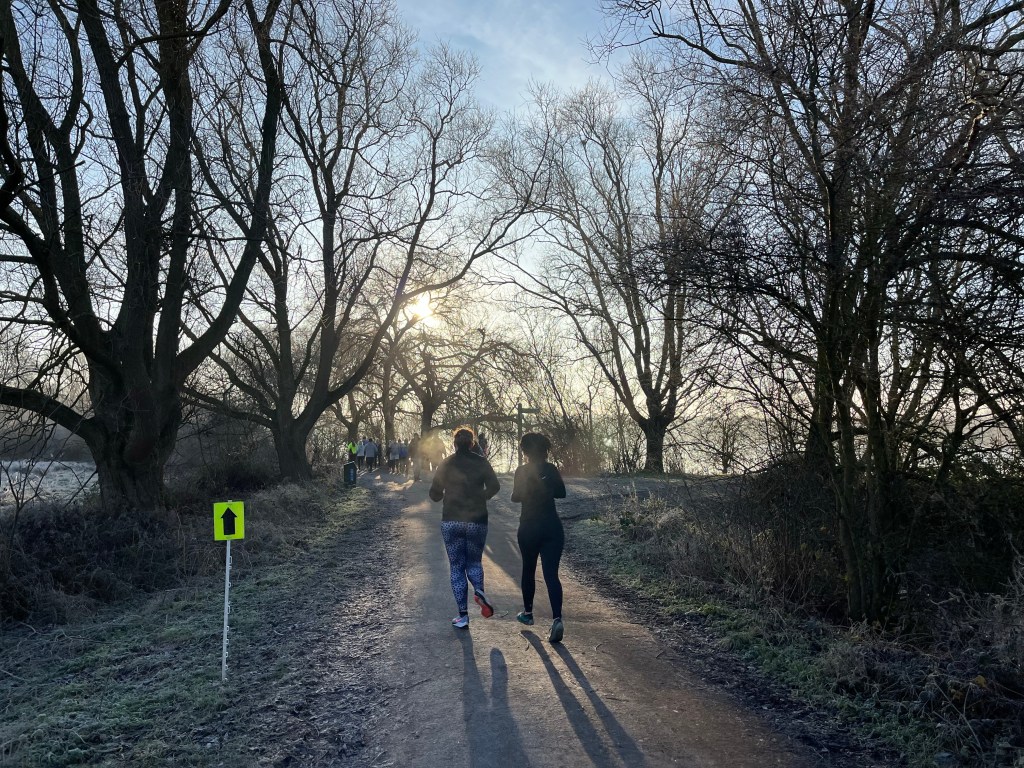
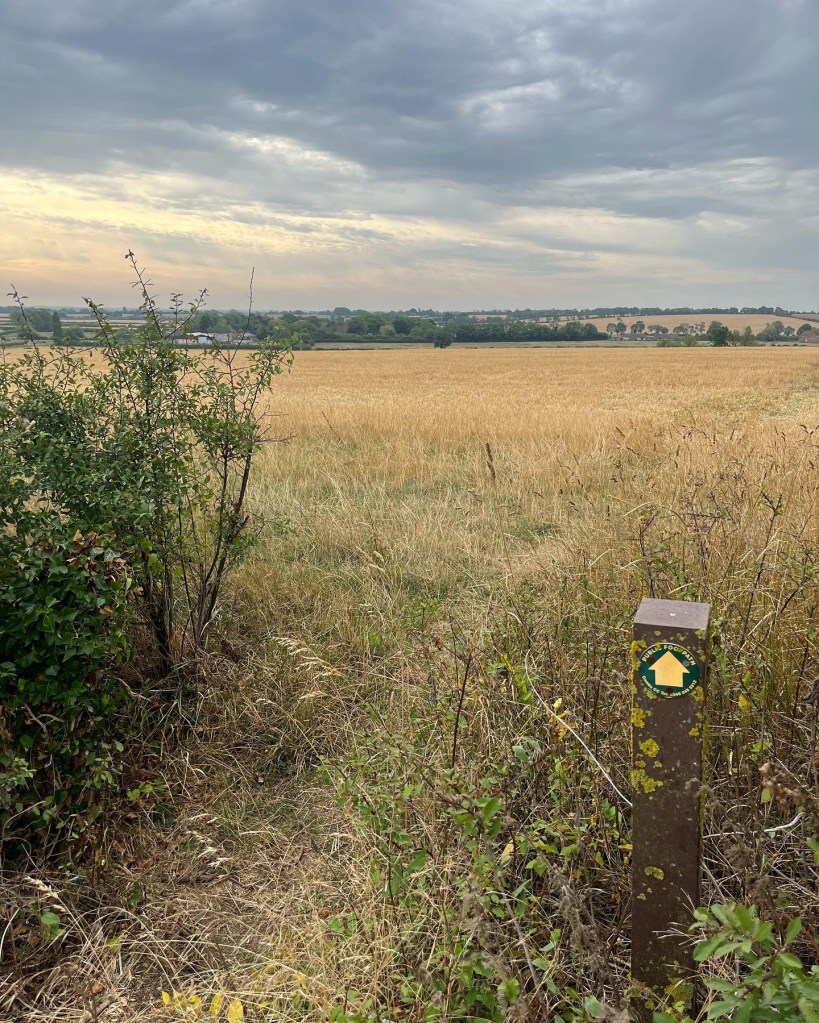
My best runs this year have been Friday morning runs. Some of them with Lazy Girl Laura, but most of them alone. Does running count as being creative? Maybe not, but it definitely does count as beautiful. I’ve shared some of my favourite running photos from the year in this blog. You can’t see me in any of the pictures, but I was there.

Thoughts from Rutland Marathon

Such perfect marathon weather’. The smooth path stretches along the edge of the dam. A family claps and cheers from a bench. Ten more runners overtake me.

I’m glad I’m not going out too fast’. The smooth path ends, turns gravelly and weaves through a carpark and up onto a grassy slope.  

‘I just need to keep the lid on for ten miles’. A marshal shouts, “well done young lady”. I’m 46, but I’ll take it. The stony track curves up and down around the inlet of the reservoir.

‘Look at the water, maybe I’ll see the osprey’. The lead runner of the half marathon whizzes past.

‘Keep it steady’. Another sharp uphill, a right turn, a left, a downhill.

The turning point must be soon’. The lead male runner passes, big beard, leopard print vest.

 ‘Do not speed up’. The first woman runs past, pink t-shirt, big smile.

‘I do not need to speed up’. Five more women pass and the turning point is there. The route doubles back around a line of orange cones in the woods.

‘Keep a lid on it’. Runners pass, still on their way to the turning point. The five mile marker goes by.

‘Only five? No, don’t think that. Half way to ten ’. The runners coming the other way are slower and more friendly.

‘This is better, I’m enjoying it’. Say “well done!” to every female runner. A dog lifts its leg to pee on the seven mile marker post.

‘Nearly at the dam, now’. A man sitting on a bench makes full eye contact with me and says nothing. Across the dam. A child jumps up and down, blowing a whistle.

‘I should be feeling better than this’.

The path stumbles between mole hills and rabbit holes. ‘This grass is really green from the rain’.

The route goes back past the start funnel. ‘Try to look good’.

The loudspeaker calls out the names of passing runners. A few cheers. ‘Try to feel good’.

Out of the carpark, the seventeen mile loop back to the finish begins. ‘I won’t count the hills’.

There were six hills between that point and Hambleton Peninsula. ‘This might be a bad patch’.  

The half marathon turning point is behind me at eleven miles. ‘I might feel better soon’.

The path stretches out along the north shore, looking flat but somehow going uphill. ‘It’s good to be outside’.

Mile fourteen. Mile fifteen. Up the hill to mile sixteen, my chest pulls with every breath of air.

“Stop it!” I shout out loud.

But I can’t push away the negative thoughts. Over the final ten miles, I try everything.

‘It’s good that my achilles isn’t hurting’.

‘Every uphill has a downhill’.

‘This gel will make me feel better.’

‘I always love running here’.

‘It’s still a beautiful day’.

‘No-one is going past you’.

‘Everyone feels the same.’

‘Don’t walk unless you have to’.

‘Just walk if you need to’.

‘Just get to the finish’.

‘You’re going to make it’.

When I cross the finish line I feel two things: relief, and certainty that there was nothing I could have done differently. This day wasn’t my day.

It is true that much of a marathon is what’s inside your head, the stories you tell yourself about how you’re feeling, the stories you tell yourself before you start, and how you spin it afterwards. But now that I’m older, I can see that it’s really the body. Yes, you can make yourself keep running or let yourself give up, you can decide to push or decide to walk. But it all comes from the body. The training, or the feelings on the day, dictate it too.

Looking at my insane heart rate recordings, I know I couldn’t have done anything else on this day. I know that the rushing of blood in my ears, the nearly fainting, that was the very edge of what was possible. I went right up against it. There was nothing more I could have done on that day.

When you’re young, or you have tons of training in your legs, you can carry a bad day and your brain is your only barrier. As you get older, on a bad day you can’t push through it.  But on a good day, you can run just as fast as ever.

Play Misty For Me

I get excited when the overnight temperature on the weather app drops to single figures, but the days are still warm. On a clear night, mist will rise from the river and spread its cold fingers over the water meadows, leaving wisps of cloud floating over the lake. As the first rays of sun peep over the horizon, the mist disappears like a magic trick.

Sunrise was at 6:36am, and I didn’t want to run in the dark, but I did want to be by the river at first light. I set my alarm for 5:35am. I know it’s mad, but this doesn’t feel early any more. In lockdown, I became obsessed with running before anyone else was up, and as the days got longer, my alarms got earlier.

I had a coffee but didn’t eat breakfast. I did my usual activation exercises. Ten years ago I would have thought this too was mad: who would sacrifice 30 minutes of sleep for a coffee and some squats? But ten years ago I could have sprinted in heels. Now I have to warm up just to walk downstairs.

I jogged through the estate in the twilight, crossing the railway tracks and the weir before I saw another person. Three women in hijabs, who I sometimes see at this hour, said good morning as they ran past me on the bridge.

Taking the river path, I could feel the mist cold in my nostrils, and damp on my arms and legs. Over the footbridge and into Ferry Meadows, the sun was up and the pale light turned briefly orange. Over the lake, the sky was settling into blue, and terns wheeled and skimmed the surface. A heron sat hunched on a buoy in the middle of the lake and invisible fish rippled the water from below.

I felt completely free to enjoy this run. It’s the second Friday after school started, my parents are away, I don’t have to work, and it’s the first Friday in a few months where I can put myself first. I didn’t have to do the school drop off. I didn’t have to run fast, or far. Still, I had a goal. Every run has a purpose. Sometimes you set it, sometimes it’s set for you, and sometimes you learn it afterwards.

Today, I ran to drink in the beauty. I don’t care if this sounds naff because it isn’t. I learned that in lockdown too.

The Next % Dilemma

I’m half way through my training plan for Brighton Marathon and I’ve realised that even if I make it to race day intact, my trainers will not. I run in New Balance 880s – basic neutral road shoes. They’re good; comfortable, no injuries and they last well. But lately, my eye has been wandering and I’ve been wondering: what if I’m the only person on race day without carbon plate shoes?

Everybody’s doing it now

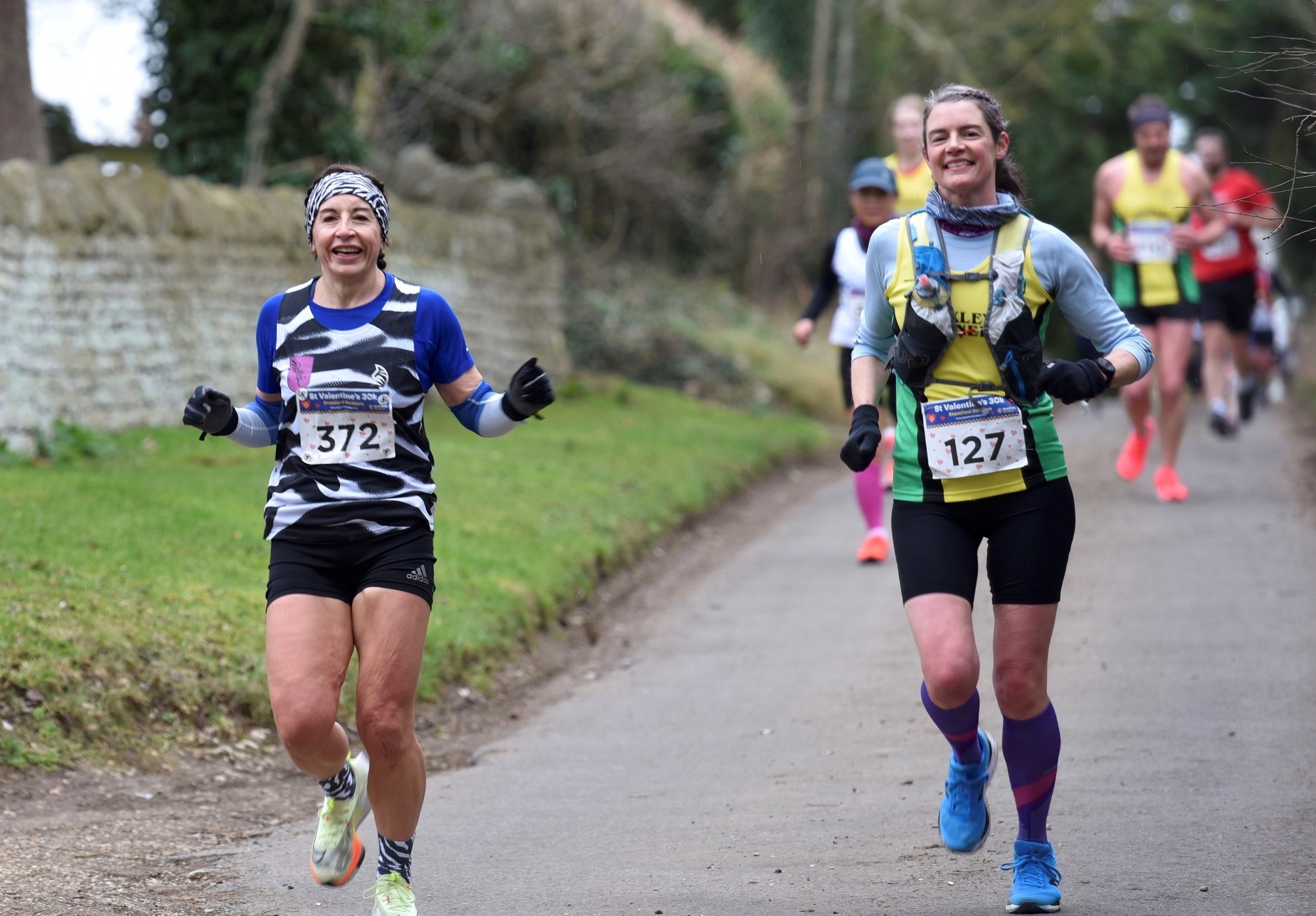
This photo was taken at the race I did yesterday: the Valentine’s 30k – run by a local club Stamford Striders. It was a great event with a real community feel, run around country roads. It’s not an elite race, but a fair proportion of runners of all speeds were wearing Nike Vaporfly Next % shoes – or similar ones with a carbon plate.

The last time I raced over a similar distance was in early 2020, when Next % shoes were still a talking point – considered to be expensive and still pretty rare. At the start line, a couple next to me were wearing matching ones, and other runners were nudging each other. Now, most marathon runners I know either own them already, or are saving up to get some. They’re common at parkrun and I even saw someone lining up at a cross country race in them last weekend.

Would I wear them for a cross country race? Of course not. Spikes, or shoes with lugs, make me faster at cross country, and I have always worn them. Would they make me faster at Brighton marathon? Probably. If I were an elite runner competing against others, or up against the clock trying to get a Boston qualifying time, I would be off to the Nike store right now. But I set my marathon pb wearing road shoes, and if I beat that pb now (as if) wearing carbon plate shoes, I would always think, “it was the shoes that did it”.

And so…

Am I going to buy a pair? I don’t think so. If someone gave me some as a present, I would be interested to see what happened, but no, I’m grateful for a reason not to spend the money.

I do occasionally panic that I will be the only one lining up in Brighton in normal shoes, but don’t you worry. If I can run sub-3:30 for a marathon in regular road shoes at 46 years old, I will make sure everyone hears about it.

How not to train for a marathon – have a baby and then get no sleep.

Dog

On this day in 2013, I had a baby. 2 hours before she was thrown onto my chest in the operating theatre, I had my first sleep for 3 days: 30 minutes of epidural-induced bliss.

Before Martha arrived, I was not a big sleeper. Never had more than 7 hours a night. Didn’t do lie-ins. Always up early. Fond of a night out.

Now? Sleep – oh, sleep, is the holy grail. The answer to any question. The solution to every problem.

At the beginning sleep is plentiful but sporadic. You all fall asleep at random times, in short bursts like Ellen Macarthur. You feel like Olympians trying to do a decathlon in the dark wearing wellies. Team spirit gets you through – “we can do this!” you croak to your partner as you pass in the hallway at 3am, handing off the baby like a baton. You watch a lot of box sets.

Slowly, progress is made. The baby sleeps for longer in one go. Unfortunately this long sleep starts at odd times, usually in the middle of dinner, and once you realise it’s happening, it’s half-way through. “Bed!” you yelp, abandoning the washing up to the cats and failing to brush your teeth for a week. The moment your head hits the pillow you are asleep.

Then, just as everything is getting better, everything goes wrong. The long sleep starts well, and sometimes lasts a bit longer, but it is fickle, oh so fickle. One night in two weeks she will sleep through the night. You, on the other hand, will still wake up every two hours. All the other nights she will wake up at the drop of a phone, or the clink of a belt buckle. “Why can’t you get changed in the bathroom?”, you will hiss at each other. The TV, like everything else, is now a distraction from feeding. Box-sets remain unwatched, possibly forever.

Slowly, real progress is made. Only now you know better than to talk about it, even to each other. Slightly more rested, you realise how tired you actually are. You go back to work and pretend to be a normal person. You drink a lot of coffee, but never after lunch, because then you lie awake after a 3am wake-up and know you are up for the day.

Running helps, up to a point. When you’re a little bit tired, exercise makes you less tired. It also helps you sleep well.

Not marathon training, though.

If I have learned one thing in the last year it is this: marathon training when you’re getting no sleep is a stupid idea.

I realise, looking back on old photos, that I was a MASSIVE SLEEPER. All I did during my previous marathon training periods, or possibly my life in general, was NAP. I loved naps. I had no idea how much I loved naps until it wasn’t possible to have any. There are so many photos of me asleep – on benches, in the garden, on the sofa – that either my husband is a somnophiliac or I took a whole lot of naps.

Sleep is important for athletes, and non-athletes who happen to be runners of marathons. It’s well known that Kenyan runners just eat, run and sleep. I have found time for the first two during this marathon training (well, mostly the first to be honest), but the third? Not so much.

On Monday I’m running the Milton Keynes marathon and I am worried. I’ve done (most of) the miles, but I really haven’t had the rest. Will I be able to run at anything like my target pace over 26.2 miles (8mins 15 secs per mile)? Will I be able to get to the start on time given that there are no direct trains from London (grr)? But mostly, will I get a full night’s sleep beforehand?

I will let you know.

On eating a whole baguette on the bus

The Marathon Hunger has set in.  I remember it vaguely from last time, but between then and now my body has been hopped up on fertility drugs, confused by pregnancy and baffled by breast feeding, so it has lost all sense of what normal hunger feels like.

On Friday I left the office at 12.30pm to work from home for the afternoon. On my way to the bus stop, I picked up a sandwich and some popcorn to eat at home as a Friday treat. Eating a shop-made sandwich at home is the height of decadence for a new parent.

By the time I got home I had eaten not only the sandwich and bag of popcorn, but also an entire baguette purchased at Waitrose on the Holloway Road, a supermarket I had no intension of visiting, and which involved crossing several roads to get to, then getting a different bus home. It pulled me in with its ‘aisles of wonder’ tractor beam. I wandered around in a food-fixated haze, unsure what would satisfy the intense need to stuff my face.

I felt so hungry, that afterwards I started to worry that I might be pregnant again, even though it is a medical impossibility. After eating the baguette, I still wasn’t full. Mitigating my gluttony shame, I can at least say that I did not also eat the cinnamon bun purchased in addition to the baguette. It stayed in the bread bin as a reminder of my secret carbohydrate festival until Sunday morning when I scoffed it after my long run.

I suspect some of this carb craving could be averted by eating more protein, but protein is expensive and bread is cheap as chips. And nuts are all very well, but only when covered in chocolate and packaged by Cadbury.