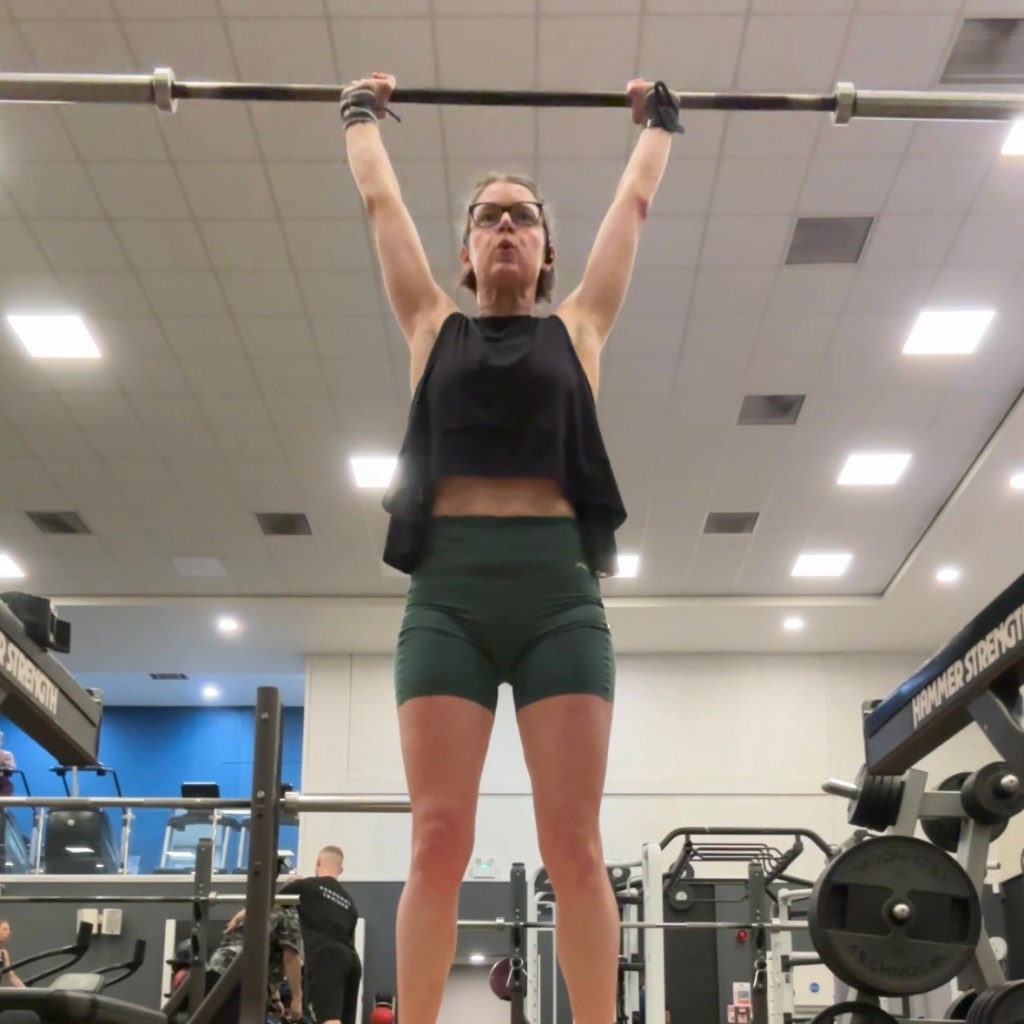
It’s ok to be a gym lightweight

Queen of the empty bar

Social media is sometimes like an aunty who once heard you say that you liked frogs and then buys you frog-shaped content – slippers and soap and ornaments and birthday cards – for the rest of your life. The minute you get curious about something, let’s say… how to do a deadlift… social media will give you so much content about deadlifts you will feel like you never want to do a deadlift again.

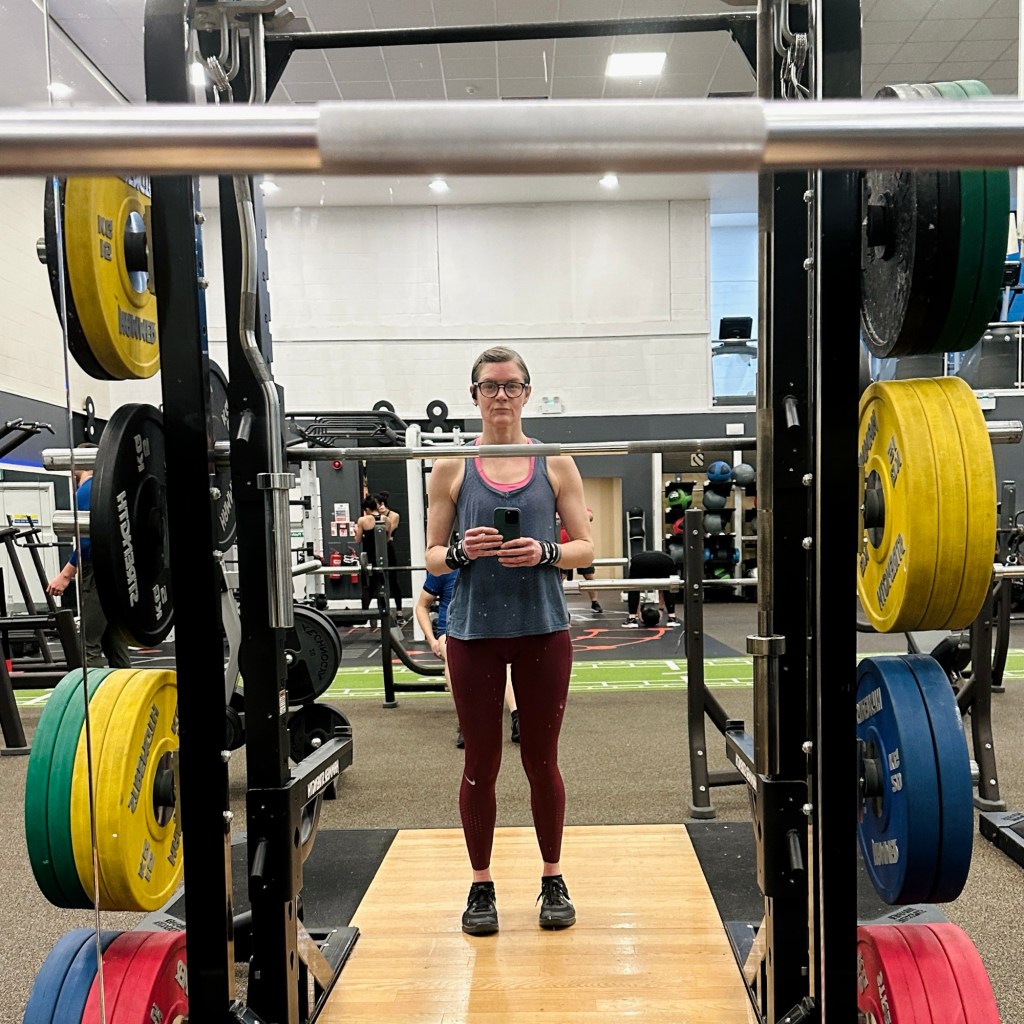
When we hold all potential human knowledge in our pockets, it’s so hard to hold on to curiosity and learn something new. But I have been trying. Once a week, since January, I’ve been to the gym to lift heavy weights. I’m 48 and menopausal, with creaky knees. After battling injury for a year, I now fully believe that lifting heavy weights is going to keep me running.

Heavy weights? I thought this was about being a lightweight. It is, I promise. The weights I lift are puny compared to what I see the awesome women in the gym lifting. But they are heavy for me. I can feel them engaging my core, challenging my stability, and building new muscles. I’m going once a week, and my legs feel stronger and more stable when I’m running. When I did crossfit a few times a week, I was strong but I had so much DOMS (delayed onset muscle soreness) I could barely run.

If you don’t lift weights, going to the gym can be intimidating. Everyone looks like an expert. It’s hard to pick what to do, even harder to know if you’re doing it right. It’s scary to join a class, and expensive to get a 1:1 personal trainer. So social media is doing a lot of heavy lifting (sorry) when it comes to training advice. Over the past few months I’ve had instagram accounts telling me that I won’t make progress unless I lift 3 times a week, that I shouldn’t do deadlifts, I should do romanian deadlifts, I should only squat, I should never squat.

I’m not going to give out training advice, but I will share that I:

  • Only lift once a week – once a week, every week, is my commitment;
  • Prioritise strength, not fitness – I get my cardio from running;
  • Take my time – yeah I look at my phone between sets;
  • Pick things I like – slam balls are fun;
  • Do the same workout every week – then I don’t have to make decisions;
  • Embrace being a lightweight – form is more important than numbers;
  • Increase weight s l o o o o w l y – in four months I’ve only upped my squat and deadlift weights once;
  • Regularly put my wedding ring in the washing machine (in my shorts pocket).

This is working for me. I can now squat down to sit on the floor and stand up again without using my hands! This is my olympics. Find what works for you, and don’t let people on the internet tell you what that is. Including me.

Life lessons from the injury rollercoaster

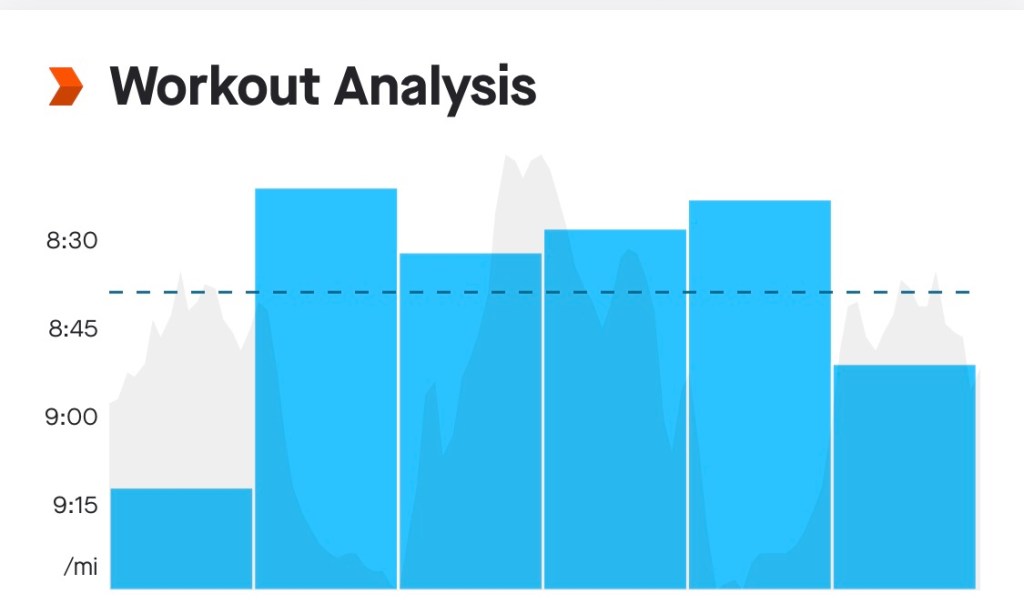
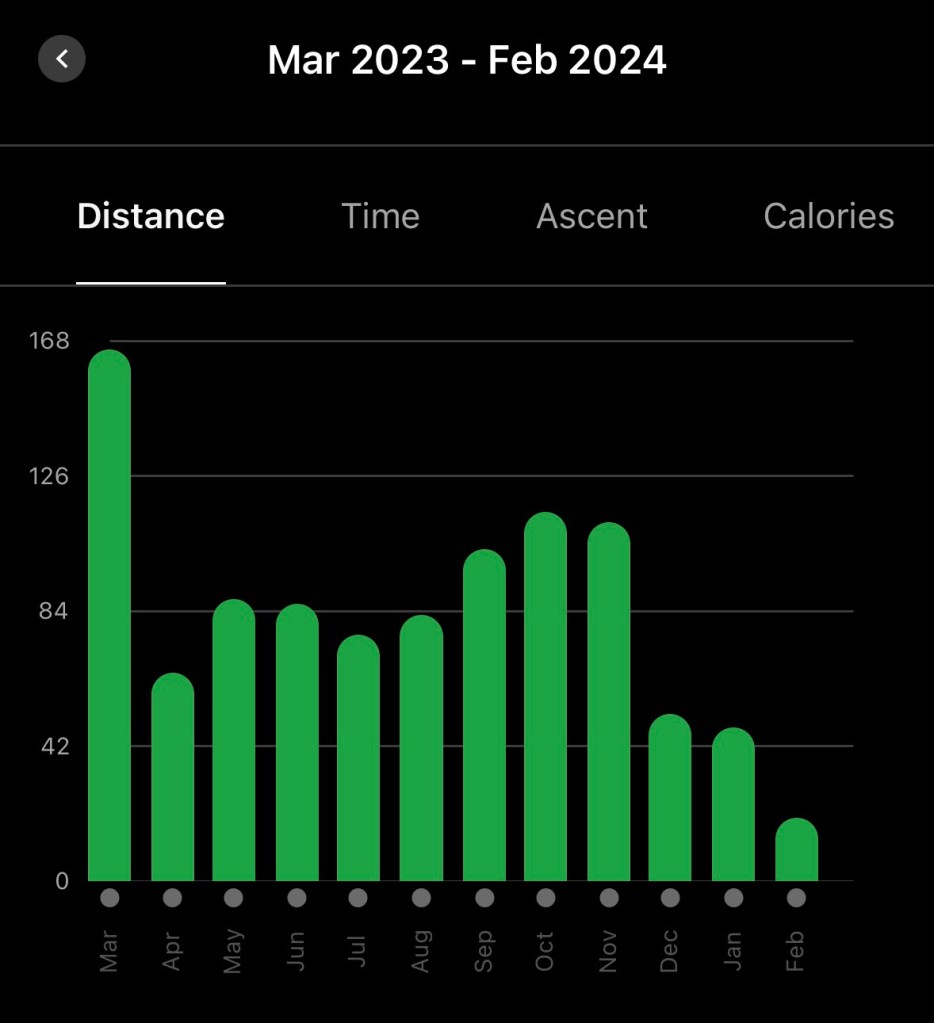
Dear Reader, you can see patterns in anything if you look for long enough. My soon to be year of running injured looks like the rolling hills of an inevitable eliptical workout. But am I on a downslope or an upslope? It looks like I should be at my lowest, but I feel hopeful. A disclaimer: here be lessons, but… never take advice from someone who’s falling apart.

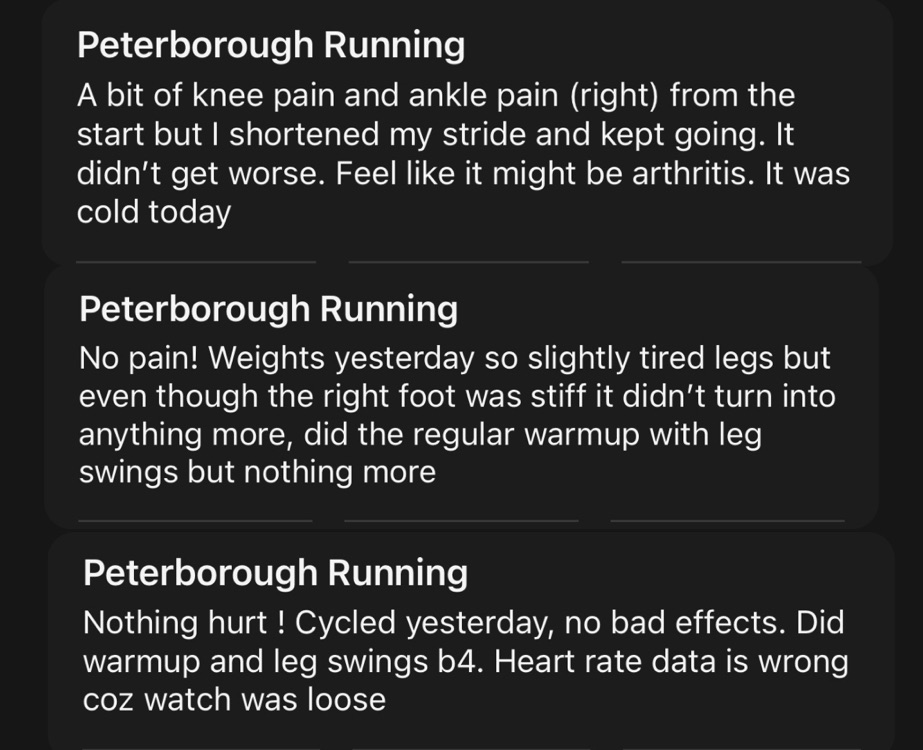
This chart is from my garmin account. I deleted strava before christmas when the tops of my feet starting hurting as well as my knees, and jealousy turned into loathing for everyone out there running ten miles like it was nothing special. No more sharing of photos and wildlife spotting for me. Just an obsessive list of private, unfiltered thoughts on how each run went and why.

My garmin notes run in cycles: celebration! commiseration! mystification! A good run might be because I did my strength exercises the day before. A bad run might be because I was tired from my strength exercises. Or because I didn’t do them. I warmed up. I did too much warm up. It was early. It was late. I was desperately searching for clues as to why my feet and knees were hurting.

At christmas, I pushed running to the back of my mind like crusty trainers in the shoe cupboard. I dug them out and saw the physio (again) in January. Her opinion was a surprise: I was doing better. My glutes and hamstrings were stronger, nothing seemed seriously wrong. She asked if I’d been doing anything different, and I said I’d been going to group cycling (spin) classes. Actually I had wondered if that’s why the tops of my feet hurt. Her advice: stop the cycling and see if that helped.

It did.

I had been making a pattern where there wasn’t one. Assuming that my ankles were sore because of my knee pain. But maybe… they weren’t connected. This week I ran my first 10k without pain in two months. I started the week planted to the sofa by a cold. Ran 4 miles on Thursday, also without pain, then on Friday I went to the gym for a couple of hours. I mixed cardio with strength, and finished with *proper weights*: deadlifts and back squats on the lifting platform. Swam 40 lengths with Martha on Saturday, ran 6.2 miles on Sunday. Is this the beginning of a good pattern?

It feels too early to say, but it’s not too soon to share one thing: building strength is the cure. I’ve done a few months of regular homework: split squats with a 5kg weight in each hand; hamstring curls on a swiss ball. The other day I realised that I can almost do a single-leg squat now – something that would have been unthinkable for my shaky ankles and creaky knees a year ago. Building strength for the functional movements of life can only help. This week’s gym session was my third *proper* session and the first where I felt really good. Strong. Like I belonged.

Is it a training race, or a race race?

It’s that time of year. You’ve just finished a long marathon training run. Your face is salty, your thighs are throbbing, but you’re buzzing. You did it! It’s in the bank. You upload your run to strava, and while you’re waiting, you scroll through other people’s runs. You look at the distances, the times, the comments. You tap “view analysis” and look at your elapsed time. It doesn’t look as good. The buzz starts wearing off.

“I could have gone faster”, you think.

Yes. You could have gone faster. But *should* you have? The answer is no, and you know it. Long slow runs are called LSRs for a reason. They’re not long tempo runs, or long steady runs, or long fast runs. Being slow is the point.

While we’re out running further, our bodies are getting stronger. The stress of the increased mileage is overloading our muscles, and triggering adaptation. By running slowly, we’re reducing the impact of this overload on our bodies, recovering more quickly, and protecting ourselves from injury. There are no strava crowns for being slow and sensible, so we just have to remember that the benefits are invisible, but real.

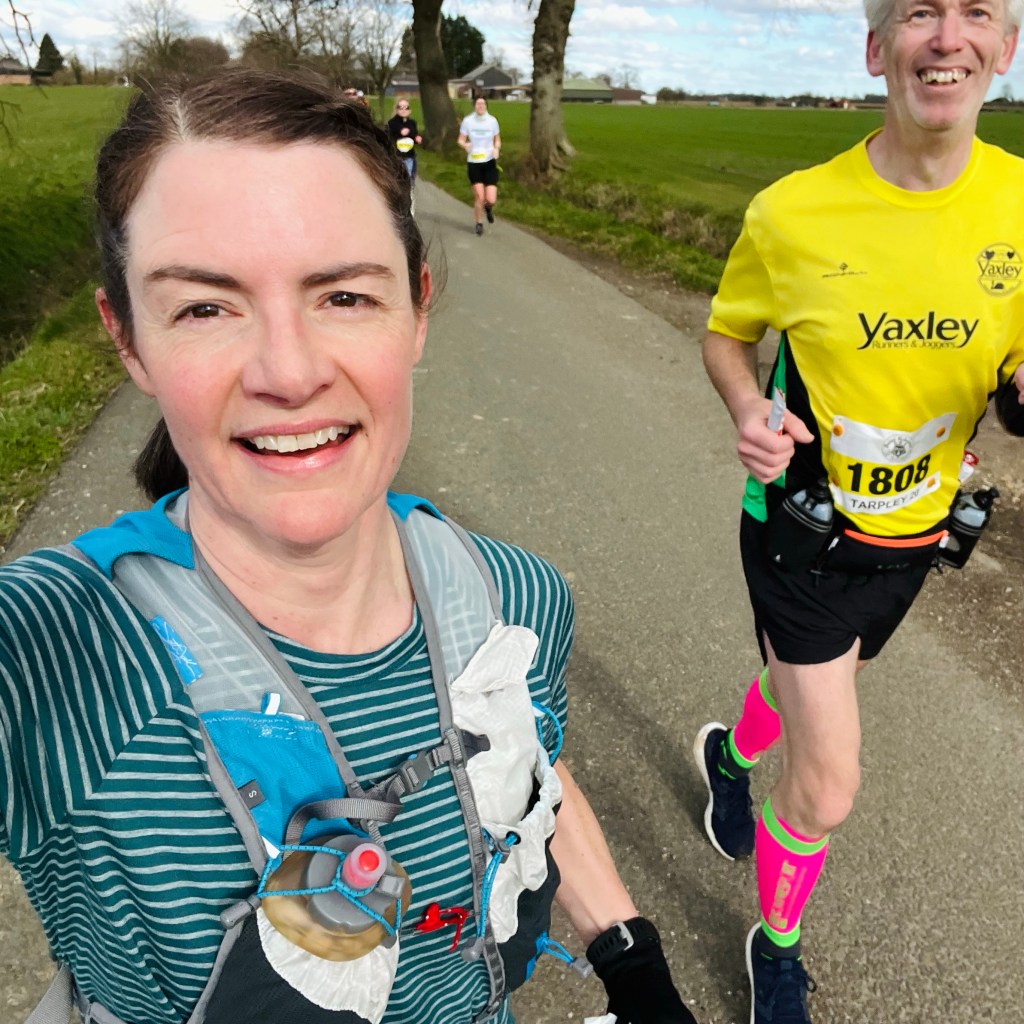
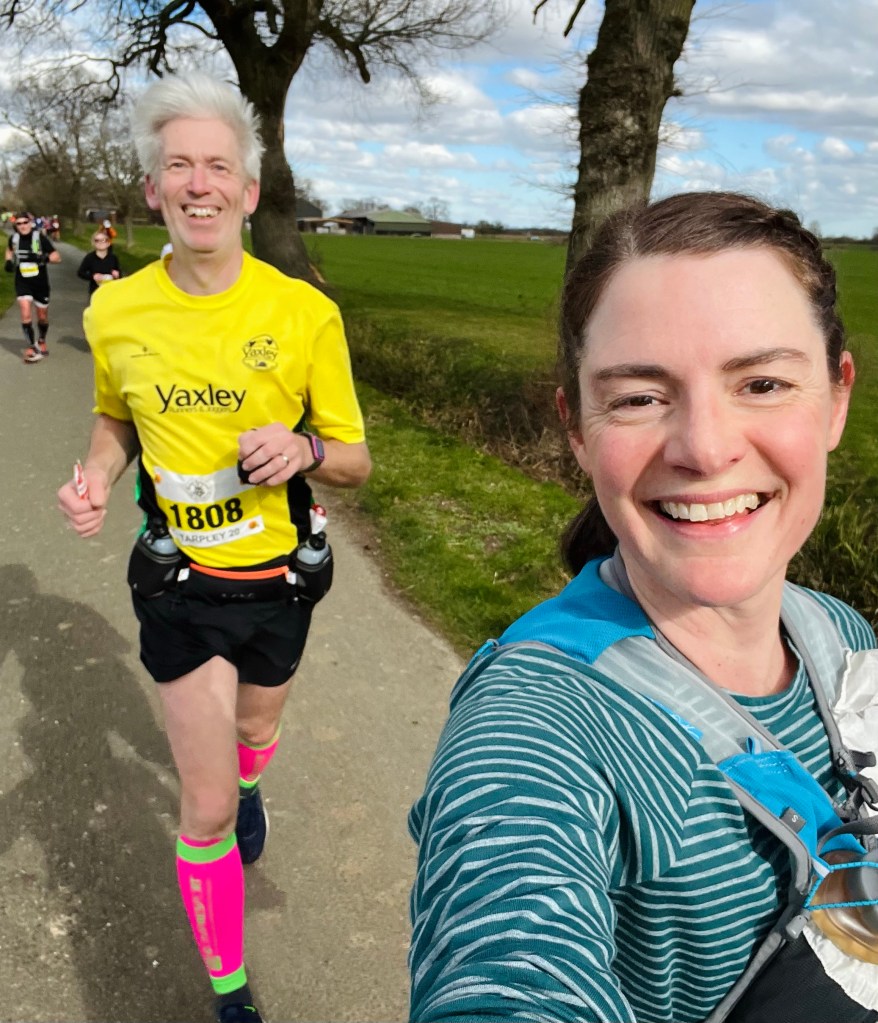
This is easy to say, but harder to stick to. Last weekend I ran a 20 mile race- the Tarpley 20 – as part of my marathon training. Before I joined a running club, I had never heard of anyone doing a race as a training run. Don’t these people realise that running is free? I would have said. But long races make for brilliant marathon training. They are locally run, reasonably priced and well supported. If you’re struggling to motivate yourself to cover 30k or 20 miles by yourself, pinning on a race number alongside 300 people who probably feel the same really helps.

The challenge with a training race, though, for anyone with a shred of competitiveness in their veins, is that it’s still a race. It’s really hard not to race a race. I should know, I’ve done it. At the Stamford 30k in 2022 I went too hard in driving rain and picked up a calf strain that ended my chances of running Brighton marathon. At the Oundle 20 in 2019, I got carried away with it being a club championship race and, looking back, put in a much better performance than I managed at Boston marathon four weeks later.

At the start line last Sunday, I could still feel the temptation. Before the race, to guard against this, I had told anyone who’d listen that I was going to take it slow. Even so, I found myself finishing my first mile in 8 minutes 17 seconds (AKA, this year’s goal marathon pace). Luckily, my brother in law caught up with me in mile two and asked me (in the nicest way) what the hell I was doing. Slowing down, I replied.

I did, and as a result, I really enjoyed the run, especially the last few miles. When I got to the finish, I not only felt I could run another 6.2 miles, I actually wanted to. I can honestly say I have never felt like that at the end of any race, ever.

I am not a coach, and I can only talk from my own experience, but I wouldn’t race – as in, properly race – anything longer than 10km in the run up to a marathon. If we’re tempted to push it harder for longer, we need to ask ourselves: what is the main goal? Is it to perform really well in the marathon, and get to it on top form and uninjured? Is it to perform really well in the club champs? Is it to boss the cross country season? Because we cannot do them all.

When it comes to your marathon, so many things about race day are uncertain. Focus on what you can control. Focus on the goal.

Don’t risk leaving your best race in training.

January: the month for taking motivation wherever we can find it

Speculoos & cream cheese: motivation in a biscuit

It’s getting near the end of January (hurrah!), and resolutions are fraying along with tempers. We are all hanging out for payday, for lighter days, and warmer weather. But running can’t wait, at least not for me. If I am going to run London marathon this year – and I think I am – I need to get out there now.

Usually I have a training plan, and use that to hold myself to account. But not this year. At least, not yet. I had so much time off running in late 2022 that I never got to build a good marathon running base. My past three months’ running still look like a rollercoaster with big dips for Covid and The Cold, and I haven’t strung together three weeks’ good mileage yet. Once I can do that, I will call it marathon training.

Running without a plan is tempting in the spring or summer, when just being outside is a delight. Right now, ploughing through the mud in -4, not having a plan is a big risk. With energy bills so high, my house is cold, and just getting changed into my running kit is the hardest part of going for a run.

January is the toughest month for running. It’s mad that this is time most people start training for their first marathon. And honestly, if nearly thirty years of running has taught me anything it’s this: find motivation wherever you can. Looking forward to a bath when you get home? Want to wear that new headband? Have to go to the post office? Want to see the seals in the River Nene? All reasons I have used to go for a run in the past two weeks.

The king of motivators – always – is the one I use least: running with other people. I run alone because it’s convenient, but also because there’s nobody else to worry about. Even when I’m running with friends and family I get anxious: am I talking too much? Too little? Am being boring? Am I going too fast? Too slow? I wish I could turn off these fears, because running with other people is brilliant. Time goes more quickly, I get to hear all the gossip, and – most importantly – I always turn up.

(p.s. I did not see the seals)

Mile Two, I Love You

I’m running, but I’m not fit. I mean, I’m fitter than someone who doesn’t run. But I’m not race fit. I mean, I could run a race, faster than some people, but not as fast as I want to run it. Okay, I am a bit fit. And the bit fit that I am, to be specific, is Mile Two Fit.

In Mile One, I am slow. Every run at the moment starts slow – this is the thing about being over 40, I have to start slowly no matter how many warm up exercises I’ve done in the hallway. My knees are creaking, my back is stiff, I’m shuffling my feet.

By Mile Two, I am ready to rock, ready to run, ready ready ready steady go baby! I feel great. I don’t even feel like I’m trying. My legs are turning over, my feet are bouncing, my breath is coming easy. I’m holding myself back and I’m still super fast. Can you even believe that mile split?!

By Mile Three the party’s winding down. I keep pushing the pace but it’s not easy now, it’s an effort. I have to concentrate on breathing, think about my stride, work hard to drive my knees forward and pick up my feet.

At Mile Four, it’s over, but I’m still moving, just about. I’ve already done 5k! Everything else is a bonus at this point. Mile Five is extra – if I slowed down enough in Mile Four I might get a second wind for half a mile. Mile Six is usually the last, so it’s fine to walk a bit of that.

Mile Two, I miss you. I want to live in that Mile Two feeling for the whole run. Mile two, I love you.

Do I seem like I’m marathon training to you?

img_6930Deciding to run a marathon is easy. Signing up to run a marathon is easy. Running a marathon… isn’t easy exactly, but at least it’s quick. The bit that really isn’t easy is every single day between signing up for a marathon and actually running it: the training.

The training is the hard bit. And training for a spring marathon is the hardest. It’s dark, it’s cold, I’ve been here before. This year feels harder though, and I’ve been trying to work out why. It’s not any darker and it’s a lot less cold in the UK this year. It is wetter and a whole lot windier, but it’s not the weather that’s the problem.

What is the problem, then? I am five weeks away from Peterborough marathon – my ninth – and I am still stuck knee deep in denial. I signed up late, after New Year. I dusted off last year’s training plan. I added on a few miles a week. I’ve done a handful of sessions. I’ve done some long runs, some races. It looks to the outside world like I’m putting the miles in: 45 a week. Fewer than many, but more than most. Not great, but not the problem either.

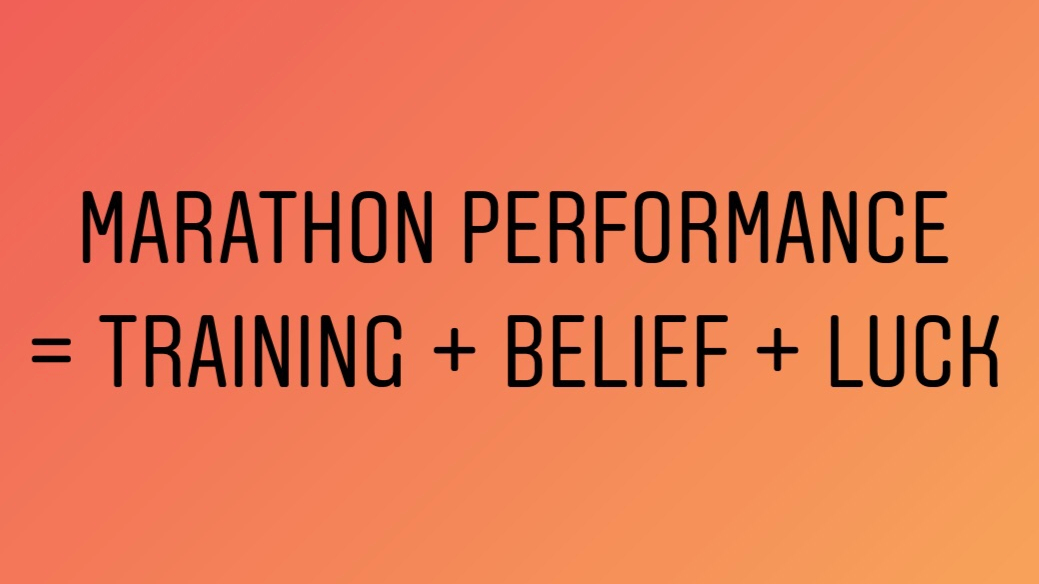
If marathon performance = training + belief + luck, is the problem lack of belief?  I’ve had some issues making my peace with getting slower, and a few weeks off with posterior tibial tendinitis in late summer knocked my confidence a bit. But that’s not it. I’m still dreaming of a 3:15 marathon. Not just dreaming, I still believe I can do it (not this year, obviously!) because that injury came after a summer of proper speed. A summer where I smashed my mile, 5k and 10k pbs even though I’m in my mid-forties.

So, it’s not the training or the belief. And I can’t do anything about the luck. The real problem this year is that… whisper it… running a marathon is just not that important.

Things that are more important than marathons this year: my daughter, my relationship, my family, my job, my friends, my colleagues, cross-country races, my sleep, cooking food, junior parkrun, a good book, NetFlix. Did I mention sleep?

I still love you, marathon, but I’m phoning it in this year and we both know it. Cross your fingers for a lot of luck on 5 April 2020.

Is it cold? Is it dark? Yes? Let’s train for a marathon!

CarinSleet

Marathon training in England in January is the worst.

It is dark from 4pm to 8am. It is cold. It is windy. Trails are muddy. Pavements icy. If you are really lucky you will catch some horizontal sleet in the face and feel like your scalp has been frozen and ripped off the back of your head like a bad wig.

Your running routes, which in the light are many and varied and fragrant and fascinating, winding through Nene Park and along cycle ways, over Castor hill and along the River Nene, have reduced to one: up and down the Oundle Road.

When the weather is like this, I recommend training for a marathon to really maximise that time outside. I would also recommend London, so that 16 weeks of training start exactly on 1 January 2018. And, if I were you, I would pick a training plan that aims for maximum mileage – none of this Run less, Run faster nonsense.

6 runs a week is what you need! What do you mean you don’t have time to do that because you have a full-time job in London and a 4 year old? Does your alarm not go off at 5am?

Once you’ve booked your place and written your training plan, erase it and start again because you need to fit it around the 5 cross-country races you said you’d run for Yaxley Runners on Sundays. Also, volunteering at junior parkrun. Also, all of your 4 year old’s friends’ birthday parties. Oh, and apparently your husband might occasionally want to leave the house. Some people are so selfish.

Now that your plan is written, the hard work is over. You really should think about fuel, though. This year, why not have an approach to nutrition which is not just ‘eat more chocolate and crisps’? And while you’re pondering that, maybe have a think about buying new trainers now rather than wearing all your existing ones down to thin rubber husks and buying 4 new pairs that don’t quite fit you 3 weeks before the race?

You are now sorted. Wait, I forgot, what about positive mental attitude? Repeat after me:

“Marathon training in England in January is the best!”

It took me two years to write this

I love running blogs. Love reading them. Love that they are hanging on to life in the age of 140 characters. Love that there’s a whole industry of fitness blogging* now. Particularly love all the female bloggers inspiring others to get involved.

I love running blogs, just not my own, apparently.

I stopped writing my blog for various reasons, a few of which were reasonable. It is hard to write about your running life without mentioning your young child, who may or may not want their little face and derring do shared with the world**. It is also hard to think of new and interesting things to say that people might want to read, whilst not writing about your young child.

I did not stop running! Of course I didn’t. I did have a miniature dalliance with crossfit – which is a whole other post – but the running continued.

I moved out of London, to Peterborough, a year ago and the running there is fantastic. Flat, completely and utterly pancake flat and devoid of anything even vaguely resembling a hill, but fantastic. From my house I can run loops of 3,4, 13, even 20 miles without seeing a car. The trails are empty. The woods full of birdsong. The air crystal clear.

So what am I doing on Sunday? The thing I said I would never do, running the sodding London marathon.

I turned 40. I realised that my Milton Keynes marathon time would qualify me for a Good for Age place. So, I leapt onto the bandwagon. I ditched the crossfit, bought a copy of the Hansons Marathon Method, and did a shed load of training.

I am ready.

Wish me luck!

IMG_1868

* I don’t love photos of people hugging protein powder jars. And I really don’t love people posting pictures of their abs accompanied by claims that body image isn’t important.

** the 23 people who read this blog.


How not to train for a marathon – have a baby and then get no sleep.

Dog

On this day in 2013, I had a baby. 2 hours before she was thrown onto my chest in the operating theatre, I had my first sleep for 3 days: 30 minutes of epidural-induced bliss.

Before Martha arrived, I was not a big sleeper. Never had more than 7 hours a night. Didn’t do lie-ins. Always up early. Fond of a night out.

Now? Sleep – oh, sleep, is the holy grail. The answer to any question. The solution to every problem.

At the beginning sleep is plentiful but sporadic. You all fall asleep at random times, in short bursts like Ellen Macarthur. You feel like Olympians trying to do a decathlon in the dark wearing wellies. Team spirit gets you through – “we can do this!” you croak to your partner as you pass in the hallway at 3am, handing off the baby like a baton. You watch a lot of box sets.

Slowly, progress is made. The baby sleeps for longer in one go. Unfortunately this long sleep starts at odd times, usually in the middle of dinner, and once you realise it’s happening, it’s half-way through. “Bed!” you yelp, abandoning the washing up to the cats and failing to brush your teeth for a week. The moment your head hits the pillow you are asleep.

Then, just as everything is getting better, everything goes wrong. The long sleep starts well, and sometimes lasts a bit longer, but it is fickle, oh so fickle. One night in two weeks she will sleep through the night. You, on the other hand, will still wake up every two hours. All the other nights she will wake up at the drop of a phone, or the clink of a belt buckle. “Why can’t you get changed in the bathroom?”, you will hiss at each other. The TV, like everything else, is now a distraction from feeding. Box-sets remain unwatched, possibly forever.

Slowly, real progress is made. Only now you know better than to talk about it, even to each other. Slightly more rested, you realise how tired you actually are. You go back to work and pretend to be a normal person. You drink a lot of coffee, but never after lunch, because then you lie awake after a 3am wake-up and know you are up for the day.

Running helps, up to a point. When you’re a little bit tired, exercise makes you less tired. It also helps you sleep well.

Not marathon training, though.

If I have learned one thing in the last year it is this: marathon training when you’re getting no sleep is a stupid idea.

I realise, looking back on old photos, that I was a MASSIVE SLEEPER. All I did during my previous marathon training periods, or possibly my life in general, was NAP. I loved naps. I had no idea how much I loved naps until it wasn’t possible to have any. There are so many photos of me asleep – on benches, in the garden, on the sofa – that either my husband is a somnophiliac or I took a whole lot of naps.

Sleep is important for athletes, and non-athletes who happen to be runners of marathons. It’s well known that Kenyan runners just eat, run and sleep. I have found time for the first two during this marathon training (well, mostly the first to be honest), but the third? Not so much.

On Monday I’m running the Milton Keynes marathon and I am worried. I’ve done (most of) the miles, but I really haven’t had the rest. Will I be able to run at anything like my target pace over 26.2 miles (8mins 15 secs per mile)? Will I be able to get to the start on time given that there are no direct trains from London (grr)? But mostly, will I get a full night’s sleep beforehand?

I will let you know.

On eating a whole baguette on the bus

The Marathon Hunger has set in.  I remember it vaguely from last time, but between then and now my body has been hopped up on fertility drugs, confused by pregnancy and baffled by breast feeding, so it has lost all sense of what normal hunger feels like.

On Friday I left the office at 12.30pm to work from home for the afternoon. On my way to the bus stop, I picked up a sandwich and some popcorn to eat at home as a Friday treat. Eating a shop-made sandwich at home is the height of decadence for a new parent.

By the time I got home I had eaten not only the sandwich and bag of popcorn, but also an entire baguette purchased at Waitrose on the Holloway Road, a supermarket I had no intension of visiting, and which involved crossing several roads to get to, then getting a different bus home. It pulled me in with its ‘aisles of wonder’ tractor beam. I wandered around in a food-fixated haze, unsure what would satisfy the intense need to stuff my face.

I felt so hungry, that afterwards I started to worry that I might be pregnant again, even though it is a medical impossibility. After eating the baguette, I still wasn’t full. Mitigating my gluttony shame, I can at least say that I did not also eat the cinnamon bun purchased in addition to the baguette. It stayed in the bread bin as a reminder of my secret carbohydrate festival until Sunday morning when I scoffed it after my long run.

I suspect some of this carb craving could be averted by eating more protein, but protein is expensive and bread is cheap as chips. And nuts are all very well, but only when covered in chocolate and packaged by Cadbury.