Play Misty For Me

I get excited when the overnight temperature on the weather app drops to single figures, but the days are still warm. On a clear night, mist will rise from the river and spread its cold fingers over the water meadows, leaving wisps of cloud floating over the lake. As the first rays of sun peep over the horizon, the mist disappears like a magic trick.

Sunrise was at 6:36am, and I didn’t want to run in the dark, but I did want to be by the river at first light. I set my alarm for 5:35am. I know it’s mad, but this doesn’t feel early any more. In lockdown, I became obsessed with running before anyone else was up, and as the days got longer, my alarms got earlier.

I had a coffee but didn’t eat breakfast. I did my usual activation exercises. Ten years ago I would have thought this too was mad: who would sacrifice 30 minutes of sleep for a coffee and some squats? But ten years ago I could have sprinted in heels. Now I have to warm up just to walk downstairs.

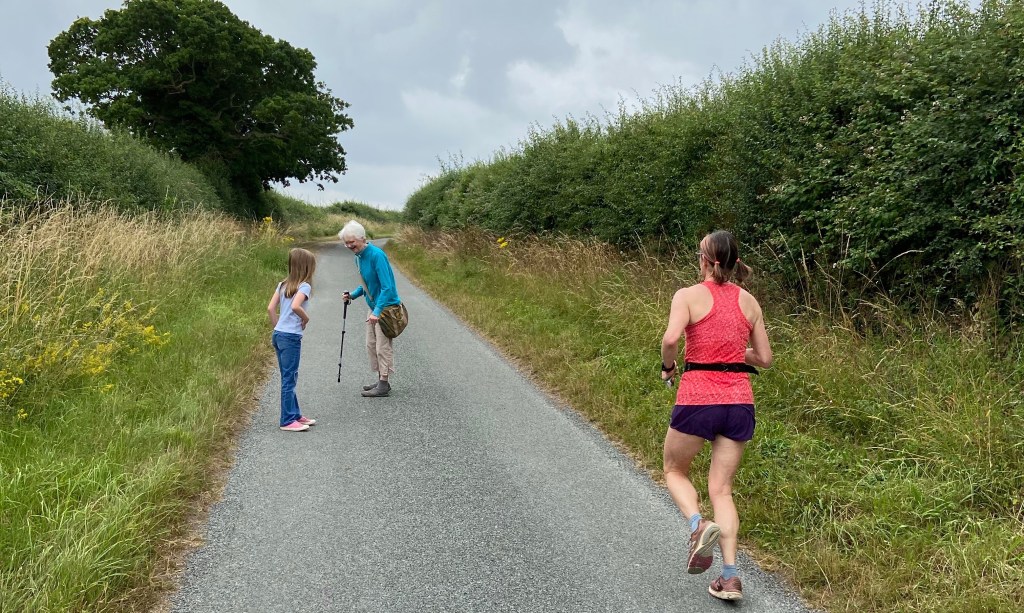
I jogged through the estate in the twilight, crossing the railway tracks and the weir before I saw another person. Three women in hijabs, who I sometimes see at this hour, said good morning as they ran past me on the bridge.

Taking the river path, I could feel the mist cold in my nostrils, and damp on my arms and legs. Over the footbridge and into Ferry Meadows, the sun was up and the pale light turned briefly orange. Over the lake, the sky was settling into blue, and terns wheeled and skimmed the surface. A heron sat hunched on a buoy in the middle of the lake and invisible fish rippled the water from below.

I felt completely free to enjoy this run. It’s the second Friday after school started, my parents are away, I don’t have to work, and it’s the first Friday in a few months where I can put myself first. I didn’t have to do the school drop off. I didn’t have to run fast, or far. Still, I had a goal. Every run has a purpose. Sometimes you set it, sometimes it’s set for you, and sometimes you learn it afterwards.

Today, I ran to drink in the beauty. I don’t care if this sounds naff because it isn’t. I learned that in lockdown too.

Mile Two, I Love You

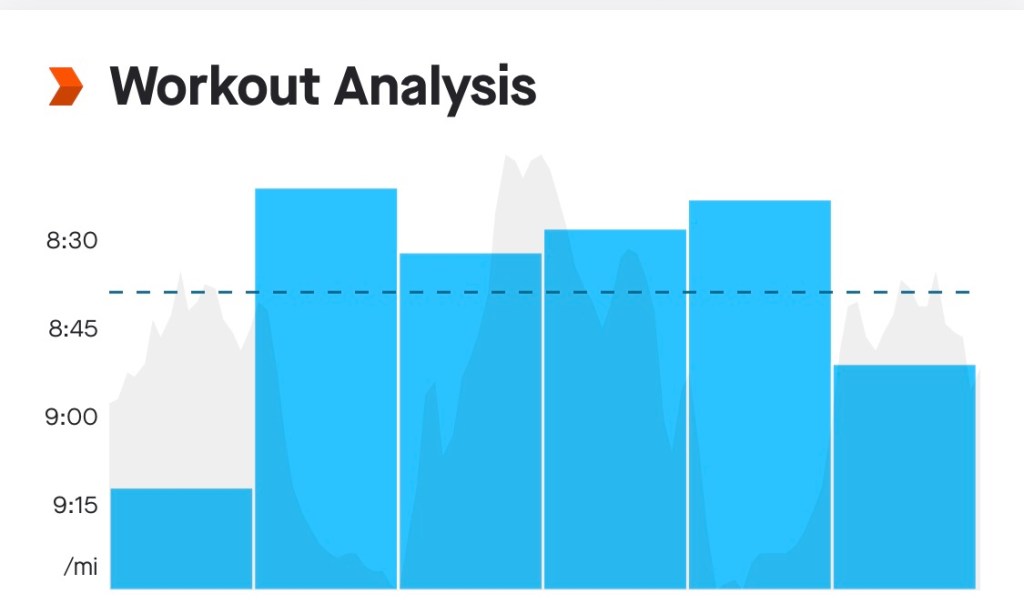
I’m running, but I’m not fit. I mean, I’m fitter than someone who doesn’t run. But I’m not race fit. I mean, I could run a race, faster than some people, but not as fast as I want to run it. Okay, I am a bit fit. And the bit fit that I am, to be specific, is Mile Two Fit.

In Mile One, I am slow. Every run at the moment starts slow – this is the thing about being over 40, I have to start slowly no matter how many warm up exercises I’ve done in the hallway. My knees are creaking, my back is stiff, I’m shuffling my feet.

By Mile Two, I am ready to rock, ready to run, ready ready ready steady go baby! I feel great. I don’t even feel like I’m trying. My legs are turning over, my feet are bouncing, my breath is coming easy. I’m holding myself back and I’m still super fast. Can you even believe that mile split?!

By Mile Three the party’s winding down. I keep pushing the pace but it’s not easy now, it’s an effort. I have to concentrate on breathing, think about my stride, work hard to drive my knees forward and pick up my feet.

At Mile Four, it’s over, but I’m still moving, just about. I’ve already done 5k! Everything else is a bonus at this point. Mile Five is extra – if I slowed down enough in Mile Four I might get a second wind for half a mile. Mile Six is usually the last, so it’s fine to walk a bit of that.

Mile Two, I miss you. I want to live in that Mile Two feeling for the whole run. Mile two, I love you.

Racing in a vaccinated world – it’s time to get out there again

Perspective is an odd thing. When parkrun were pushing for a return in England in September 2020 it felt too soon, and that turned out to be correct. I didn’t want to be Run Director responsible for a junior parkrun event when cases in Peterborough were rising and a friend or family member of a volunteer could potentially catch COVID and die as a result. Back then there were 10 new cases in P-town every day (about 36 per 100,000 people). This week, the rate is ten times higher – 360 per 100,000 people, and yet I’ve been happily running and volunteering at parkrun and junior parkrun for a few weeks now.

It’s obvious what’s changed. I am vaccinated, along with most “at risk” older and vulnerable people in the UK (though maybe not in Peteborough?). And vaccination is preventing severe illness and death. But coming back to racing and parkrun is still something I’m getting used to, and I wanted to write down how I’m feeling so that, in a year’s time, I can look back at this as Captain Hindsight and point out all the things I got wrong. Or hopefully not! Anyway:

Running outside with other people now feels safer

Remember in the early days of COVID when we weren’t sure whether we should even be outside at all? People in my local facebook group warned of particles of virus floating about like giant snowflakes in the air, and complained about joggers – our dangerous breath and sweat and snot and spit. I wore a buff for my runs and raised it over my nose and mouth when I passed people, but that didn’t stop them looking scared and moving away.

To be honest, I still hold my breath when I pass someone on a narrow path. Maybe I’ll always do it? But I know that outside transmission is much less likely, and as long as I’m not stuck running one metre behind the same person for 15 minutes, I feel comfortable.

I think COVID has made us more considerate runners. I will happily miss out on high fives if it means never being accidentally spat on or elbowed out of the way in a race, thank you very much. And as for the man I once saw sitting on a cafe chair in his sweaty pants merrily changing his trousers after parkrun, some things are best left behind.

I am ready to run a bit faster

When races started coming back in England, I was unfit, unhappy, and unready to race. Running saved my life hundreds of times over the past 18 months, but walking was also a big part of that and, for me, walking and racing don’t mix. Over the summer, many of my friends and family have been marathon training (and running! Shout out to Chris conquering the terrifyingly hilly Bath marathon) and inevitably I got fomo and signed up for a race.

I wanted to start with a race I would love, so I chose my favourite distance – a half marathon – and my favourite format – rolling country lanes. The Wissey Half Marathon takes place in “the idyllic Norfolk countryside, starting and finishing in the historic village of Oxborough”. It is advertised as fast and flat, but I wasn’t looking for a pb. I just wanted to enjoy it and push myself a tiny bit in the run-up and on the day.

I didn’t do much specific training. I was already running 30-35 miles a week, including a long run at the weekend. I did introduce a tiny bit of speed and hill work and what little I did, I enjoyed. I used David Roche’s 6 week re-introduction to speed and enjoyed the power hill strides, though finding an actual hill for them in Peterborough was the hardest bit!

I remember why I love races

After a month of grey skies and 18 degree damp, 5th September was of course warm and sunny. It was a perfect day for a picnic in the park, less perfect for racing 13.1 miles. On the car journey to Norfolk, I was surprised to find that I didn’t care. I was happy to slow down if I needed to, delighted to look at the views, and excited to get out in the countryside. I ran 11 of the 13 miles with a huge grin on my face, and yes the grin turned to a slight grimace in the last two, but we can gloss over that. My target was 8 minute miles, and I made it: 1 hour and 43 minutes on the clock, 12 minutes slower than my best, but I felt like I’d won.

I loved everything about the race: the parking on the village green; every single runner saying hello as we walked to the start; the terrible instant coffee in the village hall; fields of sunflowers either side of the road; rolling fields and combine harvesters; tractors waiting for the runners to pass; friendly marshals and their kids helping out; chats with fellow runners. My favourite moment was about 5 miles in: I was running with an older man who was run/walking (fast!) and we passed a “public footpath” sign pointing the way to a smooth grassy path along the side of a field, heading over a hill into the distance. “I wonder where that goes?” we both asked, in unison.

It’s great to be out there again.

Confession time: I got some personal bests

Well, this is awkward. It took me a couple of years to write about facing up to a future of no more personal bests. “Personal bests are temporary, running is forever”, I wrote, waxing philosophical.

But… it turns out I could get another personal best. And, um, not just one. In May, three weeks after Boston marathon, I knocked over a minute off my 10k time at Langtoft Road Run. I love this race. Flat country lanes, wisteria clad cottages, and the weather was ideal: cloudy and cool. My legs felt rested and the pace (6:45 minutes a mile) felt just the right side of too hard. Nothing really hurt until the last mile and then there was NO WAY I was slowing down and letting it go. A pb! My first personal best since joining Yaxley Runners in 2016.

New 10k pb: 41:38

img_6126-1
PB Face

10 days after Langtoft, we met at the track on a warm Wednesday evening for the club’s annual Timed Mile. A love/hate affair involving no dinner, pre-race terror and a post-effort cough that lasts all night. It was worth it, as I went sub- 6 minutes for one mile on the track for the first time. Thank god that’s over for another year.

New mile pb: 5:57

Three weeks later in Ferry Meadows, I turned up to the first race of the Peterborough Grand Prix 5km series, interested to see what would happen. It was busy, and I was carried along by faster men and women for a kilometre before actually deciding to go for the sub-20. I’ve been there many, many times before, and failed. This time it felt possible. I had a moment of fear and a flicker of feeling I didn’t want to try. But then, belief! I was going to do it. The struggle in the last kilometre was real, but I forced my legs to keep turning over, kept counting to 60 (my last resort mental trick) and forced myself to sprint for the line.

New 5k pb: 19:54

This old girl, it seems, is on fire. The question is, why?

Is it my Boston marathon training kicking in too late? Is it a bit more hill training? Is it the handful of track sessions I’ve done? Is it consistent mileage? Is it pilates? Is it self-belief? Is it the cooler weather this summer?

I think it’s all of these things combined. My only epiphany during this purple patch is this: you won’t get faster by pushing harder during races if the pace feels hard, you’ll only get faster when that pace feels easier. You’ve got to put in the work to make it feel easy.

Is it wrong to compare your running to other people’s?

“Comparison is the thief of joy. Run your own race. Don’t compare yourself to others, compare yourself to the person you were yesterday.”

Every fitness programme, every inspirational quote on instagram, every ‘brand ambassador’ for every sport agrees: if you want to be happy, stop judging yourself by others’ progress, and keep your mind on yourself (#runhappy!).

To which I say, I have tried. I really have tried. But it’s impossible. And, maybe, it’s not healthy.

It’s important to have role models

Deena Kastor said of Paula Radcliffe in 2009 that “She makes great decisions. I don’t feel bad comparing myself to her as I believe all marathon athletes do because she’s the ultimate woman in the sport. She’s got the world record by an extraordinary amount and so it’s safe and healthy for all of us to compare ourselves in this sport to look up to her. ”

We know how fast Mo Farah or Paula Radcliffe can run. And if we run ourselves, we know where we rank compared to them, i.e. in a galaxy far, far away. We will never be the fastest in the world. And this is not depressing, because we also know that we will never be the slowest.

Every runner was once a worse runner

Unless you started competing at running aged 5, you probably once struggled to run down the street without coughing up a lung.  No matter how many breaks from running you take through injury or apathy, you will (hopefully) never find running that hard again.

I know we’re all getting older, and looking at my dad panting through a parkrun at 73, running into old age doesn’t look exactly easy. But I still think it will never be as hard as it was at the start, because we will already know we can do it.

Running is a physical struggle that takes place in your head. Every run is a battle of When Can I Stop? versus I Will Keep Going. And every time I Will wins, it makes it a tiny bit easier for I Will to win again.
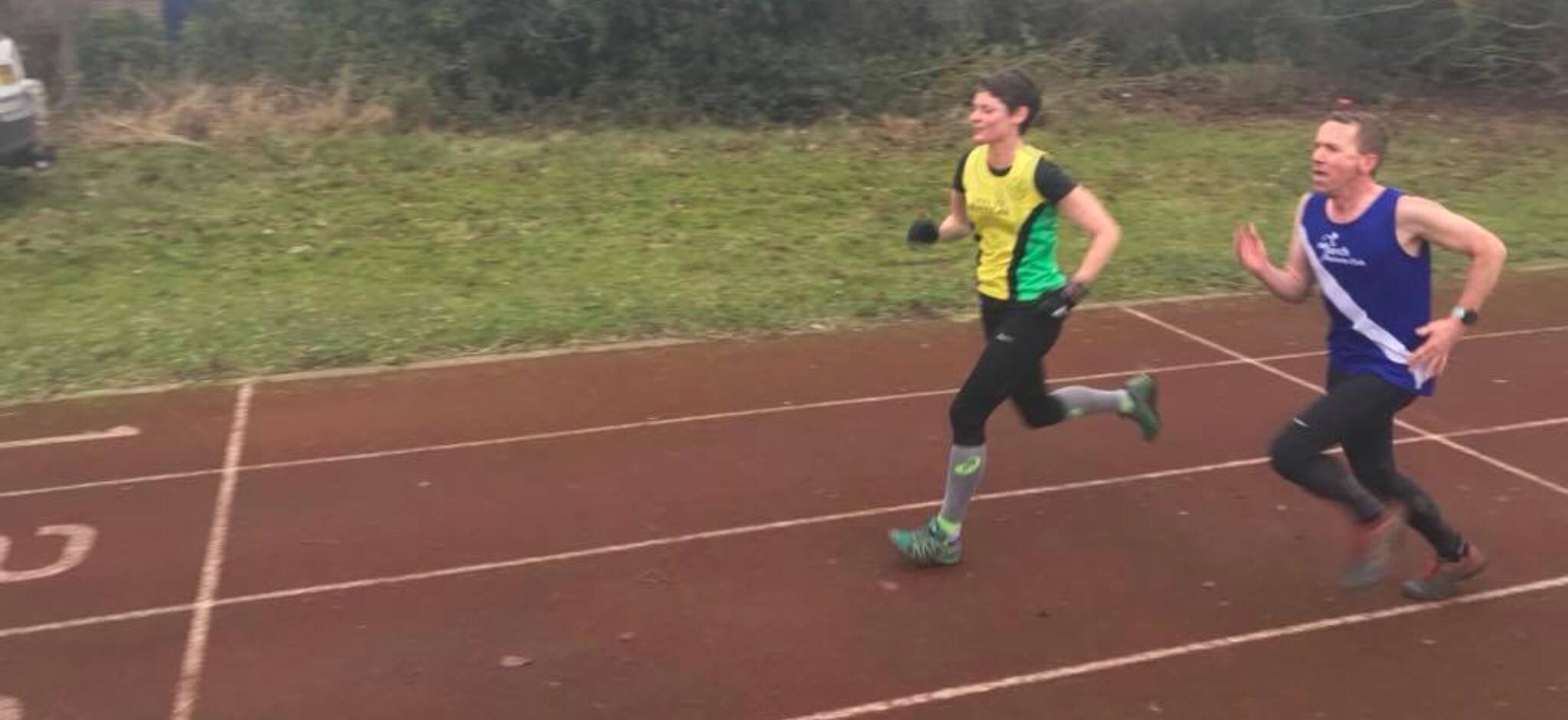


Running with others is more fun

When I started running, I did it by myself. I wanted to huff and puff and huff and walk a bit and run a bit and walk a bit and then die alone.  All alone. Smartphones did not exist in 1994, so there was no thought of sharing my progress with others.

I am a selfish runner. I run to give myself time to think, time not to think, time to be outside and enjoy the seasons, to see birds and flowers and trees and views. To get fit and stay healthy, to stay sane. To have time away from my family (sorry).

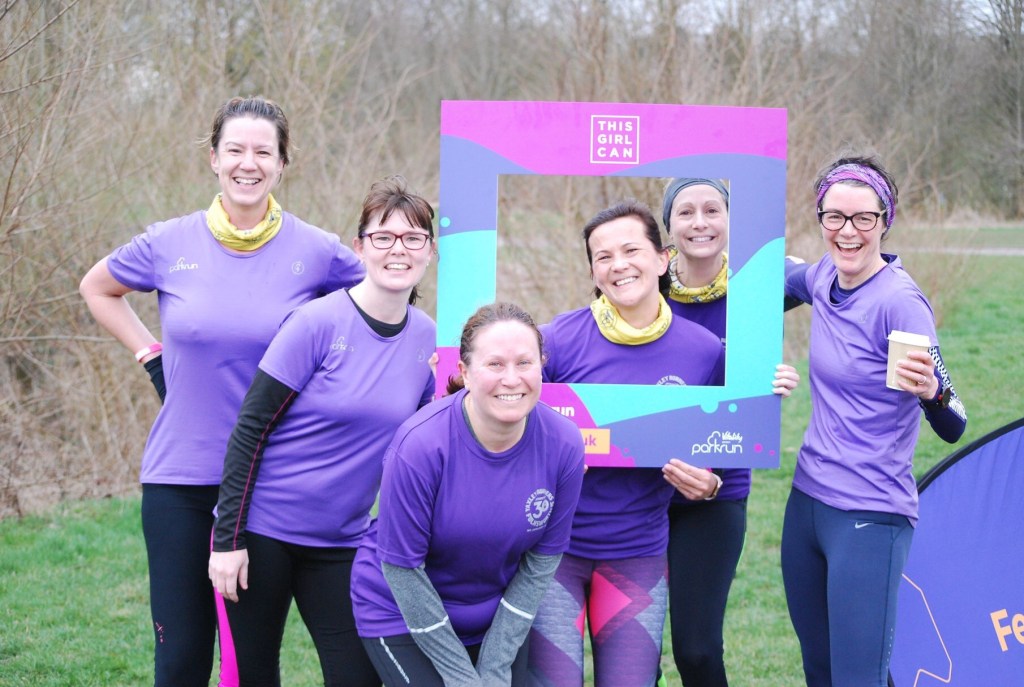
I ran alone for 22 years. At the Great Eastern Run in 2016, I watched all the other women in the queue for the loo laughing and chatting to each other while I waited, dealing with my pre-race nerves alone. They were all wearing club vests. I knew I was missing out on something.

Before I joined a running club, I had never entered a race just for fun. I would never have signed up for a 5-mile cross country race, let alone 6 of them in one season. And if I hadn’t, I would never have known how my post-race low could be totally eclipsed by the high of finding out the team triumphed, despite my performance.
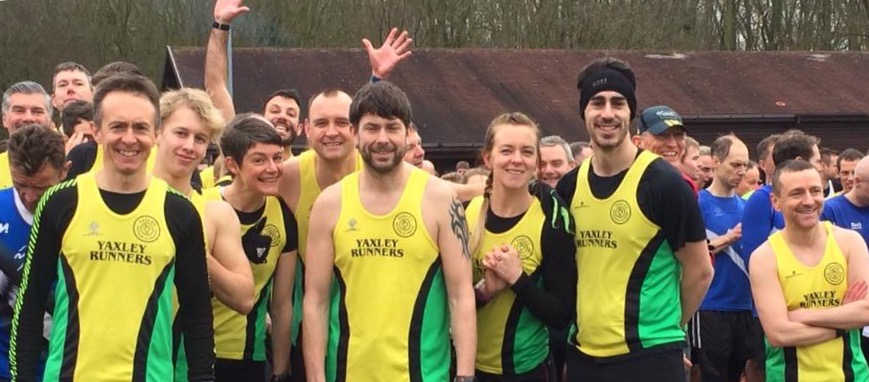


Running your own race is a myth

Running with – and against – other people isn’t just more fun. It makes us better runners. According to research carried out in 1968 at the University of California-Berkeley, running your own race is a myth. We run faster in a pack, and are “fooling ourselves” if we think that we can run as hard alone as we would against others.

Competition does not have to be unhealthy. This profile of Shalane Flanagan, winner of the 2017 New York Marathon, shows that it is possible to be both competitive with and supportive of other runners.

“We usually see competitive women, particularly athletically excellent women, only in one of two ways: either competing to defeat one another, or all about team over self. But that’s a flawed, limiting paradigm. The Shalane Effect dismantles it: She is extraordinarily competitive, but not petty; team-oriented, but not deferential. Elevating other women is actually an act of self-interest: It’s not so lonely at the top if you bring others along.”

The Strava Effect 


So if comparing your running to others’ gives you something to aim for, is more fun than running alone and makes you faster, why am I writing this? And why are there so many internet memes telling us to stop comparing ourselves to others?

Because of the internet!

It has never been so easy to track your performance, and compare it to your friend’s, that guy who always beats you, and your nearest Olympian’s. You don’t have to go to the track and study the split times, or wait for race results to come out in the newspaper. If you choose to, and most of us do, you can record your every move, upload it to Strava and share it on facebook before you’ve even finished stretching.

If it’s easy to share your own running, it’s almost impossible to avoid other people’s. Fitness boasts are everywhere, and I should know, I make them every week on my instagram. They make me feel good, but what if they make any other people feel bad?

One Sunday, I had just got back from one of those brilliant runs – where the sun is shining, you feel good and every step is a delight. It wasn’t a fast one – a proper long slow run that I really enjoyed. I was feeling on top of the world, logged the run on Strava and then up popped an almost identical run by a runner who is a similar speed to me – but she had run it 1 minute per mile faster.

Immediately I felt deflated. I could have run faster. Should I have run faster?

Know your limits

I should not have run faster! And I should not have felt deflated, looking at Strava that day. I should have been proud of my run, acknowledged that it was slower for a good reason, and felt happy for my friend. In a moment of strength, I would have done that. But I was feeling weak, so instead I unfollowed her on Strava and felt doubly bad – both for comparing myself to her and for not being able to ‘cope’ with how it made me feel.

Sometimes, you eat the bar, and sometimes the bar eats you. If you’re feeling good, and want to be inspired by others’ running, find new routes or just see what your friends are up to, pick up your phone and knock yourself out (not literally).

If you’re not, switch it off for a bit.

There are not two ideal approaches when it comes to comparing yourself to others: one zen like state where you only care about your own performance and don’t notice other people; and one where you know exactly where you fit but it only brings you joy. There is only one, human, approach: which one day brings you joy and the next day brings you down.

It is not wrong to compare your running to other people’s. It is just natural. Embrace it.

Mmm Bop! Running London the Hansons way

Gina marathon

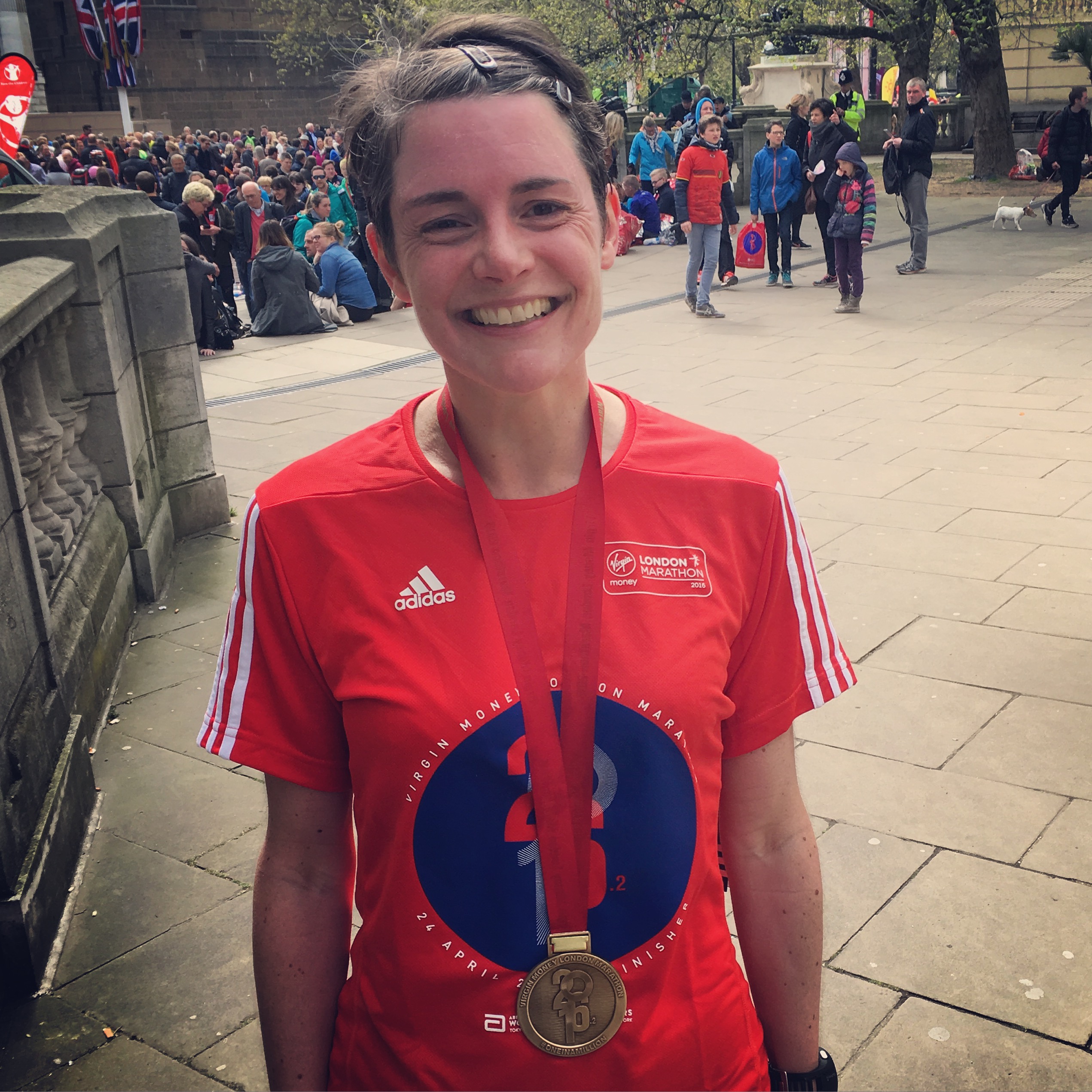
I turned 40 last year and yesterday I ran the 2016 London Marathon in 3 hours, 18 minutes and 3 seconds! This is a 10 minute personal best.  Can you tell that I’m happy?

I never thought I would run London. The huge crowds of runners at the start have always terrified me. But I had the chance to go for a ‘Good for Age’ place (starting at the much smaller Green start), so I took the backhanded compliment and went for it.

Things I loved:

  • Tower Bridge!
  • The energy of the crowds at Greenwich, Canary Wharf and especially Lower Thames Street. It really did make me run faster and feel better.
  • The comedy signs.  “If Trump can run for president you can do this” (at least 2), “If Leicester can win the league you can do this”, “Wave if you’re not wearing underwear”, and my favourite: “Touch here for Power”. Good work.
  • The music. All the drummers! When someone played Prince! The awesome noise at Run Dem Crew! And best of all the rave tunnel just before 24 miles. Next year they need strobes.

Things I didn’t:

  • Kids wearing surgical gloves wanting high fives – parents, chill out
  • The first 4 miles

The thing I forgot about:

Marathons are hard.

The Hansons Marathon Method dictates not running more than 16 miles at a time, which meant that the long runs were some of my easiest training runs. The tempo runs, maxing out at 10 miles, were harder.

26.2 miles, at tempo running pace, was the hardest. All the training (I averaged 50 miles a week) will do a lot, but it won’t run the race for you. All the work on the day still has to be done, and done by you.

The worst bit by far was the first 4 miles. It was impossible to find my pace in the crowd, dodging other runners, traffic islands, speed bumps, kerbs, water bottles, discarded clothes. I knew I needed to slow down but I couldn’t make myself do it. The need to get to the last 10 miles, just to find out if I could cope, was overwhelming.

Once past half way I got my confidence back. My splits were even, I wasn’t going to blow up. By 19 miles the wheels were definitely staying on. It was tough – my feet hurt a LOT – but what can you do? After 21 miles I stopped thinking about finish times and just concentrated on maintaining pace for that mile. At 23 miles I knew I could do it. At 25 miles I started the push. At 800 metres to go I started sprinting for the line. At 600 metres to go I stopped sprinting because that was insane, and enjoyed my coast to the finish.

I’m so glad I did it. I’m even more glad I’ve done it. I don’t think I’ll do it again?

The thing I’m most proud of:

Check out my splits!

Marathon chart


It took me two years to write this

I love running blogs. Love reading them. Love that they are hanging on to life in the age of 140 characters. Love that there’s a whole industry of fitness blogging* now. Particularly love all the female bloggers inspiring others to get involved.

I love running blogs, just not my own, apparently.

I stopped writing my blog for various reasons, a few of which were reasonable. It is hard to write about your running life without mentioning your young child, who may or may not want their little face and derring do shared with the world**. It is also hard to think of new and interesting things to say that people might want to read, whilst not writing about your young child.

I did not stop running! Of course I didn’t. I did have a miniature dalliance with crossfit – which is a whole other post – but the running continued.

I moved out of London, to Peterborough, a year ago and the running there is fantastic. Flat, completely and utterly pancake flat and devoid of anything even vaguely resembling a hill, but fantastic. From my house I can run loops of 3,4, 13, even 20 miles without seeing a car. The trails are empty. The woods full of birdsong. The air crystal clear.

So what am I doing on Sunday? The thing I said I would never do, running the sodding London marathon.

I turned 40. I realised that my Milton Keynes marathon time would qualify me for a Good for Age place. So, I leapt onto the bandwagon. I ditched the crossfit, bought a copy of the Hansons Marathon Method, and did a shed load of training.

I am ready.

Wish me luck!

IMG_1868

* I don’t love photos of people hugging protein powder jars. And I really don’t love people posting pictures of their abs accompanied by claims that body image isn’t important.

** the 23 people who read this blog.


How to run a 10k race and actually enjoy it

10k is my nemesis distance. Too long to be short, too short to be long; it’s running kryptonite.

This is one reason why I haven’t attempted a 10k race since September 2011, the others being 2) pregnancy, c) wine.

On Sunday our friend Brian was staying for the weekend and we decided to run one of the Regent’s Park Summer 10k series  – you can just turn up 15 minutes before the start, pay your £16, tie on your timing chip and off you go. Spontaneity is not usually my middle name, but in this case I think not booking in advance gave me some psychological advantages: I didn’t obsess about it beforehand, I didn’t really* train for it, and I didn’t have a pace in mind. There were no hopes to be dashed – I was just going to turn up, give it a go and see what happened.

What happened? Some flippin’ excellent things! I paced it sensibly, ran a negative split, and got a new pb of 43:04. Best of all, I didn’t even feel like death at the end so there is room for improvement.

Now that the race is over and I no longer need them, I have come up with some useful tips on how to run a 10k.

1. START SLOWLY

The Regent’s Park 10k is a 3 lap course, which I have previously found to be soul destroying, but this time I used it to my advantage. Rather than starting at maximum pace and trying in vain to get faster each lap, I started at a pace that felt way too slow and really did get faster each lap. Aiming for a 45 minute finish, I actually came in a lot quicker as I felt so good in the second and third laps.

2. STRUGGLING? SLOW DOWN

I wasn’t aiming for a pb so I tried a crazy thing: actually enjoying the race. Every time I started to feel uncomfortable in the lungs, legs or stomach, I slowed down a bit because I didn’t want to feel like that. Then, once I felt better, I found I sped back up to pace without really trying.

3. GET TACTICAL

The Regent’s Park course is billed as “flat”, but really it has a couple of slight inclines and declines which shouldn’t be ignored. If you try to run them all at the same pace, your perception of how hard you’re working gets skewed and you end up ruining yourself. Slow down a bit on every incline, and you will reap the rewards on the downhills.

4. SAVE IT FOR THE END

This is a version of 1. Pick a point at which you are willing to give it everything and save your heroics for then. I picked 8k, but it ended up being 9k, then really just the final straight. Things do even out in the end, though. I used to peg it for one lap, die in the second and end up jogging it in. How much better to end on a sprint finish in front of your husband and child?

Like any tips, these seem really obvious. But, given that I’ve managed 20 years of running without following them, I hope they’re worth sharing.

* Ok, I have done some training, but nothing specifically 10k focused other than two interval sessions during which I nearly threw up. (6 x 800m with 1.5 minute recoveries, pain fans)

photo 3
Me, daughter and 38 minute 10k-er Brian post-race. Plus plastic cup.

Underpass, Overpass: Milton Keynes Marathon 2014 Race Report

Image

Behold! Warrior woman, striding it home in 3hours 41 minutes at yesterday’s Milton Keynes Marathon, with a grazed knee but a big smile. How strong I look! How fresh!

I love this picture, taken by my sister who so brilliantly came to see me at the end of the race. I love it even though it is a massive lie.

The thing about a stadium finish, I discovered, is that it forces you to (MK) don your gameface and power home like Paula. This is a good thing, but the scene in the Arena, behind the stadium, was the true face of marathon running. Everywhere runners were prostrate in exhaustion and pain. The St John’s Ambulance medics were running out of chairs. There was a distinct whiff of vomit.

My sister and her boyfriend found me on one of the chairs having a piece of metal prised out of my knee. The St John’s medic was keen to know if it hurt. “Hurt?” I said, “compared to the race, no, it does not hurt. At all.”

I fell over at some point in the last six miles of the race. Where, I could not say. It was a bit embarrassing, spinning onto my back whilst cornering one of Milton Keynes’ 96,000 roundabouts, but my main feeling was one of relief not to be running for 10 seconds. That and appreciation for the blood now dripping down my leg. A war wound!

This race is an odd one. A city marathon that starts on empty dual carriageways, as if the zombie apocalypse had left only an army of runners on the streets, it then has a long succession of cycle paths with one child and his gran waving you on, before heading towards IKEA and ending up in a proper stadium. It has many out and backs – oh, so many out and backs – where you are cruelly faced with other runners who look better and faster and, most importantly, nearer the finish than you. In a mean piece of planning, most of the out and back sections are down and up the same hill.

This section destroyed my pacing. I wasn’t wearing headphones, so couldn’t hear the Strava lady giving splits and had to rely on my poor maths to work out mile times. I thought I was doing ok on 3:35 pace (and in fact I was) until I got overtaken by the 3:45 pacer group at 7 miles. This really threw me. I put in a couple of sub-8 minute miles over an uphill section. I shook off the 3:45 pacer but sweat was now stinging my eyes – it was too warm for heroics, and I would pay for them.

I enjoyed the race after the half-marathoners disappeared at 11 miles, but I knew pain was on the way. At 19 miles everything started to hurt: stomach, knees, quads, neck (neck?!). I promised myself to slow down but never never walk. Even on sharp underpass inclines (of which there were about 937) I ran the slowest I possibly could without walking. At one point I felt like the only person who wasn’t, it was really surprising, and I think the weather and course must have been to blame. I didn’t do it to prove anything to anyone, but because once I started walking I wouldn’t be able to start running again.

So, I went from 8:15 miles to 9:30 miles, but I made it home before that bloody 3:45 pacer.

The good thing about competing against yourself, is that you always win

??????????????

When we were little, my dad was the King of Competitiveness. Racing us up the street, he would hang back until just before the kerb and then pull a Mo Farah and beat us to the pavement at the last minute. When playing cards, he always used his superior skill to trounce our measly efforts and, when he couldn’t, he cheated. He hated games of chance. “There’s no skill involved!”, he would moan, as our tiny hands won at snap.

I say all this with affection. Never has there been a lovelier man, but the thing that he loves most of all is to win. He used to have a duffel bag full of trophies which we occasionally emptied onto the bed, practising our Oscar acceptance speeches with the one for ‘G Flight Darts Champion, 1979’. The man had a trophy for every sport: football, cross-country, boxing, ice hockey (ice hockey!), squash, cricket. There was nothing he couldn’t win at.

I have inherited this competitiveness gene. My daughter is still too little for me to test it in full – about the same age as me in the photo – but I suspect my turn to cheat at Hungry Hippos may not be far off.

On the whole, I’m grateful. You say competitiveness; I say caring. For what is the point of playing a game of cards if you don’t care who wins? Non-competitive people make very dull playing companions. They forget who is dealing. “Who is next?”, they ask time and again, “what’s trumps?”, “oh, does that mean I win?”. ARgh.

Sometimes, though, I will admit that it is not a blessing. The desire to beat your personal best running times can be a great motivator, but it cannot be switched off. In Spring 2012 I ran a marathon in 3 hours 28 minutes. In Spring 2013 I had a baby. In Spring 2014 I’m running  another marathon, and I have just had to accept that I should not attempt to better my best.

A small voice inside, even now, is still saying “really? Why not??!!”, but it must be ignored. On Saturday I ran what my training plan called a “half marathon race” and what in reality was a steady 13.1 miles. I completed it in 1h 43 minutes. Not bad, if you ignore the fact that it nearly killed me. The thought of doing that, at that speed, twice, is unimaginable. I could try it, but I would surely fail. If I tried to run the Milton Keynes marathon in 8 minute miles I could possibly manage 15, maybe 20 miles,  before blowing up like a pulverised balloon at my daughter’s first birthday party. For the first time, my desire not to do this is stronger than my desire to win.

So, my new goal: finish in 3 hours 45 minutes and ENJOY THE RACE. Still a bit competitive, obviously. I’m not giving up who I am, after all.

Weekly stats:

Monday: rest
Tuesday: 6 miles with 200m bursts
Wednesday: rest
Thursday: 7 miles with hill reps
Friday: 4.5 miles easy
Saturday: 13.1 miles “race”
Sunday: 4 miles recovery run

Total: 34.5 miles