It’s a new year, and nine months since experiencing knee pain, that’s now morphed into foot and hip pain. Soon it will be a year since I last raced.
If I leave a day or two between runs I can manage 2-3 miles of jogging without pain. Sometimes 4. Sometimes 1. For most people this wouldn’t be an issue. I can walk, cycle, swim, and work out, without pain. For me – a person who has run 5+ times a every week, for 30 years – it’s life altering.
Now that I can’t do it, and I can’t see a clear path to doing it again, I realise how much running defines me. I knew this. But now I really see it. I see how it shapes me, how it comforts me. It stops me from being an absolute arsehole to my family.
To stop this, I’ve been trying to understand all the feelings I get from running, to see if I can find them elsewhere:
Endorphins – the high from getting out of breath, and pushing my body, especially on a long run.
Peace of mind and alone time – when no-one knows where I am, and even I am not sure where I’m going next.
Connection to nature – seeing the skies, plants, animals, and birds change with the seasons.
A shift in mood – the answer to that feeling of unease, when I don’t know what’s wrong or what to do about it.
Fitness and good health – strong heart, strong lungs, strong legs.
Self worth and a feeling of achievement – the big goals that sit in the back of my mind, and the little ones that can be ticked off on every run.
Motivation and self belief – I thought it took motivation to get out and run; turns out running gave me motivation to tackle the rest of my life.
I have found some of these through walking, swimming or workouts. But only one or two at a time.
Physio exercises: I am doing them; I hate them; they’re working. It’s been ten weeks since my second trip to the physio (this injury cycle) and I’m finally ready to jinx it by writing this. My knees are not fixed, my rage is getting a regular workout, but… I’m running.
Nothing is more revealing of how pathetic it is to be human than a page of simple physio exercises, sitting unopened in your inbox, silently shaming you. Why is it so hard to take a few minutes for tiny stretches or little calf raises we can do while watching tv?
I wouldn’t know, because my physio exercises are not those kind of exercises. They’re the kind of exercises that take me as long as a five mile run, and make me nearly as sweaty. Four times four sets of twelve (split squats, hamstring walk outs, squat jumps, hamstring curls on a swiss ball). With weights. With rest between. With plyometrics now added. Plus skipping. And pilates.
If this sounds like strength training to you, that’s because it is, and I resent every single minute that it takes out of my life. To begin with, I did the whole routine every other day. I started to have have anxiety dreams about hamstring walk outs, and put it off until bedtime, then spent 45 minutes in my pyjamas swearing on a yoga mat.
I’m down to three times a week (ok I’ve done it twice this week, plus skipping and pilates), which has helped. Other things that have made it less horrific:
wearing trainers rather than wobbling around in bare feet;
building up to using weights for all sets by starting with one, then two, etc;
doing at least one set in the gym – no idea why it’s easier there, but it is!
Another thing that might have helped is starting HRT. When I mentioned to the physio that I was menopausal now (last period, October 2022), and currently having a hot flush once every 15 minutes, she said this might mean an increased risk of injury as I enter menopause, with slower rates of healing. When I thought HRT might get me running again, I made the appointment.
“Is it menopause?”, is very much like a less fun version of “Is it Cake?”, with none of the satisfying feeling when you get it right. I don’t know if the HRT is working, or the strength training is. But I ran 27 miles last week and every run felt ok. Please don’t let this jinx it.
You join me in the endtimes. I’ve had three weeks off running after picking up the “novel coronavirus” – maybe you’ve heard about it? I feel a lot better now, but while I was delirious with tiredness and brain fog, a new owner of twitter took over and immediately set about destroying it. Like a kid who doesn’t want to leave the beach, he is joyfully running straight through everyone’s sandcastles and flicking the Vs at all the parents who built them.
I joined twitter in 2011, the same year I started writing this blog, so the two will always be linked in my brain. I don’t get much pick-up from sharing my writing there, but I have a few loyal fans who click the links, and it gives me joy to connect to them.
I used to share my blogs on facebook, back when I had an account, and I miss being able to share it with friends and family in that way. But I do not miss facebook. Lately, I’ve attempted to share what I write on instagram, but it doesn’t really work does it, sharing articles on insta? It’s like trying to get kids to eat broccoli while they’re transfixed by a rotating buffet of puddings. Maybe you’ll bribe them once, but mostly they’ll ignore you.
In the Glory Days of blogging, back in 2011, people didn’t even use twitter or facebook to find articles, they actually subscribed to wordpress and blogger feeds. I subscribed to them! The number of race reports I’ve read for races I will never run or even want to run outnumbers (by far) the number I’ve actually written. The random everyday runners I followed and invested my time and support in; I miss every one.
I am sad about the death of twitter because it feels like my final connection with that golden age of blogging is dying. And it makes me feel old. But the words are still here, hidden away on my tiny corner of the internet. I’ve been reading a few today and this one raised a smile. Eleven years on, not so much has changed: I’m still running round Rutland Water, and Dan’s still making Dad jokes.
On Sunday, during a camping trip and following two nights of broken sleep in a tent, I ran 20 miles along Norfolk country roads and afterwards I simply carried on with my weekend as if it hadn’t happened. My secret? Food. Before the run, during the run, after the run: food, food, food.
I don’t often run 20 miles and am not particularly fit (for me) at the moment – I’m just trying to get to the start line of the Rutland marathon on September uninjured, with three long (18 miles +) runs under my belt. I am 46 and my knees do a weird click when I stretch my quads, but it turns out that age does bring some experience. Before my first marathon, a long run could wipe out a whole day: the aching hips, the toilet issues, feeling sick afterwards, feeling lightheaded during.
Nowadays I put in the work not to feel like that. But don’t worry! It’s not real work and most of it is very very tasty. Here’s what I did for Sunday, in case it helps you with your long run routine.
The day before
I treat a long run (18 miles plus) like a marathon. I try to carb load, drink enough water, and try not to drink too much alcohol. On Sunday this meant:
Some carbs for *every* meal the day before, plus a snack. I had a massive flapjack from the bakery in Wells-next-the-Sea.
Extra carbs with dinner/ evening meal. I was camping so I had baked beans and sausages – not a great pre-run meal – so I had a big slice of sourdough with it and afterwards I was feeling quite full, so I had another slice.
Pudding. I had toasted (or as my daughter said “roasted”) marshmallows. Yes please.
A beer, sure, it’s saturday night! But nothing after 9pm, and a pint of water after.
The morning
Finish eating 1.5 – 2 hours before I start the run
Some caffeine to start my… morning routine.
Eat boring, non fibrous, carbs. If I would usually have two slices of toast, I eat three. On Sunday I had a big iced bun and half a(nother) flapjack.
( I avoid peanut butter, after several trips to the bushes at the Bewl Water Marathon 2017)
I got up at 5:20am – recommended
The run
It was hot, so I took two full soft flasks (500ml) of water with electrolyte tablets, in my vest. I sip regularly when I feel like it. Towards the end of the run I stopped a couple of times to drink a bit more. I came back with some left, but I would rather take more and be safe.
I had two gels, at 6 miles and 14 miles – I use Science in Sport ones – I wouldn’t say I like them, but they’re easy to get hold of in supermarkets and I am now used to them.
I took some sweets (jelly tots: a bad choice, they are like glue in your mouth) and ate them at 10 miles and 16 miles. They tasted of regret.
After the run
I eat as soon as I can – I had a packet of salt and vinegar hula hoops and an apple when I got back to the tent.
Drink, obviously.
Eat something with protein within the hour – nuts, cheese, something small is fine.
Drink again – easy to forget!
Have a proper meal when I feel hungry, it doesn’t have to be big, I’ve fuelled the run already. I had half my daughter’s (massive) burger, and an ice-cream.
Have a beer, if you like! I had one from the Adnams tent at Blakeney village fete.
Healthy choices?
A 20 mile run is an extreme thing to ask your body to do. It needs quick energy, easily available, to do it well. Looking at this list, very few of these foods look like “healthy” choices. But that doesn’t mean they’re not good. This is what good looks like for me.
I have started a new sport: “Footpath Running”. Also known as “byway bounding” or “rocking the UK rights of way”, you may even have heard of it being called “trail running” by people who want to sell you shoes? But take those images of ultra marathons and mountain ridges out of your head. That’s not what Footpath Running is about.
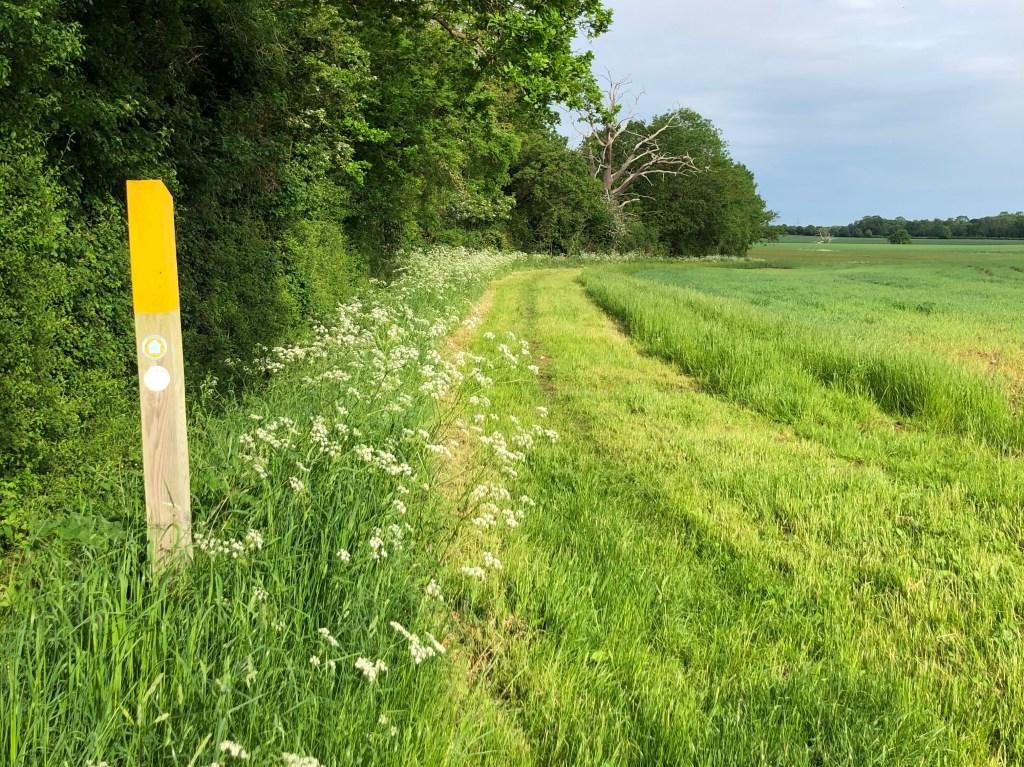
Footpath Running (Gina’s Version) is about following public footpath signs and seeing where they take you. It’s running along rivers, climbing over stiles, and creaking through gates. It’s skirting ponds and whacking through fields. Pacing quiet forest paths or crossing carpets of flowers. You can do it metres from your house (if you’re lucky). You can run 2 miles or 20. Gentle or hard. You don’t have to train for it, and you can walk whenever you like.
Trail running needs a re-brand
The image of trail running makes people think its not for them. It is fascinating to read about races like Western States, or the Spine Race, but sleep deprivation, vertigo, and copious vomiting are not things that inspire most people to do anything. If you live in a flat area, you would be forgiven for thinking that trail running is not even possible without mountains to run up, and freewheel down. It’s not true. There are hundreds of gentle, flat footpaths out there just waiting for you.
Footpaths for all!
In England, rights of way are everywhere. My number one recommendation for runners here is to pay for the OS maps app. It shows you all the local footpaths wherever you are in the UK, you can plot routes on it, and when you’re out it shows you where you are so you won’t get lost. It is brilliant and I use it every week. I’m not being fussy about what counts as a footpath here, either. If it’s not a road, it’s in: boardwalks, rutted country lanes, cycle paths, farm tracks and all.
Off-road tips
If you’re nervous about venturing off the tarmac, here are some tips from a runner who’s managed to run off road for 20 years without knowing what a “technical trail” is:
Start in the spring or summer – the ground is dry, and by the time it gets muddy you’ll be more confident;
You don’t need trail shoes unless it’s muddy or you’re going up a mountain;
Run in the early morning – it’s less hot, you can catch the rising mist or beads of dew on the grass, all the birds are out and about, and none of the people are;
Wear tights or long socks if your route has lots of nettles or is very overgrown;
Get to know the paths near where you live and run them throughout the year – getting in tune with the seasons is the original mindfulness.
And the best thing is…
Because it’s a little bit more effort to run on a footpath than a road, and the surface could be uneven or surprising, you might have to…
Two trail running firsts on yesterday’s 13 mile run loop from Oundle, Northamptonshire, via Lyveden New Bield : first tick bite, and first mid-run historical re-enactment.
Re-enactors re-enacting
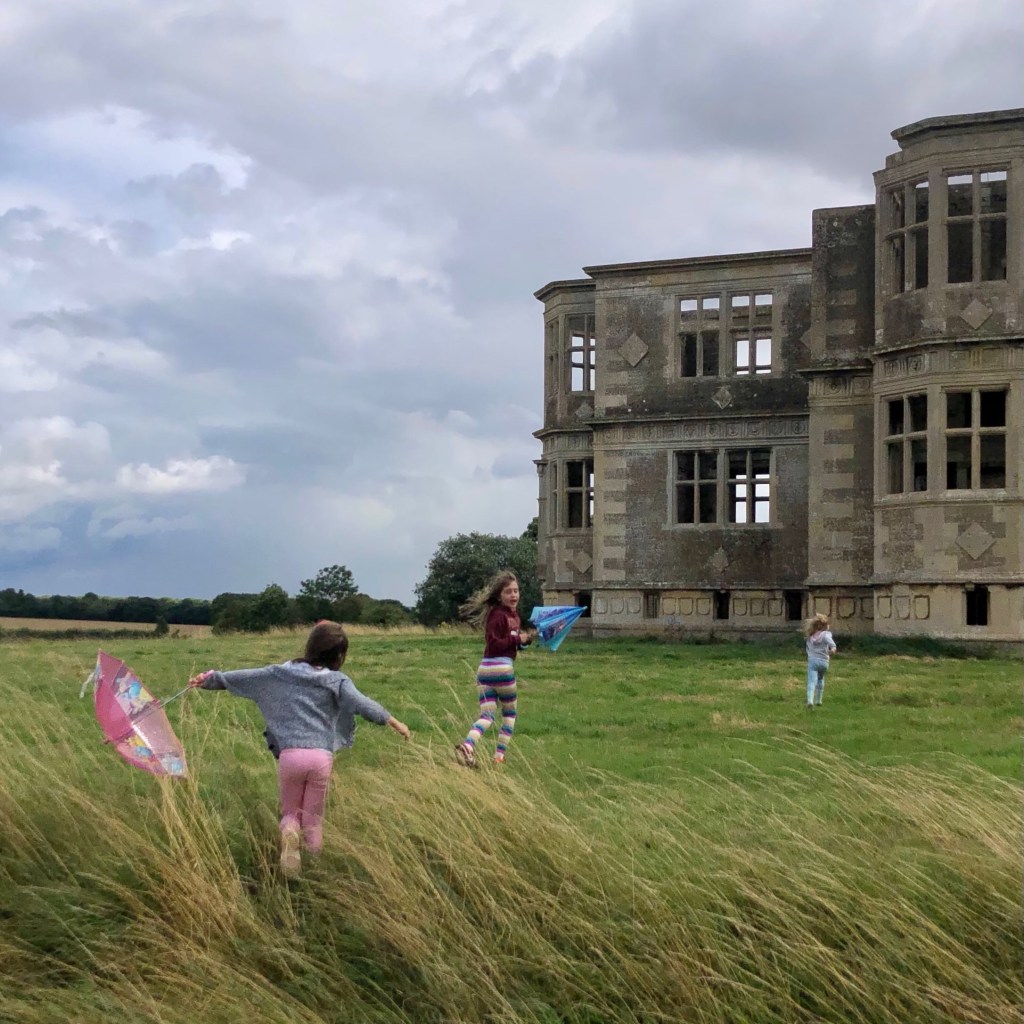
Lyveden New Bield is a classic piece of English history: beautiful, rebellious, and completely bonkers. It’s owned by the National Trust but a public footpath goes all the way around the grounds and it’s one of my favourites. A 4.5 mile out and back from Wadenhoe is particularly lovely, if you’re in the area.
Lyveden on a cloudy day
Yesterday I crested the hill by the unfinished New Bield to the sound of musket fire and drums. Lord John Robartes Regiment were parading through the daisies in the distance, bringing history to life in this mysterious place where it always feels close at hand. Visitors in modern dress looked unfinished too, wearing basic trousers and t-shirts, taking photos on their phones. I started to run back down the hill and passed a woman in full skirt and bonnet, who turned her head slowly to look at me, like someone sprung to life from a painting by de Hooch.
It was 11am, warm and sunny, when I started running. Usually I’ve been back from my run for two hours at that point, and am thinking about lunch. But a late night trying to help my daughter sleep with a blocked nose (apparently I will never understand how bad she felt) made for a late start.
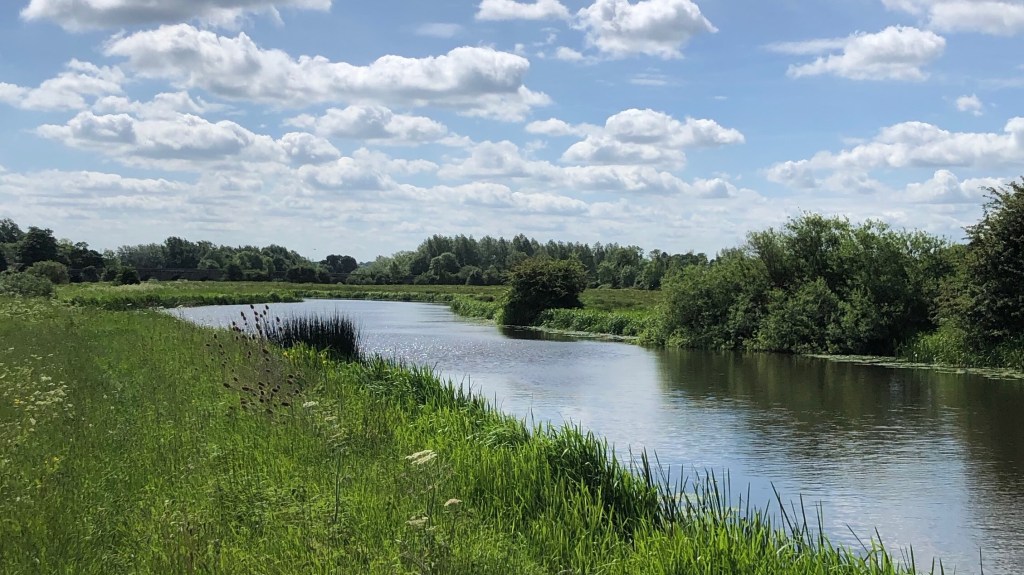
Going out in the midday sun blunts my enjoyment of running. It flattens the colours and the landscape, bringing it all into focus at once. It’s too sharp, too harsh. The reflections from the river were glaring rather than sparkling as I stood on the bank to catch my breath. There were hardly any people around, but when I startled a pheasant, a hare, or a muntjac as I ran, I didn’t get the usual feelings of awe and gratitude. I was just sticky and covered in bugs. Sparrowhawks and kites circled overhead, and I felt like their prey.
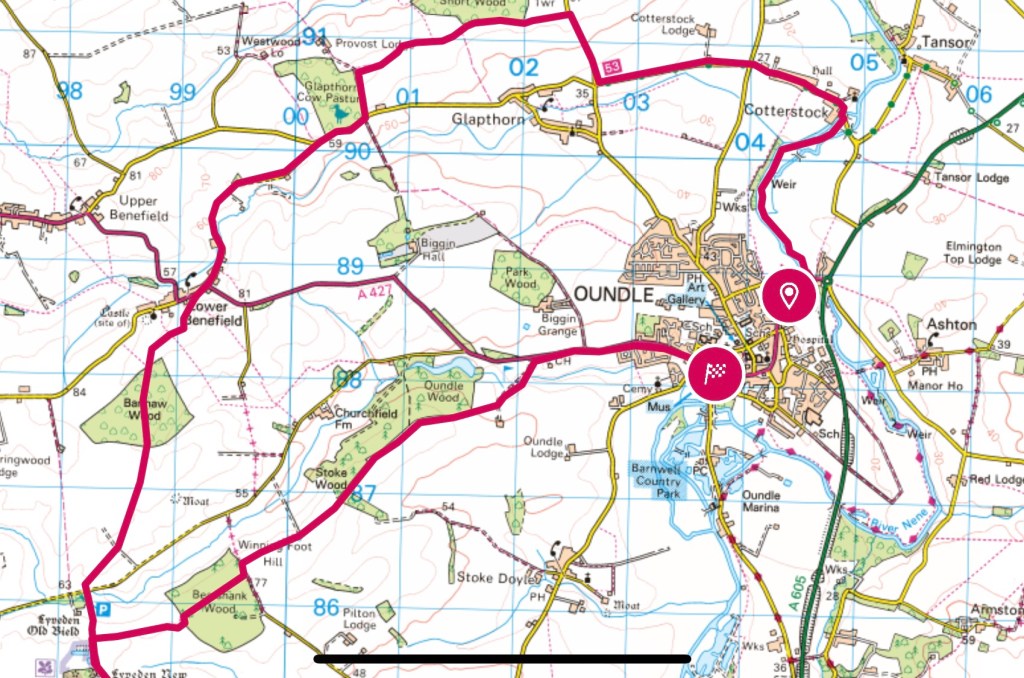
My 13 mile loop ran from Oundle wharf. Across the water meadows by the River Nene to Cotterstock, I ticked off a quick road section then up onto the trail past Shorts Wood and Glapthorn Cow Pasture. A hard track section weaved through Lower Benefield (sprinting through a field of startled cows), and back onto the fields to Lyveden. Then a new path for me, what looked from the map like a straight path between fields and woods to Oundle, cutting through the golf course at the end for an added frisson of ball-to-the-head danger.
This route is exposed to the sun, running mostly through open fields, but two wooded sections – Banhaw Wood and Bearshank Wood – did deliver tiny echoes of my usual early morning running magic. Bearshank Wood was new to me. Where could that name come from? The trail ran through the centre of the wood, along a grassy path lined with bugle. It was just the kind of path I usually love, but so overgrown that I started worrying about ticks.
Bearshank Wood
I was wearing short shorts, and had bare legs and arms. After Bearshank Wood, the path was almost invisible, heading straight through a field of oil seed rape which was head high, with overhanging plants I’d need to bushwhack through. I did, because there wasn’t an alternative. I was hot, more than half-way home, and didn’t have much water left. I needed to take the fastest route back to the car. On the next (similarly overgrown) oil seed rape field, I literally chased a deer along the path. Then the trail skirted fields for at least a mile, and I could either run through the knee high crop on loose soil, or through thigh high grass…
When I got to the car I checked for ticks. Nothing, phew. But when I got into the shower, there one was, attached to my chest (sorry!) and feeding away. I prised it off with tweezers and spent the next 8 hours obsessively checking for more. Not all ticks carry diseases, so hopefully I’ll be fine, but here’s some advice if you want to prevent ticks, or have been bitten.
One of many cross-field paths
Most of this route is running heaven at any time of year, but in future I will avoid the path from Lyveden to Oundle until crops have been harvested, and remember how much I prefer to run in the early mornings when “the fields look rough with hoary dew“.
For someone who has been a runner for 27 years, I’ve been lucky. I’ve had no major injuries and, looking back, my few minor ones have only taken me a handful of weeks to get over. So when I got a calf strain after the Stamford 30k, was I super-chilled and cool about it? Reader, I was not.
Injury face
I felt despondent. More than half-way through a training block for Brighton marathon, with seven weeks and two long runs to go, I was just getting fit and strong for the first time in two years. I felt like an idiot for pushing too hard in the 30k (justified), and worried that I would never run without pain again (absolutely not justified).
12 weeks later, everything is different. Yes, I deferred my marathon place, but I actually only stopped running for about ten days and the injury is gone. On Sunday I ran a 10k in my third fastest time ever. Spring is here and every run is a joy. Is it possible that I might take some lessons from this? Doubtful, but just in case, here are a few:
Langtoft 10k – 7th woman!
Good ways to deal with a running injury
Just foam roll it, it’ll be fine
Ask an instagram influencer what to do about it
Tape it up like that guy on youtube
Just run through it!
Joke. Actual good ways to deal with a running injury
Get an expert opinion. If you can afford it, see a physio for a diagnosis of the problem and advice on exercises and treatment. And if you have money to spend on new trainers or kit you don’t absolutely need, you can afford a physio appointment.
Stop running. If it’s not improving, and especially if it’s getting worse, STOP. Cycle, walk or swim if they don’t hurt, and you want to get out of breath or be outside.
Be kind to yourself. Running is not the only reason you get to eat chocolate or feel proud of yourself. In fact, as you’re missing those running endorphins you deserve to do *more* – not less – of the things that bring you joy. Have the cake.
Think long-term. It feels like running has turned to shit forever, but what if it’s good? This could be sorted in weeks or even days. Maybe you’ll do all those physio exercises everyday and turn into Kipchoge? It could happen! Give it time, and remember that it won’t be much time at all, looking back.
Remember there will be other races. It absolutely sucks to miss a big race, but not as much as it sucks to run one while in pain. Also, there are plenty of things that suck about races: the nerves, the plastic waste, the toilet queues. With luck, you can go for a quiet, no-pressure run on race day to remind yourself of why you do it.
Do something less boring instead. Suddenly have time on your hands? Do something with it. Call your parents; knit a scarf; read a book; see a friend; join a swanky overpriced gym!
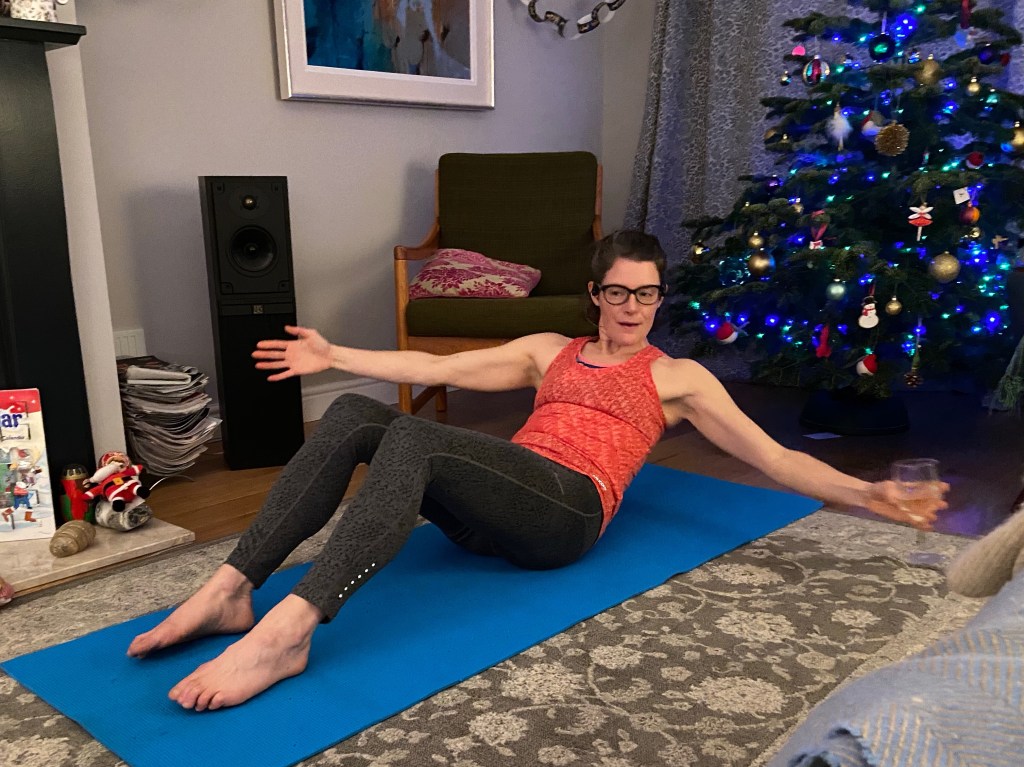
Pilates with a glass of wine? Why not?
Hope you, and future me, find these ground-breaking insights helpful. I’m just off to cancel that gym membership.
NB Proper injury advice is available from your local physio, mine is the excellent Preston’s Health.
I’m half way through my training plan for Brighton Marathon and I’ve realised that even if I make it to race day intact, my trainers will not. I run in New Balance 880s – basic neutral road shoes. They’re good; comfortable, no injuries and they last well. But lately, my eye has been wandering and I’ve been wondering: what if I’m the only person on race day without carbon plate shoes?
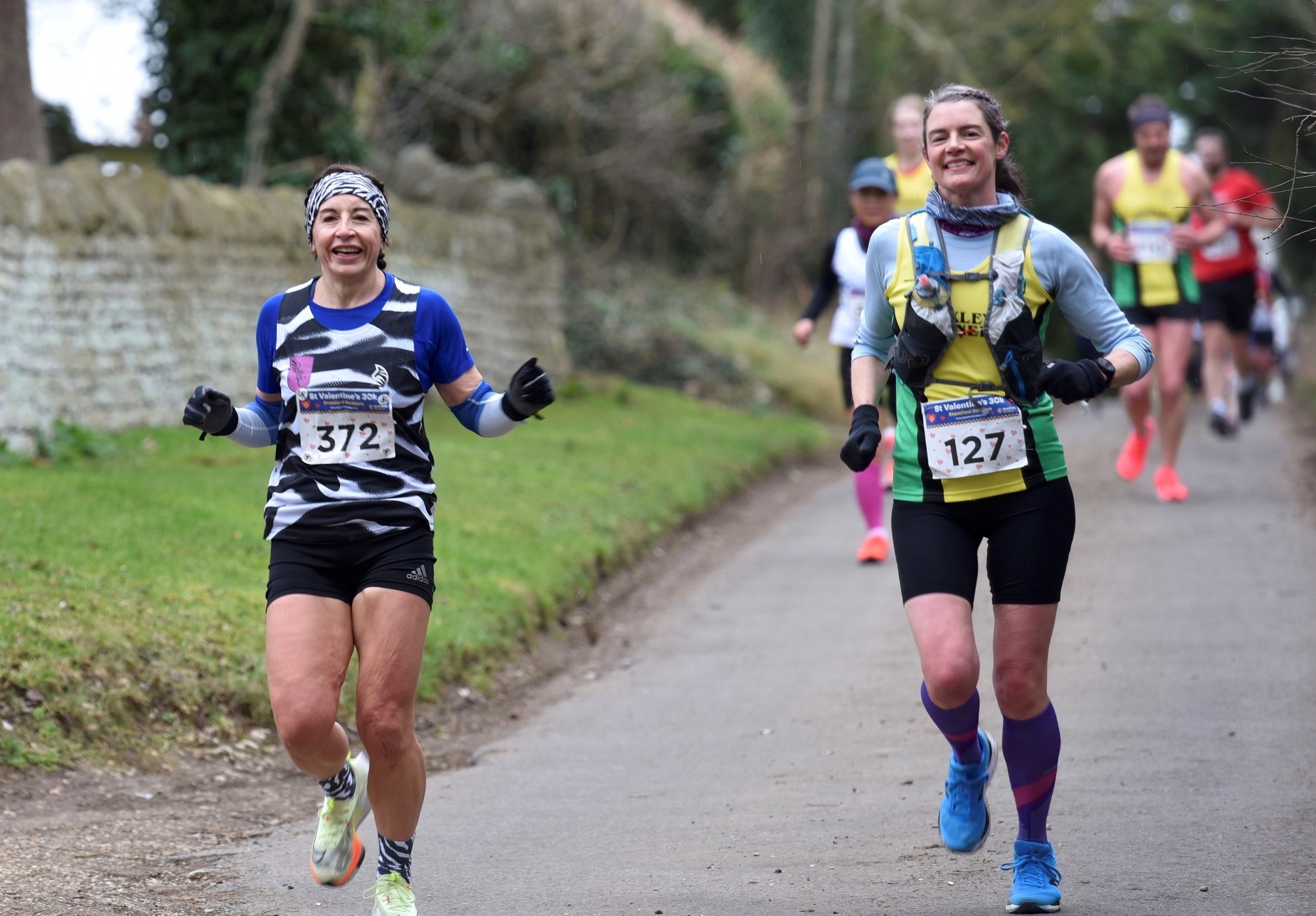
Everybody’s doing it now
This photo was taken at the race I did yesterday: the Valentine’s 30k – run by a local club Stamford Striders. It was a great event with a real community feel, run around country roads. It’s not an elite race, but a fair proportion of runners of all speeds were wearing Nike Vaporfly Next % shoes – or similar ones with a carbon plate.
The last time I raced over a similar distance was in early 2020, when Next % shoes were still a talking point – considered to be expensive and still pretty rare. At the start line, a couple next to me were wearing matching ones, and other runners were nudging each other. Now, most marathon runners I know either own them already, or are saving up to get some. They’re common at parkrun and I even saw someone lining up at a cross country race in them last weekend.
Would I wear them for a cross country race? Of course not. Spikes, or shoes with lugs, make me faster at cross country, and I have always worn them. Would they make me faster at Brighton marathon? Probably. If I were an elite runner competing against others, or up against the clock trying to get a Boston qualifying time, I would be off to the Nike store right now. But I set my marathon pb wearing road shoes, and if I beat that pb now (as if) wearing carbon plate shoes, I would always think, “it was the shoes that did it”.
And so…
Am I going to buy a pair? I don’t think so. If someone gave me some as a present, I would be interested to see what happened, but no, I’m grateful for a reason not to spend the money.
I do occasionally panic that I will be the only one lining up in Brighton in normal shoes, but don’t you worry. If I can run sub-3:30 for a marathon in regular road shoes at 46 years old, I will make sure everyone hears about it.
Racing again after so much time away is tough, mentally as well as physically. Now’s the time to put all those coaching tips into action: focus on your progress, not your time; don’t compare yourself to other people; set achievable goals.
Today was the second Frostbite Friendly League cross country race of the season (yes, it’s only been two weeks since the last one). This time, it was in Ferry Meadows, Peterborough. Fast, flat and familiar; I run parts of the route every week. Conditions were great: not a hint of mud. Mild, with a fresh breeze. Basically… no excuses. How fast I ran today, is how fast I *can* run.
Before the race I had a chat with a teammate; we’d spoken last week about how to judge our performances in this weird world where we haven’t raced for 18 months. We agreed on three things: be honest about where we are now, set a realistic goal, and judge ourselves by that and only that. Last week, this approach worked out. I wanted to run 7 minute 30 seconds miles on a hilly course. I ran 7:20s.
This week, I didn’t have any confidence in my ability. I felt tired – exhausted – and nervous and completely negative. “I think I’ll be slower than the last one”, I said to him. Even though the course was flatter. “I haven’t done any speed training” I said to another friend. Even though I’d run a fast parkrun the Saturday before. Inside, I knew I would be disappointed if I wasn’t faster than the first race, so why couldn’t I say that out loud?
I should have had more faith in myself. I didn’t finish feeling disappointed, I was delighted. I ran just over 7 minute miles; my fastest run for a very long time. My splits were pretty even, only adding 20 seconds for the small upwards section in the middle mile. A couple of times during the race, I even felt like my old self. I sped up to overtake people. I charged down the (only) downhill. I gritted my teeth and pushed to the finish even though I really, really wanted to give up.
So, what have I learned from this race that I can take into the next one?
Be more positive. Have more faith in yourself.
Races and fast parkruns count as training too.
Admit your real goals out loud. No-one apart from you cares if you don’t achieve them.
No-one likes a sandbagger.
Really looking forward to the next Frostbite race. Now, time for some hill training!
“I think I’m having a mile two moment!” a friend yelled as he ran past me on Sunday morning, up a hill through the woods during the first race of the Frostbite Friendly League cross country series. “I’m glad someone is!”, I thought, but too late to shout back even if I’d had the breath.
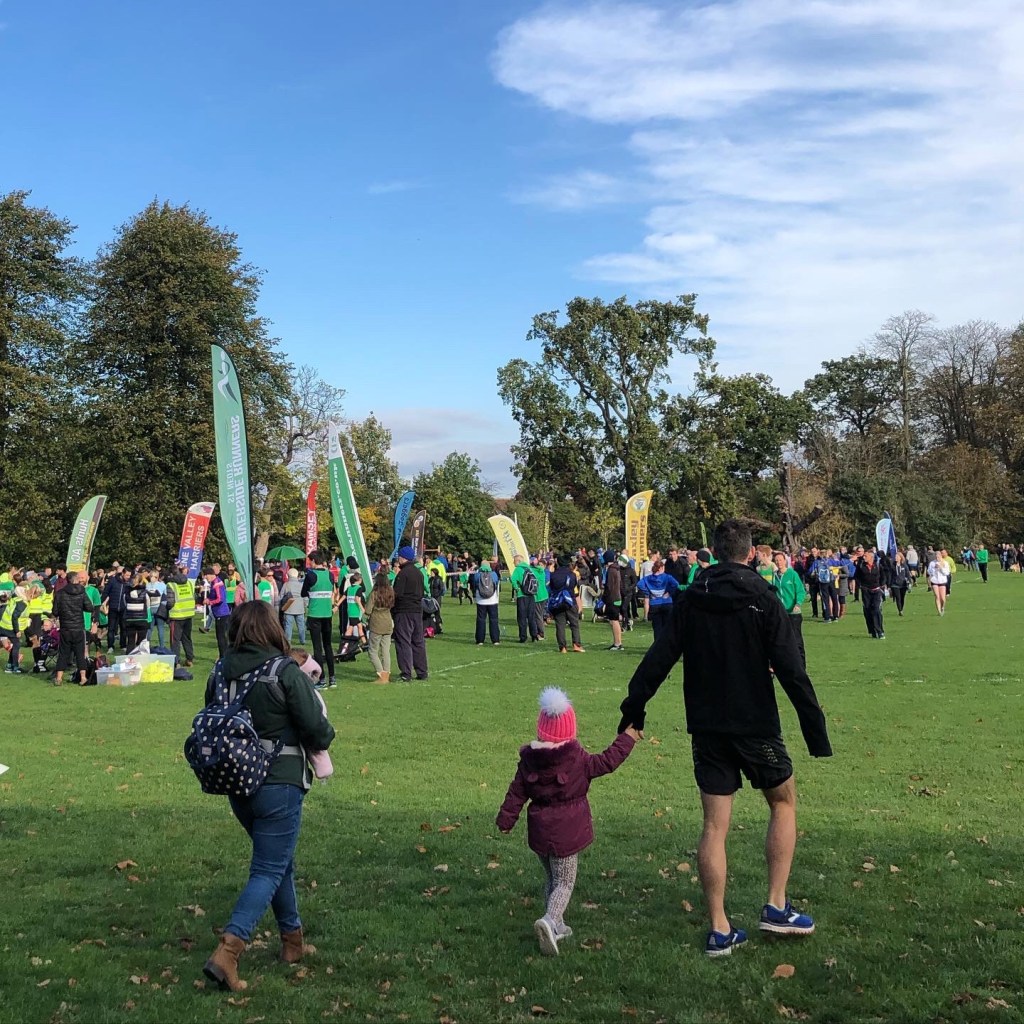
Cross country season is back in England, and I was surprised to be happy about it, as we arrived at Priory Park in St Neots in Sunday morning sunshine. If you have ever run a cross country race you will know this feeling. You hate it, but you also love it – all of it all of the time. Not just that you hate the race, and love it when it’s finished (though also that).
Feeling sick with nerves beforehand, relief when the race starts, adrenaline kicking in for the first mile, realisation that this will go on for another 4 miles and you’ve definitely gone off too fast (always), gritting your teeth for the monster middle section, slowing down every time the throat tightens, speeding up again for the downhills. And then, no matter how slowly you’ve just been running, sprinting it in at the end like a 400m runner.
It’s so great to be out there again, burning our lungs and side stepping tree roots, cheering our teammates and vowing to do more hill training before the next one. If there’s a better fitness test out there than a series of 5 mile cross country races from October to March, I’d be surprised. I’ve run them in good weather and bad, coming off a summer of excellent training and one of injury. During marathon training, after a rest. They always tell you where you’re at.
So where am I at? I ran the first race (4.8 miles) one minute slower than my best time. It’s the first race of the series, and I’m never at peak fitness for it. But one minute off, after 18 months with no races and a lot of sitting at home on my arse? I’m happy with that. The best thing is that I didn’t feel like I couldn’t go faster at all, I just knew I couldn’t do it on Sunday. It’s still in there, my fitness. Got 5 more races to dig it out.



















 Not a Jogger