Maybe don’t show me the strava stats

I’ve always been a late adopter when it comes to tech. The last person in my friendship group to get a mobile phone, I held out until the day I had to spend an hour and twenty minutes waiting in the car park of Balham Sainsburys because everyone was running late, but had no way of telling me.

When I started running in 1993 I wore a casio stopwatch that went up to one hour, before starting again at 00:00:00. I still have it, it still works, and I’ve never changed the battery. I just looked up when GPS watches were invented, and the first garmin went on sale 20 years ago. I bought one in 2014.

Why did I need a watch to tell me how fast I was running? I worried it would stop me from “running on feel” and listening to my body. Now I can’t imagine running without it. If I want to test whether I’m still running on feel, I just don’t look at my watch during the run, and check the data later. That way I can still run on feel, but also find out if my feelings are accurate.

I’m on my third garmin now, but still a fairly basic version (Forerunner 55) with all the alerts and suggestions switched off. I don’t want my watch to tell me what to do, or nag me to do more. The best thing about using a GPS watch is not having to do sums. Racing used to be a maths test: dividing your goal time by 26.2, writing down key splits on your hand, and re-calculating your pace at every mile marker.

Uploading my runs to strava, I love seeing my routes, and other people’s, to get ideas of where to run. Back in the pre map-my-run days, when I wanted to plan out a long run I genuinely had to get a piece of string and measure out a run on the A-Z or an ordnance survey map. Now I do an online version of this with the amazing OS app. But instead of writing the directions on my hand (hands were very important in the past), I can just look at the route on my phone in the middle of the run, and it tells me where I am.

Technology really is magic, and we’re lucky to have it. It has changed so much about running, it’s hard to remember what it used to be like. But last month, my free strava account was automatically upgraded to a subscription for a month, and I remembered that tech isn’t always good for you. At first, I was excited. What’s not to love about viewing our fitness trends over time, and training progress week by week?
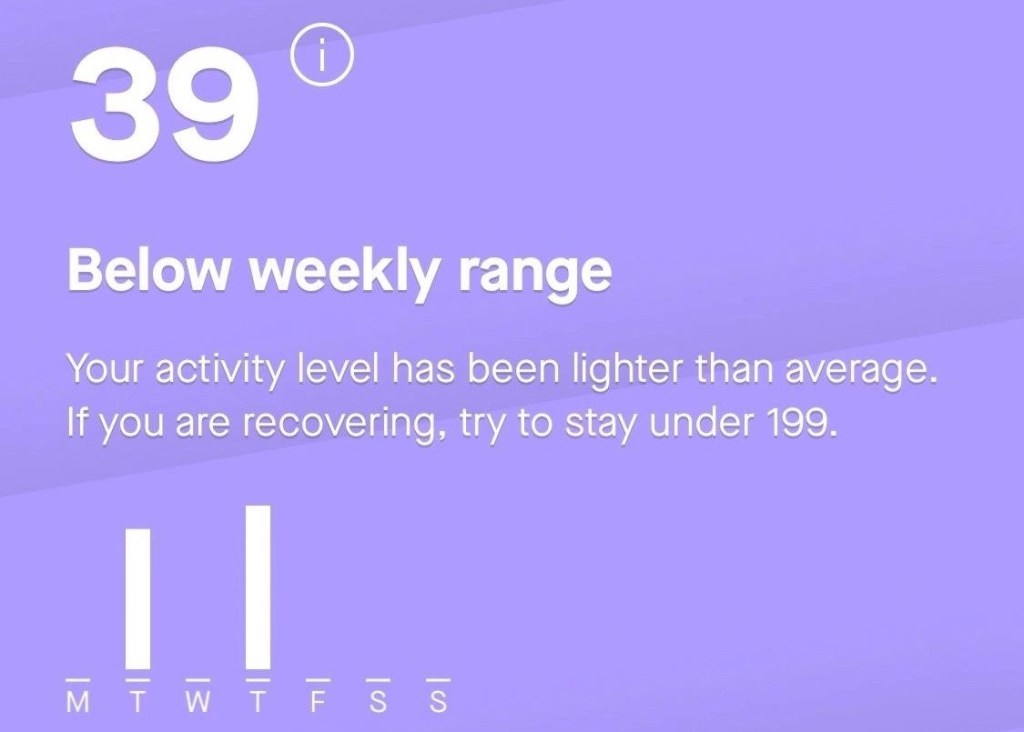
What’s not to love? For me, this kind of analysis was de-motivating, and anxiety-inducing. When all my numbers are going up, I feel pressure to keep them there. When they’re going down, I feel depressed and frustrated I’m not making them go up again. This is what losing “running on feel” looks like to me. An overload of analysis which controls my feelings about running. I didn’t feel bad about my training before, but now that I can see the stats, I do.

Strava has tried not to make its language all about monster weeks, and to frame rest weeks as positive. But the colours, the numbers, the charts, they paint more of a picture than the words. If you’re a runner like me who is self-critical, and over-competitive, this is risky.

The month’s subscription just came to an end, and my account is back to normal, just in time for me to pick up a knee injury. So whatever happens now, at least not having to look at my declining fitness trend is a light in the darkness.
Is it a training race, or a race race?

It’s that time of year. You’ve just finished a long marathon training run. Your face is salty, your thighs are throbbing, but you’re buzzing. You did it! It’s in the bank. You upload your run to strava, and while you’re waiting, you scroll through other people’s runs. You look at the distances, the times, the comments. You tap “view analysis” and look at your elapsed time. It doesn’t look as good. The buzz starts wearing off.

“I could have gone faster”, you think.

Yes. You could have gone faster. But *should* you have? The answer is no, and you know it. Long slow runs are called LSRs for a reason. They’re not long tempo runs, or long steady runs, or long fast runs. Being slow is the point.

While we’re out running further, our bodies are getting stronger. The stress of the increased mileage is overloading our muscles, and triggering adaptation. By running slowly, we’re reducing the impact of this overload on our bodies, recovering more quickly, and protecting ourselves from injury. There are no strava crowns for being slow and sensible, so we just have to remember that the benefits are invisible, but real.

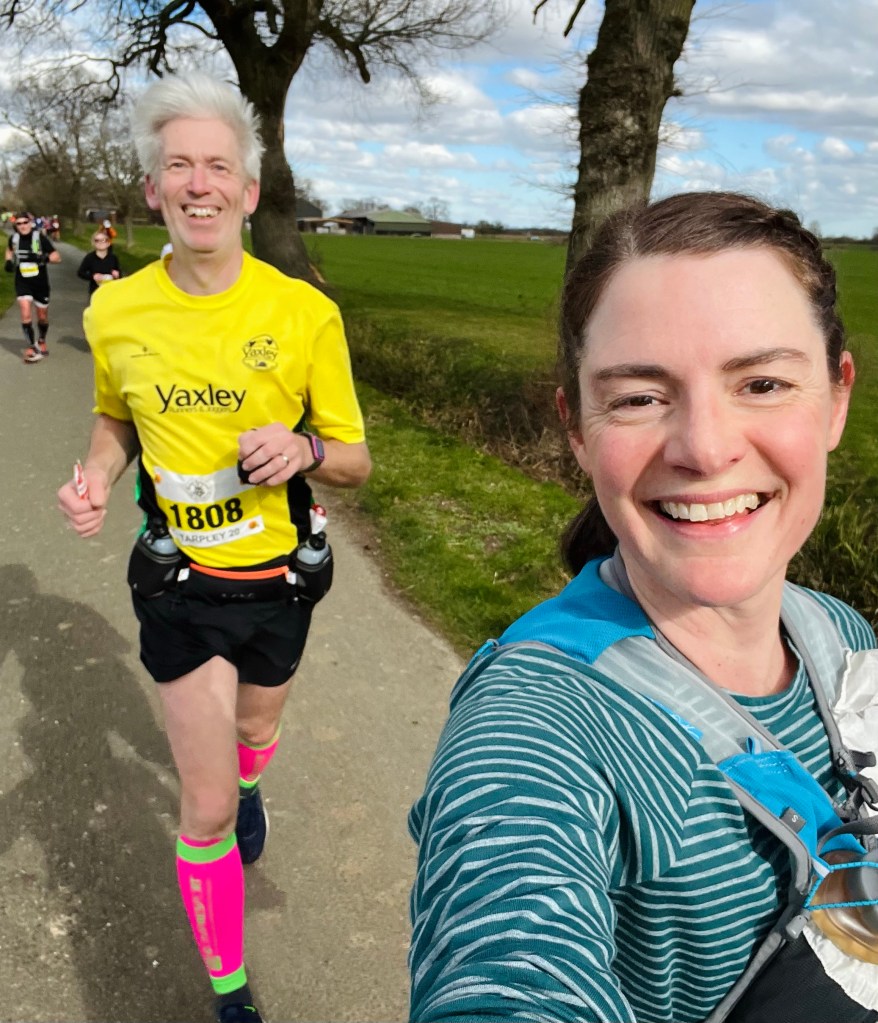
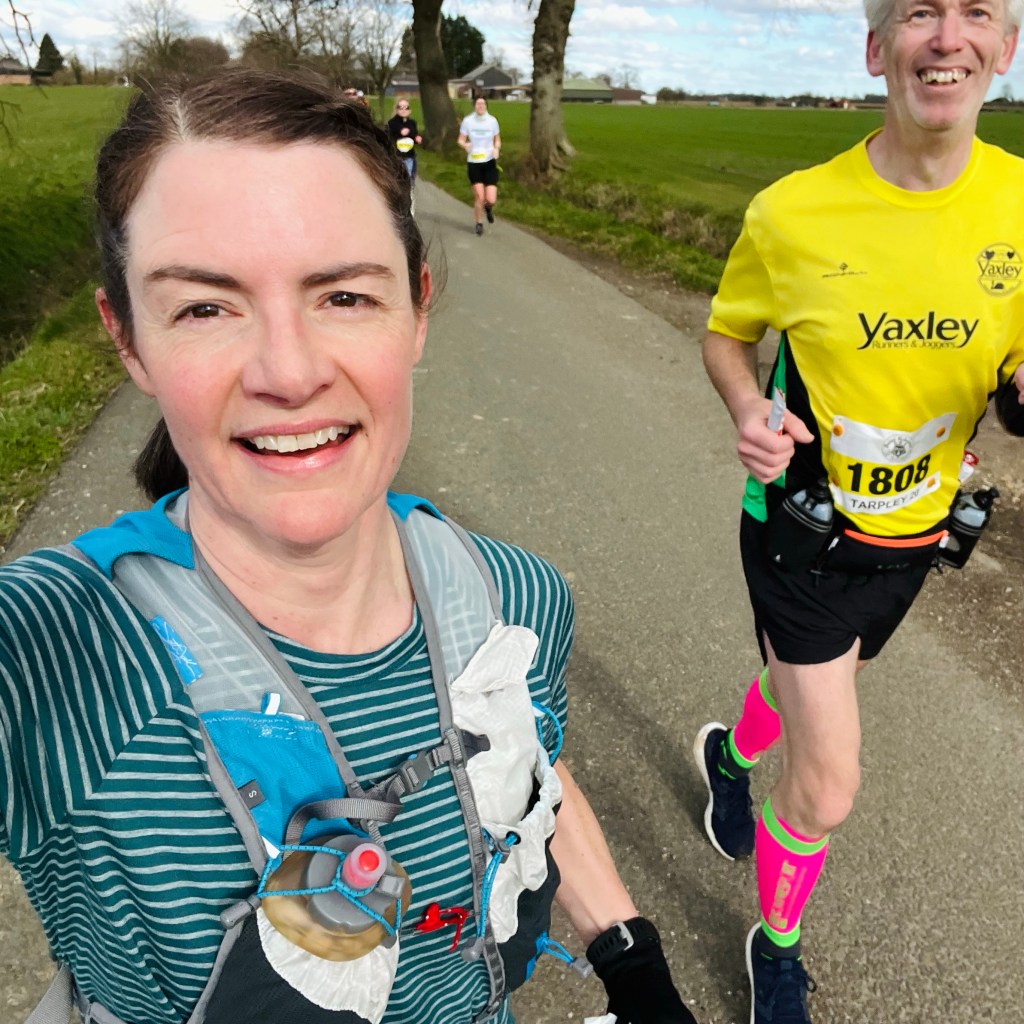
This is easy to say, but harder to stick to. Last weekend I ran a 20 mile race- the Tarpley 20 – as part of my marathon training. Before I joined a running club, I had never heard of anyone doing a race as a training run. Don’t these people realise that running is free? I would have said. But long races make for brilliant marathon training. They are locally run, reasonably priced and well supported. If you’re struggling to motivate yourself to cover 30k or 20 miles by yourself, pinning on a race number alongside 300 people who probably feel the same really helps.

The challenge with a training race, though, for anyone with a shred of competitiveness in their veins, is that it’s still a race. It’s really hard not to race a race. I should know, I’ve done it. At the Stamford 30k in 2022 I went too hard in driving rain and picked up a calf strain that ended my chances of running Brighton marathon. At the Oundle 20 in 2019, I got carried away with it being a club championship race and, looking back, put in a much better performance than I managed at Boston marathon four weeks later.

At the start line last Sunday, I could still feel the temptation. Before the race, to guard against this, I had told anyone who’d listen that I was going to take it slow. Even so, I found myself finishing my first mile in 8 minutes 17 seconds (AKA, this year’s goal marathon pace). Luckily, my brother in law caught up with me in mile two and asked me (in the nicest way) what the hell I was doing. Slowing down, I replied.

I did, and as a result, I really enjoyed the run, especially the last few miles. When I got to the finish, I not only felt I could run another 6.2 miles, I actually wanted to. I can honestly say I have never felt like that at the end of any race, ever.

I am not a coach, and I can only talk from my own experience, but I wouldn’t race – as in, properly race – anything longer than 10km in the run up to a marathon. If we’re tempted to push it harder for longer, we need to ask ourselves: what is the main goal? Is it to perform really well in the marathon, and get to it on top form and uninjured? Is it to perform really well in the club champs? Is it to boss the cross country season? Because we cannot do them all.

When it comes to your marathon, so many things about race day are uncertain. Focus on what you can control. Focus on the goal.

Don’t risk leaving your best race in training.

Whisper it… I might be getting my fitness back

After three months of covid and a post-covid cold from hell, I’m finally getting back to my pre-covid fitness. It makes me nervous to write this, in case I chase it away, but I also want to record it. If I say it out loud, I can start to believe it.

Early morning intervals are back

Three months sounds like nothing, but feels like forever. At first I was just happy to be able to get outside. But when my garmin beeped a “your stress levels are unusually high” warning at the start of a run, and then repeatedly told me my easy jogs were done at a “threshold” level heart rate, I was worried. How could I listen to my body, when I felt fine but so obviously wasn’t?

Mine was a mild Covid case, with most of the OG symptoms but no cough. I only took one day off work and, after two weeks of no running, I was keen to start again. People who’d had covid (which at this point was pretty much everyone) kept warning me to “take it easy”, and “don’t rush back to exercise”. It sounded like they wanted to add “… or you’ll get long covid”. I tried to find some proper medical advice for post-covid running, but failed. Is there any?

This Runner’s World article is the best summary I could find of what information there is for us to go on. It shares data on elite athletes, which I did not find helpful, but also looks at a big study of fitbit data which finds that the average covid sufferer doesn’t return to regular resting heartrate for 79 days following infection. 79 days is… three months.

Three months after Covid infection, my heart rate is now connected to the effort I’m putting in. I can stay in the “easy” heart rate zone without stopping to walk, and in the past two weeks I’ve run:

  • my first interval session since October 2022;
  • a 5 mile cross-country race, within 15 seconds a mile of my old pace; and
  • an 18 mile long run.

My heartrate looked normal during each of these, and they were all a massive effort and a hideous struggle. I loved them!

It’ s official. I’m back. (fingers crossed)

January: the month for taking motivation wherever we can find it

Speculoos & cream cheese: motivation in a biscuit

It’s getting near the end of January (hurrah!), and resolutions are fraying along with tempers. We are all hanging out for payday, for lighter days, and warmer weather. But running can’t wait, at least not for me. If I am going to run London marathon this year – and I think I am – I need to get out there now.

Usually I have a training plan, and use that to hold myself to account. But not this year. At least, not yet. I had so much time off running in late 2022 that I never got to build a good marathon running base. My past three months’ running still look like a rollercoaster with big dips for Covid and The Cold, and I haven’t strung together three weeks’ good mileage yet. Once I can do that, I will call it marathon training.

Running without a plan is tempting in the spring or summer, when just being outside is a delight. Right now, ploughing through the mud in -4, not having a plan is a big risk. With energy bills so high, my house is cold, and just getting changed into my running kit is the hardest part of going for a run.

January is the toughest month for running. It’s mad that this is time most people start training for their first marathon. And honestly, if nearly thirty years of running has taught me anything it’s this: find motivation wherever you can. Looking forward to a bath when you get home? Want to wear that new headband? Have to go to the post office? Want to see the seals in the River Nene? All reasons I have used to go for a run in the past two weeks.

The king of motivators – always – is the one I use least: running with other people. I run alone because it’s convenient, but also because there’s nobody else to worry about. Even when I’m running with friends and family I get anxious: am I talking too much? Too little? Am being boring? Am I going too fast? Too slow? I wish I could turn off these fears, because running with other people is brilliant. Time goes more quickly, I get to hear all the gossip, and – most importantly – I always turn up.

(p.s. I did not see the seals)

Thoughts from Rutland Marathon

Such perfect marathon weather’. The smooth path stretches along the edge of the dam. A family claps and cheers from a bench. Ten more runners overtake me.

I’m glad I’m not going out too fast’. The smooth path ends, turns gravelly and weaves through a carpark and up onto a grassy slope.  

‘I just need to keep the lid on for ten miles’. A marshal shouts, “well done young lady”. I’m 46, but I’ll take it. The stony track curves up and down around the inlet of the reservoir.

‘Look at the water, maybe I’ll see the osprey’. The lead runner of the half marathon whizzes past.

‘Keep it steady’. Another sharp uphill, a right turn, a left, a downhill.

The turning point must be soon’. The lead male runner passes, big beard, leopard print vest.

 ‘Do not speed up’. The first woman runs past, pink t-shirt, big smile.

‘I do not need to speed up’. Five more women pass and the turning point is there. The route doubles back around a line of orange cones in the woods.

‘Keep a lid on it’. Runners pass, still on their way to the turning point. The five mile marker goes by.

‘Only five? No, don’t think that. Half way to ten ’. The runners coming the other way are slower and more friendly.

‘This is better, I’m enjoying it’. Say “well done!” to every female runner. A dog lifts its leg to pee on the seven mile marker post.

‘Nearly at the dam, now’. A man sitting on a bench makes full eye contact with me and says nothing. Across the dam. A child jumps up and down, blowing a whistle.

‘I should be feeling better than this’.

The path stumbles between mole hills and rabbit holes. ‘This grass is really green from the rain’.

The route goes back past the start funnel. ‘Try to look good’.

The loudspeaker calls out the names of passing runners. A few cheers. ‘Try to feel good’.

Out of the carpark, the seventeen mile loop back to the finish begins. ‘I won’t count the hills’.

There were six hills between that point and Hambleton Peninsula. ‘This might be a bad patch’.  

The half marathon turning point is behind me at eleven miles. ‘I might feel better soon’.

The path stretches out along the north shore, looking flat but somehow going uphill. ‘It’s good to be outside’.

Mile fourteen. Mile fifteen. Up the hill to mile sixteen, my chest pulls with every breath of air.

“Stop it!” I shout out loud.

But I can’t push away the negative thoughts. Over the final ten miles, I try everything.

‘It’s good that my achilles isn’t hurting’.

‘Every uphill has a downhill’.

‘This gel will make me feel better.’

‘I always love running here’.

‘It’s still a beautiful day’.

‘No-one is going past you’.

‘Everyone feels the same.’

‘Don’t walk unless you have to’.

‘Just walk if you need to’.

‘Just get to the finish’.

‘You’re going to make it’.

When I cross the finish line I feel two things: relief, and certainty that there was nothing I could have done differently. This day wasn’t my day.

It is true that much of a marathon is what’s inside your head, the stories you tell yourself about how you’re feeling, the stories you tell yourself before you start, and how you spin it afterwards. But now that I’m older, I can see that it’s really the body. Yes, you can make yourself keep running or let yourself give up, you can decide to push or decide to walk. But it all comes from the body. The training, or the feelings on the day, dictate it too.

Looking at my insane heart rate recordings, I know I couldn’t have done anything else on this day. I know that the rushing of blood in my ears, the nearly fainting, that was the very edge of what was possible. I went right up against it. There was nothing more I could have done on that day.

When you’re young, or you have tons of training in your legs, you can carry a bad day and your brain is your only barrier. As you get older, on a bad day you can’t push through it.  But on a good day, you can run just as fast as ever.

Do I seem like I’m marathon training to you?

img_6930Deciding to run a marathon is easy. Signing up to run a marathon is easy. Running a marathon… isn’t easy exactly, but at least it’s quick. The bit that really isn’t easy is every single day between signing up for a marathon and actually running it: the training.

The training is the hard bit. And training for a spring marathon is the hardest. It’s dark, it’s cold, I’ve been here before. This year feels harder though, and I’ve been trying to work out why. It’s not any darker and it’s a lot less cold in the UK this year. It is wetter and a whole lot windier, but it’s not the weather that’s the problem.

What is the problem, then? I am five weeks away from Peterborough marathon – my ninth – and I am still stuck knee deep in denial. I signed up late, after New Year. I dusted off last year’s training plan. I added on a few miles a week. I’ve done a handful of sessions. I’ve done some long runs, some races. It looks to the outside world like I’m putting the miles in: 45 a week. Fewer than many, but more than most. Not great, but not the problem either.

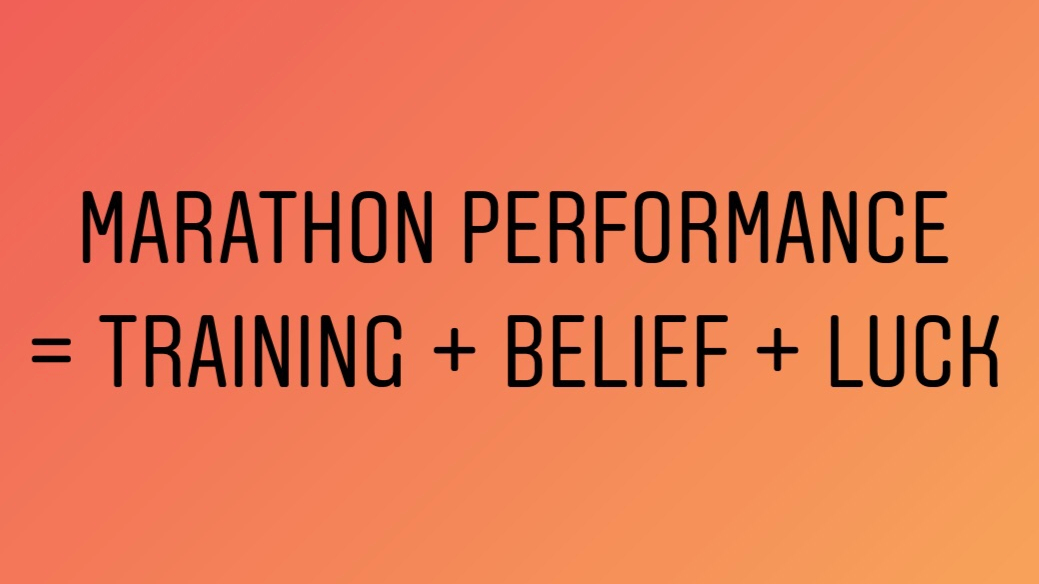
If marathon performance = training + belief + luck, is the problem lack of belief?  I’ve had some issues making my peace with getting slower, and a few weeks off with posterior tibial tendinitis in late summer knocked my confidence a bit. But that’s not it. I’m still dreaming of a 3:15 marathon. Not just dreaming, I still believe I can do it (not this year, obviously!) because that injury came after a summer of proper speed. A summer where I smashed my mile, 5k and 10k pbs even though I’m in my mid-forties.

So, it’s not the training or the belief. And I can’t do anything about the luck. The real problem this year is that… whisper it… running a marathon is just not that important.

Things that are more important than marathons this year: my daughter, my relationship, my family, my job, my friends, my colleagues, cross-country races, my sleep, cooking food, junior parkrun, a good book, NetFlix. Did I mention sleep?

I still love you, marathon, but I’m phoning it in this year and we both know it. Cross your fingers for a lot of luck on 5 April 2020.

Boston, baby!

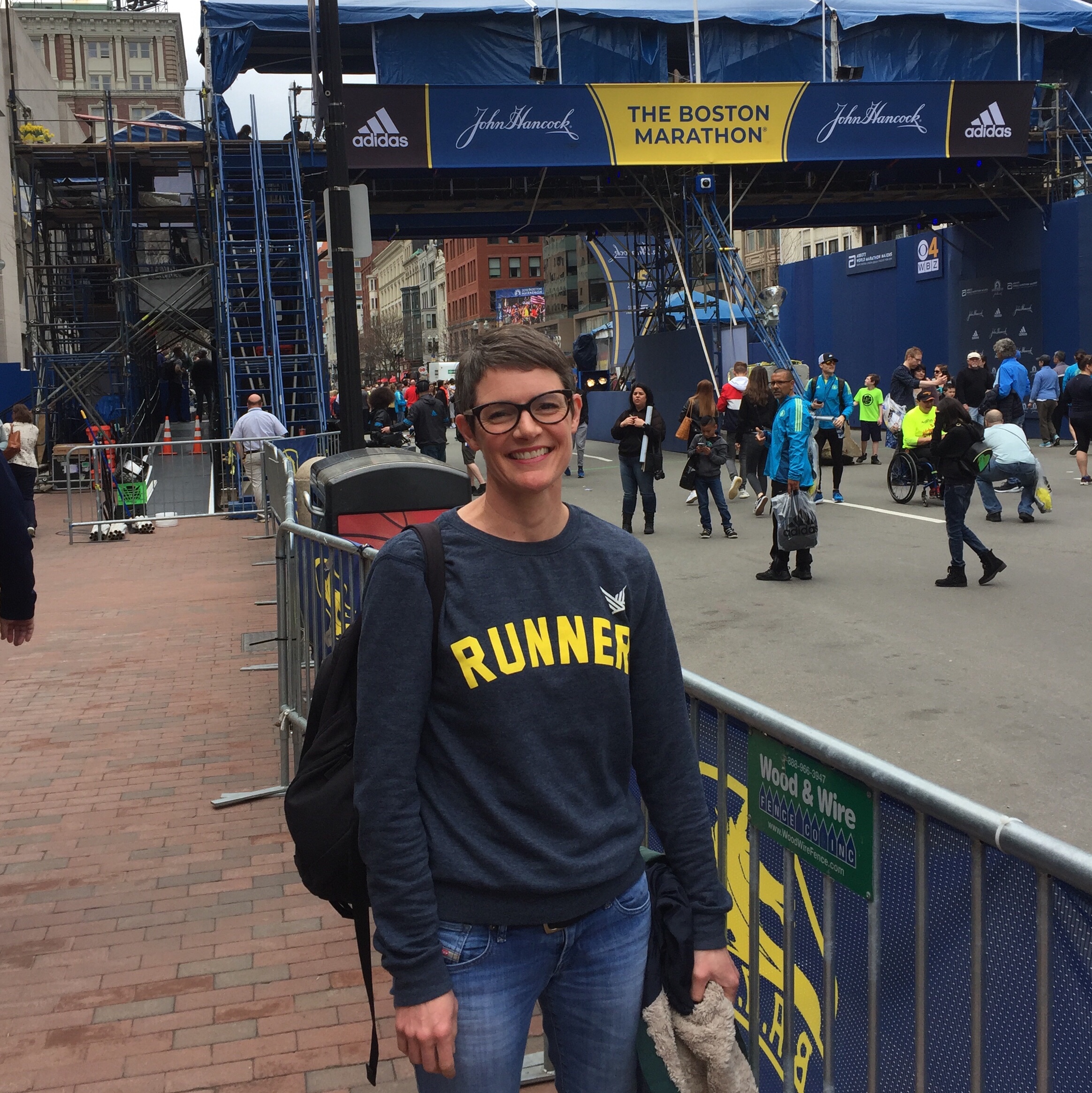
I ran the 2019 Boston marathon! I haven’t written a race report in a while, but I’m making an exception for this one.

Why is Boston so special? Because you have to work hard to make it to the start, work harder to make it to the finish, and when those Bostonians say “Good Job!” as they hang the unicorn medal around your neck, they really make you believe it.

If you don’t believe me, watch this excellent film. Be careful though, it might make you want to sign up.

Getting to the start

As a Brit, Boston was a race I was aware of, but not one I thought I’d ever run. I’m not a huge fan of aeroplanes or big city marathons, so the thought that I would fly somewhere ‘just’ to run a marathon was nuts. But then, in 2017, a couple of my running clubmates ran Boston, and I realised what a big deal it was. Given that most people struggle to run fast enough to qualify, and I could, why wouldn’t I?

After many years of not caring about this race, I suddenly cared a lot. We planned a big trip around it, seeing friends in Connecticut and in New York. We saved for 18 months – booking the hotel room as soon as I nailed my qualifying time at Edinburgh (after a failed attempt in London) in 2018.

No pressure, then

Boston

With all the expectations I had of the race, the holiday and the $$$$$$$ we were spending on hotel rooms, I had one job: get to the start line uninjured. I abandoned the high mileage Hansons plan which did so well for me in 2016 but resulted in injury in 2018. I used one of the free Boston plans (level 3) and something crazy happened – I actually enjoyed the training! It was varied, interesting, and most of the interval training was 10k or half marathon pace, not 5k. Win win win.

I arrived in the US ready for the taper, and… well… let’s just say I enjoyed it.

The most well-organised race I’ve ever run

So, my holiday was great! But what about the race? I trained for a 3:25, and ran a 3:32. It was amazing and awful – sometimes at the same time. But definitely mostly amazing.

Things I loved:

  • So many fast women! I started in the blue wave, with a qualifying time of 3:32, and I was mostly surrounded by female runners for the whole race. This was brilliant and in my experience very unusual! There was not a whole lot of chatting going on (we were working too hard for that), but it was truly awesome and inspiring to run alongside so many speedy women.
  • A race run by runners, for runners. It felt like a local race, scaled up, but not commercialised. Everything you wanted was where you needed it when you needed it. Coffee? Bagel? Toilet? Toilet again just before the start? They even gave you a bottle of water BEFORE your medal at the end. Extra points for this.
  • The volunteers – there were almost half as many volunteers as runners and it showed. They were SO GREAT at every water station and at the finish they made me feel like a rockstar.
  • The City – this is a big deal for Boston. There were signs everywhere from the minute you arrive. The crowds during the race were smaller than London, but three times as enthusiastic. One guy locked eyes with me and shouted ” I BELIEVE IN YOU”. I believed in him.

Things I didn’t:

  • The weather. It is so changeable there you could get anything, and we did. Torrential rain stopped before I started, but the humidity stayed. It was already warm and once the sun came out at 10 miles I knew my pace was toast.
  • My bloody shorts. It was the third day of my period, and I should have known better than to wear blue shorts. My biggest worry was that spectators would think that I’d shat myself. “It’s blood!” I considered shouting, “I just have my period!” Seriously, I am ashamed to say it did knock my confidence and I was really self conscious for most of the race. Plus towards the end the dried blood made for some pretty bad chafing. Sorry if this grosses you out (actually, no I’m not), but for all you bleeders, know that it happened and I got through it. No-one died of shock or made a rude comment and I am a WARRIOR.

The things I will remember

  • The rolling ribbon of runners stretching out in front of me as far as I could see, seemingly stationary in the far distance.
  • The smell of weed as we passed the groups of college kids.
  • The fight not to pass out running up (and down) the Newton Hills.
  • The taste of Gatorade. So much Gatorade.
  • That I did not walk.
  • That the sun went in as soon as I finished.
  • The feeling of joy when Dan and Martha met me afterwards.
  • The taste of the Harpoon IPA afterwards.

“Welcome to Boston!”

No more personal bests?

I heard something clever on a podcast lately about running. No, I don’t remember which one. I listen to a lot of podcasts.

“First you run for health. Then you run for time. Then you run for meaning”

Me, I’m right in the middle of the last section: searching for the meaning in running.

I ran a lot of miles in 2018 – 1,627 – and entered 17 races. I did not got a personal best (pb) time in the marathon. I did not get a pb in the half marathon, 10k, 5k, or Mile. It was the same story in 2017.

Every week my lovely running club members post their new personal best times on our club facebook page. “How lovely!”, I post, “You are amazing!”, and I mean it, I do. I am also hugely jealous. All these runners improving their times, feeling like life is on the up and up, whilst my times are getting slower, or staying the same.

I am 43 years old and wondering: am I on the downward slope towards death now?

Reality Check!

I am still running fast. I ran a parkrun 30 seconds outside my pb earlier this year. I am marathon training at the moment and, on a good day, running can still feel great.

At this point you’re either thinking “Don’t worry, Gina, you’re not past your best, you can still get a pb if you work hard enough!”, or “so what? There’s more to running than being fast.”

If we were having this conversation last year, I would have agreed with the first thought. Now, I’m trying to get on board with the second one. Should I embrace slow running?

Slow down and just enjoy it

Before the 2018 London Marathon, when the blazing sun made me want to walk from mile 3 and vomit from mile 10, I told everyone that if I couldn’t run my goal time (already 15 minutes slower than my pb), I would “slow down and just enjoy it”. I am here to tell you, I did slow down, and I did not enjoy it.

Why does slow running equal enjoyment? It’s not an either/or. I’ve had some good slow runs and I’ve had some horrific ones. Dragging out the pain is not a win for anyone. A 5 hour marathon must be harder (for the mind and body) than a 3.5 hour one.

So what’s it all for?

I’ve been running for 20 years. I love running. I am a running evangelist. I am a running ninja. I am a running bore. I run 4-6 days a week, every week. If I haven’t run for two days I feel wrong. If a week passes and I don’t go for a run, I am either ill or injured. Have I mentioned I like running?

It’s normal that there isn’t much room for improvement now. Yes, I could find new time-based goals: age-group pbs, new races, new distances, embrace ultra running… But I think that would be missing the point. Running for meaning, for me, means remembering why I love running.

Running gives me headspace, gets me outside, shows me the seasons passing and the phases of the moon, introduces me to new places, gets me where I want to go, makes me friends, makes me strong, shows me what I’m capable of, helps me believe in myself.

Personal bests are temporary. Running is forever.

Is it cold? Is it dark? Yes? Let’s train for a marathon!

CarinSleet

Marathon training in England in January is the worst.

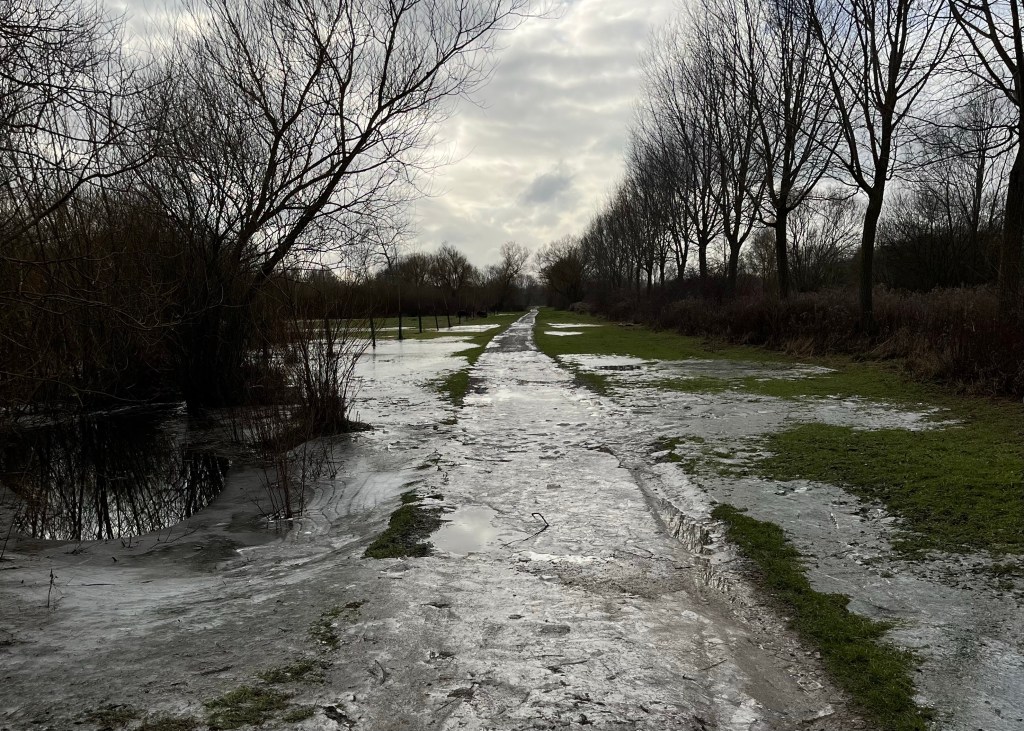
It is dark from 4pm to 8am. It is cold. It is windy. Trails are muddy. Pavements icy. If you are really lucky you will catch some horizontal sleet in the face and feel like your scalp has been frozen and ripped off the back of your head like a bad wig.

Your running routes, which in the light are many and varied and fragrant and fascinating, winding through Nene Park and along cycle ways, over Castor hill and along the River Nene, have reduced to one: up and down the Oundle Road.

When the weather is like this, I recommend training for a marathon to really maximise that time outside. I would also recommend London, so that 16 weeks of training start exactly on 1 January 2018. And, if I were you, I would pick a training plan that aims for maximum mileage – none of this Run less, Run faster nonsense.

6 runs a week is what you need! What do you mean you don’t have time to do that because you have a full-time job in London and a 4 year old? Does your alarm not go off at 5am?

Once you’ve booked your place and written your training plan, erase it and start again because you need to fit it around the 5 cross-country races you said you’d run for Yaxley Runners on Sundays. Also, volunteering at junior parkrun. Also, all of your 4 year old’s friends’ birthday parties. Oh, and apparently your husband might occasionally want to leave the house. Some people are so selfish.

Now that your plan is written, the hard work is over. You really should think about fuel, though. This year, why not have an approach to nutrition which is not just ‘eat more chocolate and crisps’? And while you’re pondering that, maybe have a think about buying new trainers now rather than wearing all your existing ones down to thin rubber husks and buying 4 new pairs that don’t quite fit you 3 weeks before the race?

You are now sorted. Wait, I forgot, what about positive mental attitude? Repeat after me:

“Marathon training in England in January is the best!”